Diplomacy Under Permanent Crisis and Fragmented Global Order Today Evolving

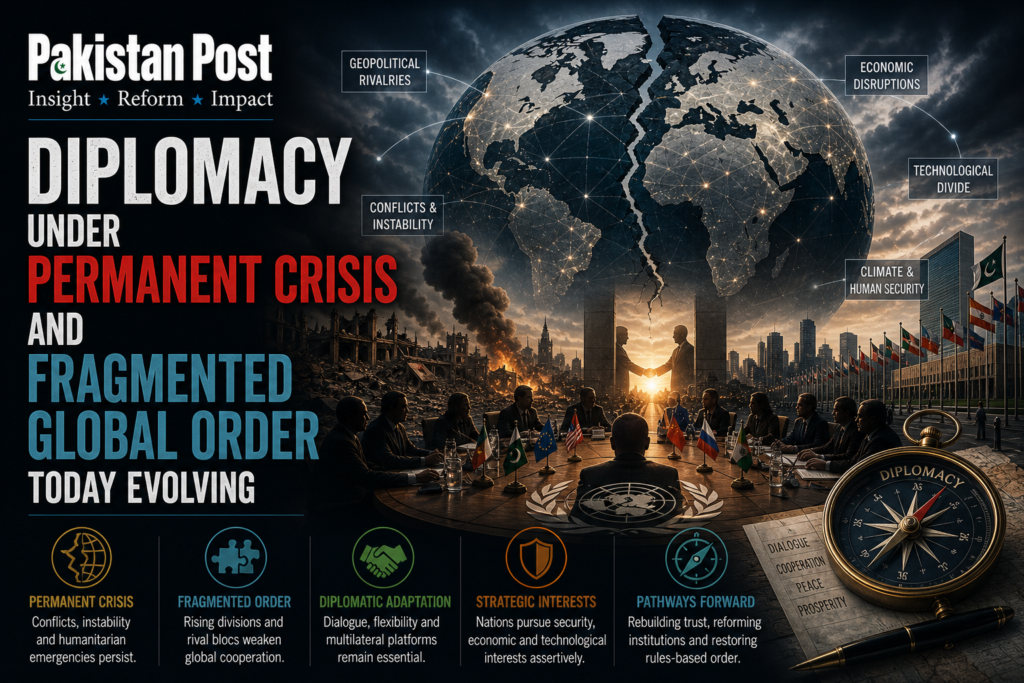
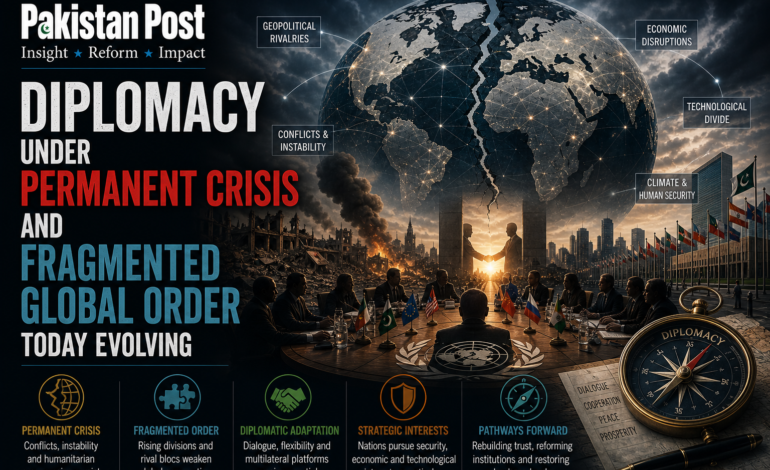
Diplomacy in the early twenty first century no longer resembles the calibrated architecture of post Cold War optimism, nor the structured bargaining systems that defined classical international relations theory. It has become an adaptive survival mechanism within a geopolitical environment where crises are not interruptions of order but the order itself. The wars in Ukraine and Gaza, alongside the intensifying strategic ambiguity over Taiwan, have collectively dissolved the illusion that conflict is episodic. Instead, the international system now operates in a condition of continuous political combustion, where diplomacy is conducted under pressure of simultaneity, media acceleration, and fragmented authority.
What distinguishes this era is not simply the presence of multiple conflicts, but their interconnection through global supply chains, financial systems, information networks, and ideological polarization. A missile strike in Eastern Europe reverberates through energy markets in Asia. Escalation in the Levant reshapes political discourse in Western capitals and recalibrates voting blocs in multilateral institutions. Tensions in the Taiwan Strait influence semiconductor pricing, defense postures, and alliance cohesion across continents. Diplomacy, therefore, is no longer bilateral problem solving but systemic crisis management embedded in a hyper connected environment.
The traditional diplomatic toolkit, once cantered on negotiation, treaty making, and discreet backchannel communication, has been fundamentally disrupted by the rise of real time information warfare. Statecraft is now inseparable from narrative construction. Governments do not only negotiate outcomes; they compete to define the meaning of events before formal diplomatic processes even begin. In this sense, diplomacy has become deeply entangled with media ecosystems, where perception often precedes policy and where legitimacy is shaped by instantaneous global visibility rather than long term institutional consensus.
This transformation has profound implications for middle powers, particularly states situated at the intersection of multiple geopolitical fault lines. Pakistan represents one such case, operating within overlapping strategic theatres that include South Asian security competition, Middle Eastern political volatility, and the broader US China systemic rivalry. Its diplomatic environment is therefore not defined by a single regional framework but by a convergence of multiple crises, each with its own temporal logic and narrative ecosystem.
In the context of Gaza, Pakistan’s diplomatic positioning is largely shaped by normative commitments, domestic political sentiment, and its historical association with broader Islamic solidarity narratives. Yet even this seemingly consistent position is filtered through global media framing, where responses are interpreted through competing lenses of humanitarian concern, geopolitical alignment, and alliance politics. In Ukraine related diplomacy, Pakistan has adopted a more cautious posture, shaped by economic dependencies, energy considerations, and the need to maintain functional relations with Western financial institutions. On Taiwan related tensions, Pakistan aligns with its longstanding strategic partnership with China, reinforcing a position that reflects structural alignment rather than situational recalibration.
The result is a diplomatic posture that is simultaneously principled, pragmatic, and constrained. It reflects the broader condition of what can be described as distributed diplomacy, where coherence is no longer defined by ideological uniformity but by the ability to navigate contradictory pressures without systemic rupture. In such an environment, inconsistency is not necessarily failure; it may be a structural necessity.
However, the deeper transformation lies in diplomatic time itself. Classical diplomacy operated on the assumption of temporal spacing, where crises unfolded sequentially and allowed for deliberation, analysis, and phased response. Today, crises are synchronous. Decisions on one geopolitical front must be made while other crises are still unfolding, often with incomplete information and under conditions of intense external scrutiny. This simultaneity compresses diplomatic judgment and increases the risk of reactive policymaking.
Media systems intensify this compression. The global information environment does not merely report diplomatic activity; it actively shapes the conditions under which diplomacy is conducted. Leaks, statements, and symbolic gestures are amplified across digital platforms, often detaching them from institutional context. As a result, diplomatic signals are frequently misinterpreted, over interpreted, or strategically reframed by competing actors. In this environment, ambiguity becomes both a tool and a vulnerability.
For Pakistan, this media saturated diplomatic space creates a dual challenge. On one hand, it must project coherence to external audiences, particularly international financial institutions, strategic partners, and multilateral forums. On the other hand, it must respond to domestic informational pressures that demand moral clarity, rapid response, and symbolic alignment with popular sentiment. This dual audience problem often results in calibrated ambiguity, where statements are designed to satisfy multiple constituencies without fully committing to a singular interpretive frame.
At the systemic level, crisis diplomacy is increasingly shaped by the erosion of trust in multilateral institutions. Organizations such as the United Nations Security Council, once envisioned as arbiters of global peace, now function primarily as platforms for narrative contestation rather than decisive action. Veto dynamics, geopolitical polarization, and selective enforcement of international norms have weakened institutional credibility. Consequently, states increasingly rely on ad hoc coalitions, regional arrangements, and bilateral crisis management mechanisms.
This shift reflects a deeper fragmentation of global authority. There is no longer a single diplomatic centre of gravity. Instead, multiple overlapping governance nodes coexist, often with conflicting norms and priorities. Western alliance’s emphasize rule-based order and institutional accountability, while emerging powers prioritize sovereignty, development, and noninterference. This divergence produces a pluralized diplomatic environment in which consensus is rare and contested.
Within this fragmented order, crisis diplomacy becomes less about resolution and more about containment. The objective is not necessarily to end conflicts but to prevent escalation beyond manageable thresholds. This containment logic is visible in Ukraine, where diplomatic efforts focus on preventing regional spillover rather than achieving comprehensive settlement. It is evident in Gaza, where negotiations revolve around humanitarian pauses rather than structural political resolution. It is implicit in Taiwan related tensions, where ambiguity itself functions as a stabilizing mechanism.
Pakistan’s diplomatic engagement within this environment reflects both constraint and adaptation. Its foreign policy establishment operates within a narrow corridor of maneuverability defined by economic dependence, security imperatives, and geopolitical proximity to major powers. Yet within this corridor, it seeks to exercise agency through selective engagement, diversified partnerships, and issue specific alignment. This strategy, while not fully coherent in classical terms, reflects the realities of a system where coherence itself is increasingly elusive.
Another dimension of contemporary crisis diplomacy is the rise of symbolic statecraft. Diplomatic actions are no longer evaluated solely on material outcomes but also on symbolic resonance. Participation in summits, issuance of statements, and positioning within voting blocs carry performative weight that often exceeds their immediate policy impact. States therefore engage in what can be described as visibility diplomacy, where presence and positioning are as important as policy substance.
This symbolic layer is particularly significant for middle powers, which often lack the coercive instruments of great powers but retain influence through narrative positioning. For Pakistan, symbolic diplomacy plays a crucial role in articulating its identity as a responsible state, a regional stabilizer, and a voice of the Global South. However, symbolic alignment must constantly be balanced against material constraints, creating an ongoing tension between representation and capability.
The acceleration of crisis cycles also affects diplomatic expertise itself. Traditional diplomatic training emphasized patience, incremental negotiation, and long horizon strategic thinking. Contemporary diplomats must now operate in compressed timelines, manage digital communication ecosystems, and respond to rapidly shifting geopolitical narratives. This requires a hybrid skill set that combines classical statecraft with media literacy, technological awareness, and real time analytical capacity.
In this evolving environment, one of the most significant risks is strategic fatigue. As crises multiply and overlap, states may become increasingly reactive rather than proactive, responding to events rather than shaping them. This reactive posture can lead to policy inconsistency, reduced credibility, and diminished strategic influence over time. For countries like Pakistan, avoiding this trajectory requires institutional strengthening, narrative coherence, and diversification of diplomatic engagement.
At the global level, the persistence of permanent crisis raises fundamental questions about the future of diplomacy itself. If crises are no longer exceptional but structural, then diplomacy must be reconceptualized not as a tool for restoring order but as a continuous process of managing instability. This implies a shift from resolution-oriented frameworks to resilience-oriented frameworks, where the goal is to maintain systemic functionality despite ongoing disruption.
Such a shift also requires rethinking the relationship between power and legitimacy. In a fragmented order, legitimacy is no longer derived solely from institutional position but from perceived effectiveness in managing crises. States that demonstrate capacity to stabilize situations, even temporarily, gain influence irrespective of formal hierarchy. This creates opportunities for middle powers to enhance their diplomatic relevance through targeted engagement and adaptive strategy.
Yet the system remains inherently unstable. The absence of unified norms, combined with intensifying geopolitical competition, ensures that crises will continue to emerge and intersect. Diplomacy will therefore remain under permanent strain, operating in a space where clarity is rare and ambiguity is strategic.
For Pakistan, and for similar states navigating this environment, the central challenge is not to resolve the fragmentation of global order, but to operate effectively within it. This requires recognizing that diplomacy is no longer a linear path toward stability, but a continuous negotiation with instability itself. The future of diplomatic practice will depend not on the restoration of a previous order, but on the ability to adapt to a world where crisis is the baseline condition of international politics.
A Public Service Message