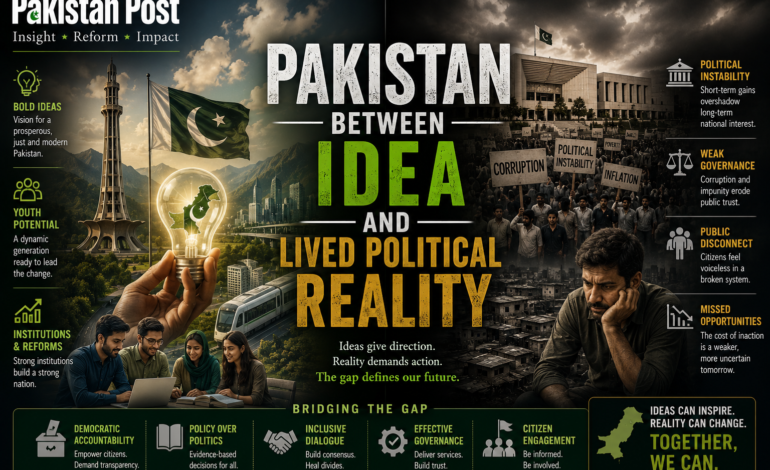
Pakistan Between Idea And Lived Political Reality


Pakistan is a country that often speaks in one language and lives in another. The dissonance is not merely administrative or economic; it is philosophical. It is a state where the grammar of official ideology promises coherence, unity, and moral direction, while the syntax of everyday life reveals fragmentation, improvisation, and competing truths. The result is not simple contradiction but a layered epistemic order in which the “idea of Pakistan” and the “experience of Pakistan” circulate as parallel realities that rarely fully intersect.
The ideological construct of the state rests on a narrative of origin, purpose, and continuity. It is a story told through constitutional language, civic education, national commemorations, and institutional rhetoric. In this narrative, Pakistan is not only a territorial entity but a moral project, a collective destiny anchored in historical necessity and civilisational distinctiveness. This imagined coherence functions as what political philosophy would describe as an ontological claim: the state exists as a unified, intelligible whole, capable of being represented in singular form.
Yet the lived reality of the country resists such simplification. Across its urban centres, rural peripheries, and digital spaces, Pakistan appears less as a singular entity and more as a mosaic of social worlds. Economic inequality stratifies citizenship into sharply differentiated experiences of access and vulnerability. Linguistic and cultural diversity complicates any singular narrative of identity. Institutional performance varies not only across sectors but across geography, producing uneven landscapes of governance where law, service delivery, and justice are experienced as inconsistent rather than universal.
This divergence can be understood through a phenomenological lens, where the state is not merely an external structure but a field of lived perception. What the citizen encounters is not the abstract idea of the state but its manifestations: a bureaucratic office, a school system, a police station, a court, a hospital. Each encounter becomes a moment of interpretation, where the legitimacy of the state is not assumed but continuously evaluated. In this sense, the state is not only what it declares itself to be but what it is experienced as in everyday life.
Postcolonial theory adds another layer to this analysis. The institutional architecture of governance carries inherited forms of administration, legal rationality, and bureaucratic organisation that were not entirely generated within the indigenous epistemic tradition. These structures coexist with local social norms, informal economies, and cultural practices that operate according to different logics. The result is a hybrid state form where formal rationality and informal negotiation exist in constant tension. This hybridity does not necessarily produce collapse, but it does produce ambiguity in how authority is interpreted and accepted.
Political epistemology further illuminates the crisis by focusing on how knowledge about the state is produced, validated, and circulated. Official narratives are disseminated through curricula, public broadcasting, and institutional statements that aim to establish a coherent national self-understanding. Yet alternative epistemic channels—social media, oral networks, independent journalism, and everyday discourse—generate competing interpretations of reality. These parallel knowledge systems do not merely disagree on facts; they often operate with different criteria for what counts as truth. The result is a fragmented epistemic field where consensus becomes difficult to sustain.
Within South Asian Muslim intellectual traditions, particularly those associated with reformist and philosophical thought, there exists an enduring preoccupation with the relationship between moral purpose and historical reality. The idea of selfhood as dynamic and evolving provides a conceptual vocabulary for understanding political identity not as fixed essence but as continuous becoming. In this framework, collective identity is not simply inherited but actively constructed through ethical and intellectual struggle. This tradition, while not directly translatable into modern state theory, offers interpretive resources for thinking about the tension between ideological aspiration and material condition.
The gap between state ideology and lived experience becomes most visible in governance. Bureaucratic institutions often operate through procedural logic that assumes uniformity, while citizens encounter these systems through unequal capacities of access and influence. Administrative delays, discretionary enforcement, and uneven service delivery create a perception that the state is not a single rational actor but a differentiated set of power centres. This perception weakens the idea of institutional neutrality and reinforces the sense that outcomes are contingent rather than guaranteed.
In the education system, the divergence is reproduced at the level of narrative formation. Textual representations of national history and identity often coexist with diverse regional memories and lived experiences that may not fully align with official accounts. Students thus inhabit two epistemic environments simultaneously: one formal and prescriptive, the other informal and experiential. This duality shapes how identity is internalised, often producing cognitive dissonance between learned ideology and observed reality.
Media narratives further complicate this landscape. State-aligned and independent platforms frequently operate with distinct interpretive frameworks, producing parallel public spheres. In one, stability and coherence are emphasised; in the other, contestation and critique dominate. Digital discourse intensifies this fragmentation by enabling rapid circulation of unverified claims, emotional narratives, and algorithmically amplified content. The result is not merely disagreement but epistemic saturation, where multiple versions of reality coexist without stable hierarchy.
The judiciary, often positioned as a guardian of constitutional order, also becomes a site where the tension between idea and experience is negotiated. Legal texts embody normative coherence, yet their application is shaped by institutional constraints, procedural delays, and broader socio-political pressures. Public trust in judicial processes therefore oscillates between formal reverence for legal authority and practical scepticism regarding outcomes. This oscillation reflects a deeper uncertainty about whether institutional ideals consistently translate into lived justice.
Civil society functions as both a mediator and a challenger within this system. Advocacy networks, professional associations, and grassroots movements articulate demands that often emerge from lived inequalities. These expressions of social reality sometimes align with official policy frameworks but frequently expose gaps between declared intent and actual implementation. In doing so, civil society becomes a key site where the disjunction between ideological statehood and experiential citizenship is made visible.
Digital discourse represents perhaps the most volatile arena of this epistemic duality. Online platforms compress time and amplify contradiction, allowing competing narratives to circulate simultaneously without resolution. In this environment, the state is continuously interpreted, contested, and reimagined. Authority becomes less about institutional position and more about narrative influence. The stability of the ideological construct is thus subjected to constant pressure from decentralized forms of meaning production.
The consequences of this divergence are structural rather than episodic. Policy coherence is affected when assumptions embedded in planning models do not align with on-ground realities. Economic strategies premised on uniform behavioural responses encounter friction in a society characterised by heterogeneity of access, trust, and opportunity. Social trust itself becomes conditional, shaped by prior experience rather than institutional promise. In such a context, legitimacy is not a static attribute but an ongoing negotiation.
From a social ontological perspective, Pakistan can be understood as existing simultaneously in two modes of being. One is declarative, expressed through constitutional identity, ideological framing, and symbolic representation. The other is experiential, constituted through everyday interactions, material conditions, and social relations. These modes are not separate entities but interwoven dimensions of the same political reality. However, when the distance between them expands, the state experiences what might be described as epistemic strain.
The question, then, is not whether one version of Pakistan is more real than the other, but how long a polity can sustain a significant gap between its self-description and its lived reality without generating systemic tension. In some historical contexts, such gaps are narrowed through institutional reform, inclusive governance, and adaptive political imagination. In others, they persist and deepen, producing cycles of mistrust and recalibration.
Pakistan’s trajectory suggests an ongoing negotiation rather than a settled outcome. On one hand, there are institutional efforts to standardise governance, expand digital infrastructure, and refine policy coordination, all of which aim to bring lived experience closer to formal design. On the other hand, persistent structural inequalities, regional disparities, and informational fragmentation continue to generate divergent realities that resist full integration into a single narrative frame.
Whether convergence is possible depends not only on administrative capacity but on philosophical openness to plurality within the concept of the state itself. If the ideological construct remains rigid, it risks becoming increasingly detached from lived experience. If it becomes more interpretively flexible, it may be able to absorb complexity without losing coherence.
In this sense, Pakistan is not merely a case study in governance challenges but in the deeper philosophical problem of modern statehood: how to reconcile the need for narrative unity with the inevitability of experiential diversity. The answer remains unresolved, suspended between aspiration and reality, idea and experience, coherence and complexity.
A Public Service Message