
Structural Slavery Through Regulatory Systems: Dependency Theory, Post-War Global Order, and the Metrics of Modern Dominance

The architecture of the post-Second World War international order was presented as a moral and institutional corrective to the violence of empire. The devastation of Europe and Asia demanded reconstruction; the collapse of old empires required new frameworks of governance; and the specter of ideological bipolarity between Washington and Moscow necessitated mechanisms of stability. Yet the institutional settlement that emergedfrom the creation of the International Monetary Fund and the World Bank at Bretton Woods to the later evolution of the World Trade Organization—did not merely stabilize the world economy. It structured it. And in structuring it, it generated what dependency theorists would later recognize as a durable asymmetry between “core” and “periphery,” an asymmetry that today operates less through territorial occupation and more through regulatory design, compliance metrics, and technocratic conditionalities.
This transformation from colonial extraction to regulatory governance marks the evolution of domination from visible empire to structural management. The colonies of the nineteenth century have largely disappeared, but the hierarchies that defined them have not. They have been embedded into financial systems, trade regimes, and regulatory architectures. The periphery no longer sends raw materials to imperial capitals under direct coercion; instead, it aligns its fiscal, monetary, environmental, and industrial policies with norms defined externally, often under the banner of development, modernization, and global integration. This is not colonialism through land. It is governance through metrics.
Dependency theory, articulated by scholars such as Andre Gunder Frank and Samir Amin, diagnosed the paradox of postcolonial development. The formal end of empire did not translate into economic autonomy. Instead, newly independent states found themselves integrated into a world economy whose rules were written by industrial powers. The “core” countries, having industrialized earlier and possessing financial capital, technological depth, and military reach, established terms of trade and institutional norms that preserved their structural advantage. The periphery exported commodities and imported manufactured goods; it borrowed capital and repaid it with interest denominated in currencies it did not control; it adopted policy frameworks shaped by multilateral institutions dominated by the core.
The genius of the post-war order was that it universalized its own assumptions. Liberalization, privatization, fiscal discipline, trade openness, and later regulatory harmonization were framed not as political preferences but as objective necessities. Under the rhetoric of modernization theory and strategic development, peripheries were told that their path to prosperity lay in mimicking the institutional structures of advanced economies. Yet the sequencing of development that had allowed the core to industrializeprotective tariffs, state subsidies, capital controls, and strategic industrial policy—was often discouraged or prohibited for latecomers. In this asymmetry lay the seeds of structural dependency.
The Bretton Woods system initially aimed to stabilize currencies and prevent competitive devaluations. But as global capitalism evolved, the roles of the IMF and World Bank expanded from stabilization and reconstruction to policy supervision and structural reform. Particularly after the debt crises of the 1980s, conditional lending became the primary instrument through which the periphery was disciplined into compliance with a neoliberal template. Structural adjustment programs required reductions in public spending, liberalization of trade, deregulation of markets, and privatization of state assets. These reforms were justified as necessary corrections to macroeconomic imbalance. Yet they often reshaped domestic political economies in ways that privileged external creditors and multinational corporations over local industries and social welfare systems.
The mechanism was subtle yet powerful. Debt created leverage; leverage created conditionality; conditionality created policy convergence. Countries in financial distress, often after global interest rate shocks beyond their control, were required to adopt reforms that reoriented their economies toward export-led growth and foreign capital integration. Compliance costsadministrative, political, and socialwere borne domestically. Benefits accrued disproportionately to creditors and investors headquartered in the core. When growth followed, it was cited as proof of reform success. When inequality widened or industries collapsed, the narrative shifted to insufficient implementation. Suffering was not evidence of structural bias; it was interpreted as transitional pain.
The evolution from structural adjustment to contemporary regulatory governance deepened rather than diminished this dynamic. Today, transnational regulatory mechanisms function as instruments of structural dominance. Environmental standards, carbon border adjustment mechanisms, financial transparency requirements, anti-money-laundering protocols, intellectual property regimes, and digital governance norms collectively form a dense web of compliance obligations. Each may be normatively defensible. Together, they construct a system in which capacity to comply becomes a determinant of competitiveness.
Consider environmental regulation and carbon taxation. Advanced economies, having industrialized over centuries of high emissions, now lead the normative push toward decarbonization. Mechanisms such as carbon border adjustments aim to prevent carbon leakage and incentivize global climate responsibility. Yet for developing economies whose comparative advantage lies in energy-intensive manufacturing, such mechanisms risk functioning as non-tariff trade barriers. The transition costsupgrading technology, shifting energy infrastructure, reconfiguring supply chainsare substantial. Access to green finance and advanced technology remains uneven. As a result, the periphery must absorb higher compliance costs to maintain market access to core economies. Competitiveness is reshaped not only by productivity but by regulatory alignment.
Similarly, intellectual property regimes embedded in global trade agreements often protect the technological dominance of core countries. High standards of patent enforcement benefit firms that already possess extensive innovation portfolios. Late industrializers face constraints in technology transfer and domestic learning. While the rhetoric emphasizes protection of innovation, the structural effect is to preserve knowledge asymmetries. Development becomes conditional on paying for access to technologies that were themselves historically nurtured through state support in the core.
Financial regulation presents another dimension of creeping dependency. Global banking standards, risk-weighting frameworks, and compliance regimes are typically designed in forums where advanced economies hold disproportionate influence. Smaller or developing states must adjust their domestic systems to align with these norms in order to maintain access to global capital markets. Failure to comply risks higher borrowing costs, capital flight, or reputational damage. Compliance, however, can constrain policy space. Domestic priorities—credit to small industries, developmental banking, capital controlsmay be subordinated to externally validated risk models. The language is technical; the implications are political.
The transformation from overt imperialism to regulatory dominance reflects a shift in the locus of power from territory to standards. In earlier eras, empire required armies and administrators. In the contemporary order, influence operates through rating agencies, credit assessments, compliance audits, and multilateral reviews. Sovereignty is not abolished; it is calibrated. States retain formal autonomy but operate within parameters defined by global norms. Deviation is possible but costly.
This structural configuration can be understood as modern structural slaverynot in the literal sense of bondage, but as systemic constraint. The periphery participates voluntarily in global institutions, yet the design of those institutions channels outcomes in predictable directions. Structural policies define what is considered rational, responsible, and modern. Alternative development paths are stigmatized as protectionist, populist, or unstable. The power of the core lies not only in economic scale but in epistemic authoritythe ability to define best practice.
The creeping nature of this dominance is crucial. It does not announce itself as domination. It arrives as reform. It is introduced through technical assistance missions, capacity-building workshops, development loans, and partnership frameworks. Policy documents speak of governance enhancement, fiscal responsibility, and sustainable growth. Yet each reform narrows the space for divergent trajectories. Over time, national policy landscapes converge toward templates generated in financial centers far removed from local realities.
The justification of suffering within this order reveals its moral architecture. When austerity reduces public services, it is framed as necessary stabilization. When trade liberalization undermines small farmers or nascent industries, it is described as creative destruction. When compliance costs strain public finances, they are portrayed as investments in credibility. The burden of adjustment rests with those least able to bear it. The legitimacy of the system is preserved by attributing failure to domestic inefficiency rather than structural asymmetry.
To be clear, the post-war order has generated unprecedented global growth and poverty reduction. Integration into global markets has lifted millions from extreme poverty in parts of Asia and elsewhere. Yet even these successes reflect differentiated incorporation. States that strategically managed integrationretaining industrial policy space, sequencing liberalization, and cultivating domestic capacityoften fared better than those that adopted wholesale deregulation. The variance underscores a central insight of dependency theory: development is not merely about participation in global markets but about the terms of participation.
In the twenty-first century, the regulatory turn intensifies the asymmetry. Metrics have become instruments of governance. Credit ratings influence sovereign borrowing costs. Ease-of-doing-business indicators shape investor perceptions. Environmental, social, and governance scores affect capital flows. These metrics are constructed through methodologies that reflect specific normative assumptions about market efficiency, risk, and sustainability. States strive to improve their rankings, often restructuring domestic policy to align with external evaluative criteria. The pursuit of favorable metrics can overshadow substantive developmental goals.
The COVID-19 pandemic further illuminated structural dependency. Advanced economies mobilized massive fiscal stimuli and secured vaccine supplies through advance purchase agreements. Many developing states faced limited fiscal space and delayed access to medical technologies. Intellectual property protections and supply chain bottlenecks constrained rapid local production. Emergency financing from multilateral institutions provided relief but also expanded debt burdens. Crisis response capacity, once again, was stratified along lines of structural position within the global order.
Geopolitical shifts add another layer. The rise of alternative development financiers and regional institutions suggests partial fragmentation of the post-war architecture. Yet even new actors operate within a global system shaped by decades of institutional sedimentation. Regulatory standards in trade, finance, and environment remain deeply embedded. Structural slavery does not require unanimity among core powers; it persists so long as the architecture of governance privileges those with rule-setting capacity.
What then distinguishes structural slavery from ordinary interdependence? Interdependence implies mutual vulnerability. Structural slavery denotes asymmetric vulnerability. The core can absorb shocks, rewrite standards, and mobilize capital at scale. The periphery must adapt. Its policy errors are punished more swiftly by markets; its regulatory deviations attract greater scrutiny; its fiscal expansions encounter higher borrowing costs. Even its natural resources, critical for global supply chains, are priced within systems dominated by multinational intermediaries.
The normative challenge is profound. Global coordination on climate, finance, and trade is necessary to address collective problems. Yet when coordination morphs into unilateral standard-setting by powerful actors, the legitimacy of the system erodes. Development becomes synonymous with compliance rather than capability. Sovereignty becomes symbolic rather than substantive.
Reimagining the global order requires confronting the historical layering of dependency. Post-war institutions were not neutral. They reflected the distribution of power in 1944 and after. As economic weight shifts and new actors emerge, governance structures must adapt to reflect pluralism rather than hierarchy. Greater voice for developing countries in decision-making bodies, more equitable technology transfer frameworks, and differentiated regulatory responsibilities could mitigate asymmetry. Without such reform, transnational regulatory mechanisms risk entrenching a world in which policy autonomy is inversely proportional to economic power.
The persistence of structural dominance through regulatory systems challenges the comforting narrative that colonialism ended with flag independence. It compels a more nuanced understanding of powersone that recognizes the capacity to define standards as a form of sovereignty. When one set of countries designs the metrics by which all others are judged, dominance becomes procedural rather than territorial.
In the final analysis, structural slavery in the contemporary global order is neither accidental nor conspiratorial. It is systemic. It arises from the intersection of institutional design, historical advantage, and normative authority. Dependency theory provides the analytical lens; the post-war settlement provides the institutional scaffolding; regulatory governance provides the operational mechanism. The result is a world in which compliance is conflated with progress and deviation with irresponsibility.
For think tanks and policymakers in the periphery, the imperative is not withdrawal from global systems but strategic engagement. Understanding the architecture of dependency allows for calibrated negotiation, coalition-building among similarly positioned states, and selective adoption of standards that enhance rather than constrain domestic capacity. The objective is not to dismantle global governance but to democratize it.
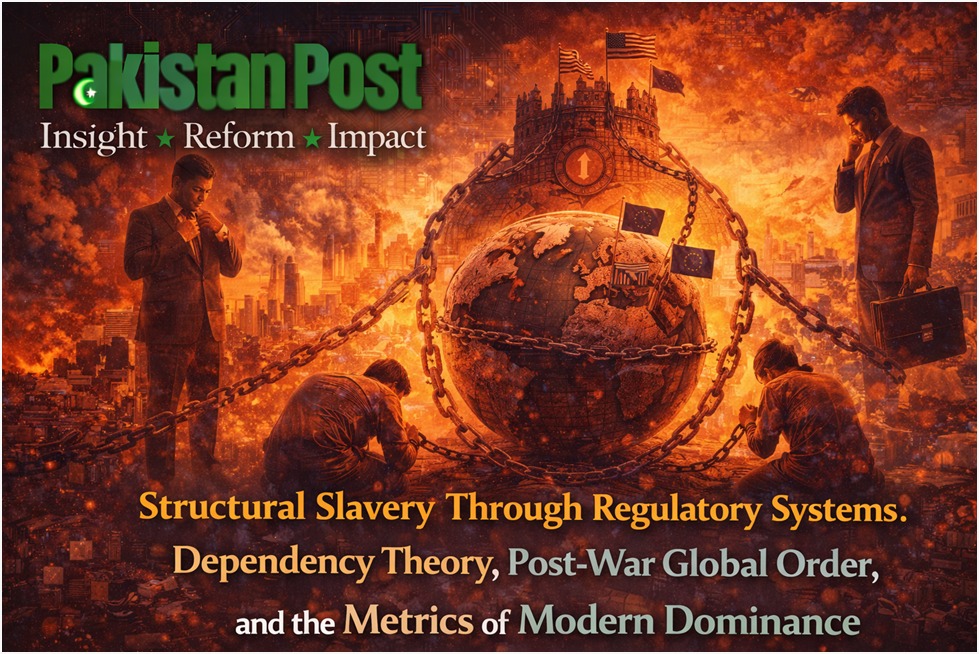
If the twentieth century witnessed the end of territorial empire, the twenty-first confronts us with the subtler empire of standards. The chains are no longer visible, yet they bind through fiscal rules, environmental benchmarks, trade clauses, and financial ratings. Recognizing structural slavery within regulatory systems is the first step toward transforming an order that equates dominance with development into one that aligns development with dignity.
A Public Service Message