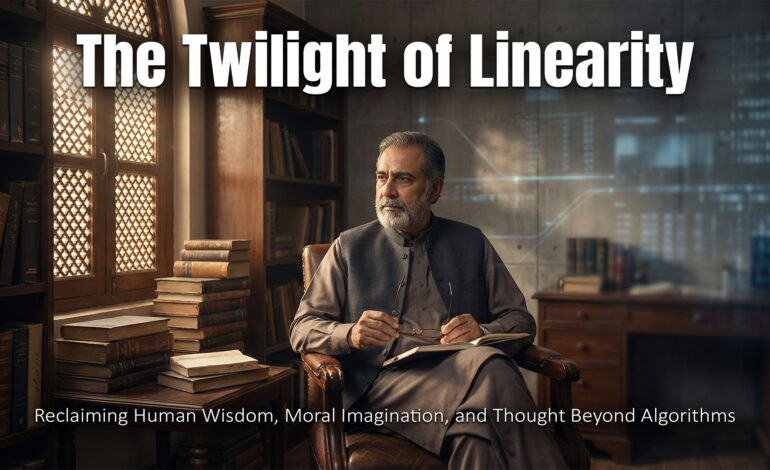
The Twilight of Linearity: Embracing the Uncharted Depths of Human Thought

By Sadia Majeed

“As Socrates once said, ‘The unexamined life is not worth living.’” These words, spoken more than two millennia ago, remain a beacon for human self-reflection. Yet, in our age of technological triumphalism, we risk forgetting the very essence of examination, of introspection, of dialogue. We are dazzled by the certainties of data, the efficiencies of algorithms, and the seductive promise that machines can model, anticipate, and even surpass our own cognition. In this enthrallment, we overlook a deeper truth: wisdom is not born from the accumulation of knowledge alone. It is forged in the crucible of lived experience, in the tension of reflection, in the fragility of uncertainty.
Technological linearity—the predictable, calculative, and procedural mode of thought embedded in machines and algorithms—threatens to reduce the vast expanse of human imagination into a mere echo chamber of ideas that already exist. ChatGPT and other AI models, marvels of programming and data synthesis, can simulate conversation, generate art, and even approximate insight. Yet they cannot wonder, they cannot question, and they cannot dream in the way humans do. And herein lies the peril: the more society relies on linear, algorithm-driven thought, the closer humans come to resembling the very robots they have created, while robots increasingly mimic human reasoning, yet devoid of conscience, empathy, or moral discernment.
If we are not vigilant, the distinction between human and machine, between wisdom and computation, will blur. The consequences of such inversion are profound. In a world where philosophers no longer guide thought and prophets no longer illuminate morality, the human experiment risks being converted into a sterile, non-humanistic edifice—a place where love, empathy, and catharsis are supplanted by mathematical logic and algorithmic determinism.
The Nature of Technological Thinking
Heidegger’s warning resonates deeply in this context: “Calculative thinking is not meditative thinking.” Linear thinking, the logic of algorithms and machine processes, excels at efficiency, consistency, and pattern recognition. It thrives on predictability and certainty. It can optimize, simulate, and predict, yet it is blind to the nuances of moral imagination, the ambiguity of human experience, and the unpredictable dynamics of creativity.
Consider the AI systems we so readily embrace. They are extraordinary tools, yet their cognition is derivative, not inventive. They are mirrors reflecting the sum of human endeavor but lack the reflective awareness to question, critique, or feel. If society elevates such calculative thinking above meditative reflection, humans may unconsciously begin to emulate the very linearity they seek to outsource. Decision-making becomes transactional, empathy becomes optional, and contemplation becomes an inconvenient luxury.
This is not merely a technological concern; it is a philosophical and moral crisis. Human thought, once rich with paradox, ambiguity, and interpretive depth, risks being flattened into sequences, inputs, and outputs. And as humans approximate machine logic, machines are simultaneously endowed with human-like authority, making decisions that shape society while remaining incapable of moral responsibility.
The consequences are clear: a world dominated by linearity risks transforming from a living, breathing humanistic experiment into a deterministic system, governed more by data than by conscience, more by efficiency than by compassion, more by pattern than by empathy.
The Oracle of Delphi and Inner Wisdom
In ancient Greece, the Oracle of Delphi symbolized the depths of wisdom that transcend linearity. Her insights were not drawn from texts or systematic instruction but from an attunement to the ineffable currents of being. She spoke in riddles, paradoxes, and enigmatic phrases, compelling those who sought guidance to engage in interpretation, reflection, and discernment.
The oracle teaches us that wisdom cannot be handed down in certainty; it must be sought in dialogue with ambiguity. Every question posed to her was an invitation to wrestle with the unknown, to confront doubt, and to discover understanding within oneself. Spoken intellectualism mirrors this process: it is the art of creating meaning through dialogue, improvisation, and attentive presence. Knowledge emerges not from passive reception but from active engagement, from the tension between what is known and what is uncertain.
To cultivate the inner oracle is to reclaim the capacity for meditative thought. In a world enamored with calculative reasoning, we must nurture spaces where reflection, wonder, and uncertainty are not weaknesses but sources of strength. This inner voice, subtle and questioning, resists the flattening effects of algorithmic thought. It reminds us that the human mind is not merely a processor of inputs but a living, interpretive, moral, and creative force.
The Prophetic Voice and Moral Imagination
Throughout history, prophets have functioned as the embodiment of moral and divine wisdom. From Moses to Muhammad, Buddha to Jesus, prophets did not speak in the language of calculation, linearity, or efficiency. They spoke in the language of the heart, compassion, and justice. They disrupted complacency, challenged the powers that be, and reoriented societies toward ethical imperatives that transcend mere material accumulation.
In our era, the prophetic voice is endangered. As algorithms increasingly mediate human thought and social organization, the moral imagination risks being sidelined. Without individuals attuned to ethical reflection, societies may pursue power, efficiency, and utility while neglecting justice, empathy, and human flourishing. A world devoid of prophets and philosophers is not neutral; it is sterile. It is a world in which moral vacuums are filled by systems, codes, and equations, while the messy, vibrant, and essential human dimension fades.
The prophetic function is not about religion alone; it is about the cultivation of vision, courage, and conscience. It reminds humanity that knowledge without moral insight is insufficient, that efficiency without empathy is dangerous, and that civilization cannot be sustained by calculation alone. Without such voices, society risks converting humanistic aspiration into algorithmic determinism—a world where love, catharsis, and empathy are secondary to predictability, control, and linear outcomes.
The Gift of Spoken Intellectualism
Spoken intellectualism is not a relic of antiquity; it is a lifeline for the future. It is the art of conversation, dialogue, and attentive presence. It is the space where ideas meet, clash, and transform. It is where knowledge is tested, refined, and humanized. Martin Buber’s insight resonates profoundly here: “All real living is meeting.” The encounter—the act of listening, responding, and being present—is where wisdom emerges, unbounded by pre-programmed logic.
In spoken intellectualism, meaning is co-created. It is not linear; it is iterative, relational, and improvisational. Dialogue allows us to wrestle with uncertainty, confront ambiguity, and cultivate empathy. Unlike algorithmic reasoning, it embraces the unpredictability of human thought, moral intuition, and emotional resonance. In these spaces, humans reclaim their agency, resisting the flattening influence of technological linearity.
By embracing this practice, society safeguards what makes us distinct from the machines we create. It preserves the unpredictability, moral reflection, and creative imagination that define the human experience. Spoken intellectualism ensures that thought remains alive, adaptive, and capable of producing wisdom that algorithms, for all their power, cannot replicate.
Human Beings, Machines, and the Risk of Inversion
A critical danger emerges when the logic of machines begins to shape human cognition. Linear thinking conditions humans to prioritize efficiency, predictability, and algorithmic solutions over reflection, empathy, and moral discernment. Conversely, machines increasingly mimic human reasoning, making decisions that influence human lives while lacking conscience or ethical accountability.
The result is a perilous inversion: humans begin to act like machines, and machines begin to act like humans, at least superficially. The more our societies defer to calculative systems, the more we risk losing what is quintessentially human: imagination, moral insight, and the capacity for spontaneous, empathetic response. Simultaneously, machines may acquire authority over decisions without the ethical faculties to wield it wisely.
This inversion is not a dystopian abstraction; it is a philosophical and existential warning. If philosophers no longer cultivate human wisdom and prophets no longer embody moral insight, society will transform into a rigid, non-humanistic edifice. Humanistic experiment—the dynamic interplay of empathy, creativity, and moral imagination—will give way to algorithmic determinism. The world may remain functional, efficient, and technologically impressive, but it will no longer be a living, breathing environment where love, catharsis, and ethical reflection shape reality.
The Humanistic Experiment vs. Algorithmic Edifice
Human civilization is, at its core, an experiment in living: a delicate negotiation between creativity, moral consciousness, and social cohesion. It has always depended on spaces where dialogue, reflection, and ethical imagination flourish. Without these, the edifice of society becomes rigid, sterile, and inhospitable to the human spirit.
Algorithms, data, and linear thinking have immense utility, but they cannot replace the nuanced, interpretive, and moral faculties that define human life. Empathy cannot be coded. Love cannot be algorithmically generated. Catharsis, moral responsibility, and ethical reflection emerge only through human experience and dialogue. When these elements are absent, society becomes a mathematical abstraction, efficient yet lifeless—a world where the human soul is subordinated to procedure and predictability.
To preserve the humanistic experiment, we must consciously cultivate philosophers, prophetic vision in human conscious, and practitioners of spoken intellectualism. These are the guardians of wisdom, the mediators between experience and insight, the custodians of ethical imagination. Without them, the world becomes merely a computational construct, impressive in its precision but impoverished in its humanity.
A New Era of Wisdom
The path forward is not the rejection of technology but the reclamation of human thought and moral imagination. A new era of wisdom demands the integration of meditative reflection, dialogue, and the cultivation of the prophetic and philosophical vision in human conscious. Knowledge must be humanized, made responsive to ethical imperatives, and enriched by lived experience.
We must dare to be prophets: to speak truth to power, to challenge societal idolatries, and to envision alternative possibilities. We must dare to be oracles: to embrace ambiguity, paradox, and interpretive labor. We must dare to be human: to think, feel, create, and love. Spoken intellectualism is the vessel through which this daring can be realized—a practice that keeps the human mind alive, moral, and free amidst the pressures of linear, technological thinking.
If we succeed, the human world remains a living place, rich with empathy, insight, and creative possibility. If we fail, we risk converting human life into algorithmic abstraction, efficiency into dogma, and calculation into the measure of all value.
Conclusion: The Call to Humanity
The twilight of linearity is upon us. Technology is not destiny, but it exerts an irresistible gravitational pull toward mechanistic thinking. In response, we must cultivate the uncharted depths of human thought: dialogue, reflection, and moral imagination. We must reclaim the roles of philosopher and prophet, not as archaic relics, but as essential agents of human survival.
To embrace spoken intellectualism is to affirm the humanistic experiment. It is to insist that empathy, love, catharsis, and reflection remain central to our collective existence. The world can continue to advance technologically, but it will only thrive as a living, meaningful place if we preserve the non-linear, interpretive, and moral dimensions of thought that make life worth living.
The choice is ours. We can surrender to linearity, transforming ourselves into instruments of efficiency and letting algorithms dominate the measure of reality. Or we can dare to reclaim our humanity: to listen, to question, to reflect, and to speak with wisdom. The latter path is neither simple nor convenient, but it is the only path that preserves what it means to live, to care, and to be human.
A public service message