Industrial Disarticulation and Export Stagnation in Pakistan Economic System Crisis

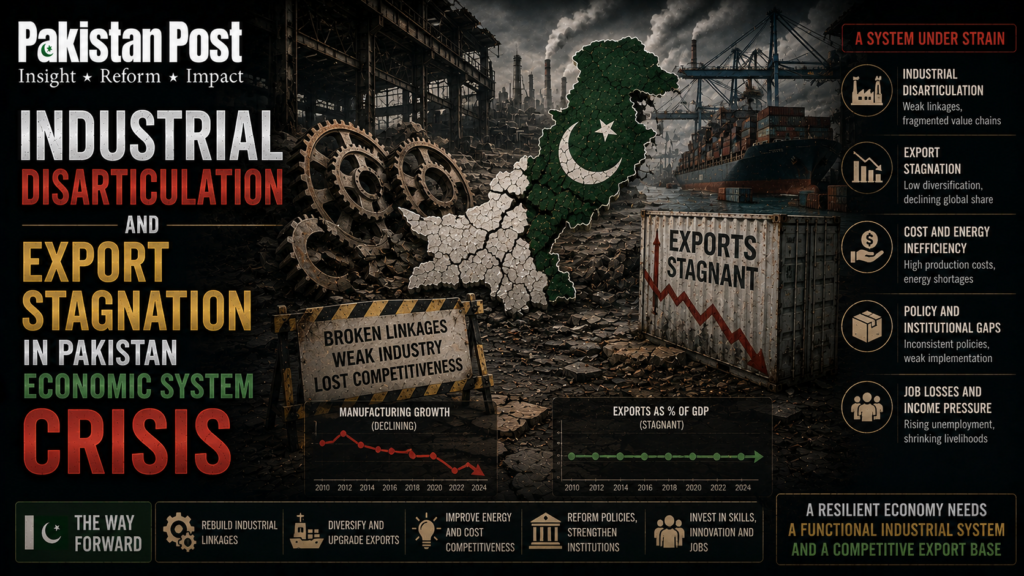
Pakistan’s economic structure now stands at a critical inflection point where incremental policy adjustments are no longer sufficient to offset deep structural decay in industrial productivity, export diversification, and external account stability. The country’s industrial base, once envisioned as a platform for gradual technological upgrading and export sophistication, has instead ossified into a narrow concentric model dominated by low value-added textiles, intermediate goods assembly, and import-dependent production chains. This structural narrowing has not only constrained foreign exchange earnings but has also amplified systemic exposure to external shocks, including commodity price volatility, global demand contraction, and shifting trade regimes.
At the core of this trajectory lies a persistent policy incoherence that has oscillated between protectionist impulses and ad hoc liberalization, without constructing a sustained industrial strategy capable of nurturing competitive depth. Successive policy cycles have prioritized short-term balance of payments stabilization over long-term productive transformation, thereby reinforcing a rent-oriented industrial culture. Incentive regimes have been fragmented, regulatory predictability remains weak, and fiscal instruments have been frequently re-engineered in response to immediate macroeconomic pressure rather than structural necessity. This volatility has deterred capital formation in high-risk, high-productivity sectors such as engineering goods, chemicals, precision manufacturing, and digital exports.
The textile sector, while historically the backbone of Pakistan’s exports, now represents a structural vulnerability rather than a strategic asset. Its limited technological intensity, exposure to cyclical global demand, and dependence on imported inputs have constrained its capacity to generate sustained foreign exchange surpluses. Instead of evolving into a diversified manufacturing ecosystem, the industrial base has remained trapped in low complexity production, producing diminishing returns in an increasingly competitive global environment where regional peers are rapidly ascending value chains through automation, state-backed industrial financing, and export-oriented innovation ecosystems.
Compounding this structural stagnation is the country’s increasing reliance on remittance inflows as a parallel external stabilizer. While remittances have historically provided critical support to household consumption and external account management, they now function as a compensatory mechanism for industrial underperformance. This dual dependency, exports concentrated in low-value textiles and external stability reliant on overseas labor earnings, creates a fragile macroeconomic equilibrium highly susceptible to external shocks. A slowdown in Gulf economies, tightening immigration regimes in Europe and North America, or automation-driven displacement of low-skilled labor could trigger immediate external liquidity stress.
From an establishment perspective, this dual dependency structure introduces a strategic vulnerability that extends beyond economics into national security domains. External financing cycles increasingly dictate domestic fiscal autonomy, while industrial weakness constrains defense production localization, technological sovereignty, and strategic autonomy. The absence of a diversified export base effectively locks Pakistan into a semi-peripheral economic position within global supply chains, where it remains a price taker rather than a price setter, and a consumer of imported technology rather than a producer of indigenous innovation systems.
Moreover, the institutional architecture governing industrial policy remains fragmented across multiple ministries, regulatory bodies, and provincial jurisdictions, resulting in policy diffusion and executional inconsistency. Industrial planning is frequently subordinated to short-term fiscal considerations, particularly IMF conditionalities and balance of payments stabilization frameworks, which prioritize import compression over export expansion. This has produced a cyclical pattern of stabilization followed by relapse, without any sustained structural ascent.
The technological gap further exacerbates this stagnation. Pakistan’s industrial sector exhibits limited integration with global innovation networks, minimal investment in research and development, and weak linkages between academia and industry. As global manufacturing transitions toward AI-driven production systems, robotics, and data-enabled supply chain optimization, Pakistan’s industrial base remains largely anchored in labour-intensive, low-productivity frameworks. This widening technological asymmetry risks long-term exclusion from emerging high-value global production networks.
In this context, export diversification is not merely a policy option but an existential economic imperative. Diversification must extend beyond product categories into structural reconfiguration of production ecosystems. This includes the development of engineering goods clusters, pharmaceutical manufacturing hubs, agri-processing export corridors, and digitally enabled services exports. Regional integration presents a significant opportunity, particularly through alignment with Central Asian markets, Middle Eastern logistics corridors, and China’s industrial relocation dynamics under evolving Belt and Road frameworks. However, such integration requires institutional credibility, regulatory predictability, and investment security frameworks that are currently underdeveloped.
Foreign direct investment inflows remain constrained not only by macroeconomic instability but also by structural governance risks, including regulatory unpredictability, energy pricing volatility, and inconsistent taxation regimes. Investors increasingly perceive Pakistan’s industrial environment as reactive rather than strategic, where policy reversals are frequent and contractual enforcement remains uneven. This perception significantly elevates risk premiums and discourages long-horizon capital deployment in productive sectors.
Energy sector inefficiencies further compound industrial stagnation. High electricity tariffs, circular debt accumulation, and reliance on imported fuel sources create a cost structure that is structurally uncompetitive for export-oriented manufacturing. Without a fundamental recalibration of energy economics toward indigenous resources, renewable integration, and industrial tariff rationalization, export competitiveness will remain structurally constrained.
The demographic dimension introduces additional pressure. Pakistan’s expanding labor force, if not absorbed into productive industrial and export sectors, risks transforming into a structural liability rather than an economic asset. The absence of skilled industrial employment opportunities accelerates informalization of labor markets, outward migration of skilled youth, and increasing dependency on remittance inflows. This reinforces the very dual dependency trap that undermines industrial transformation.
Establishment-level concerns increasingly center on the intersection of economic fragility and strategic autonomy. A weakened industrial base limits domestic defense production capabilities, increases reliance on imported critical technologies, and constrains geopolitical maneuverability. Economic vulnerability thus translates into strategic constraint, where fiscal dependence reduces diplomatic leverage and external policy autonomy.
To reverse this trajectory, a coherent industrial policy framework must be institutionalized with cross-governmental enforcement authority, insulated from short-term political cycles. Such a framework must prioritize export complexity upgrading, not merely export volume expansion. Incentive structures must be realigned toward high-productivity sectors, with targeted subsidies for technology adoption, export financing for non-traditional sectors, and risk mitigation instruments for early-stage industrial diversification.
Pakistan must also institutionalize regional value chain integration as a central pillar of its industrial strategy. This includes leveraging geographic proximity to emerging Eurasian markets, repositioning its logistics infrastructure as a transit and production hub, and aligning industrial standards with regional trade blocs. Without such integration, Pakistan risks continued marginalization from global production networks.
In parallel, a structured labor export strategy must replace ad hoc migration dependency. This requires formal bilateral labor agreements, skill certification frameworks, and structured deployment of Pakistani labor into high-income economies under regulated mobility regimes. The objective must shift from remittance dependence to strategic labor diplomacy, where human capital export is managed as a sovereign economic instrument rather than an unmanaged demographic overflow.
Ultimately, the industrial disarticulation currently observed is not merely a sectoral issue but a systemic economic condition with deep fiscal, social, and strategic implications. Without decisive structural intervention, Pakistan risks locking itself into a low-growth equilibrium characterized by chronic external dependence, industrial stagnation, and repeated balance of payments crises.
The window for gradualism has narrowed significantly. What is now required is not policy adjustment but structural re-engineering of the industrial and export architecture. Failure to act decisively will entrench Pakistan further into a cycle of dependency, vulnerability, and constrained sovereignty, where economic fragility becomes the defining constraint of national policy itself.
A Public Service Message