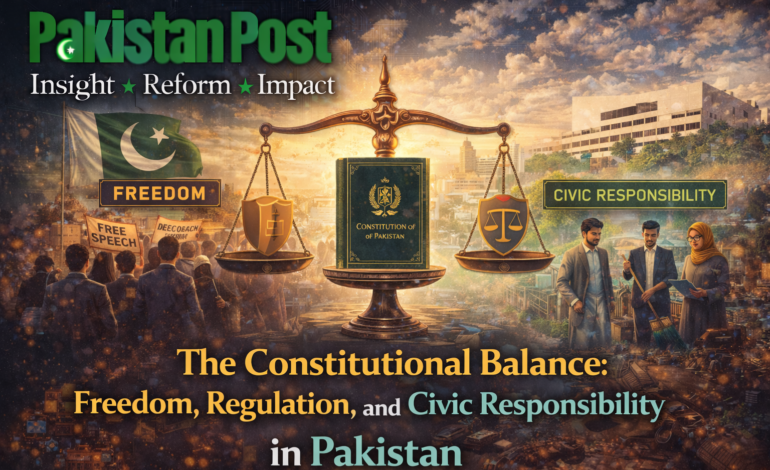
The Constitutional Balance: Freedom, Regulation, and Civic Responsibility in Pakistan

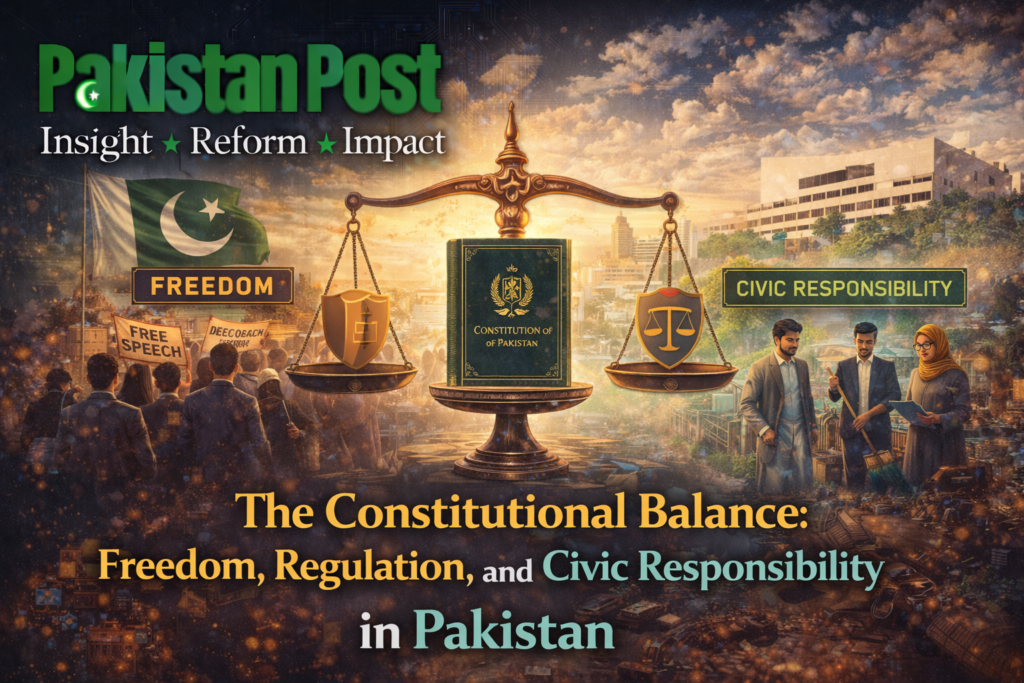
In the evolving architecture of Pakistan’s digital media ecosystem, regulation is no longer a narrow legal instrument; it is a structural determinant of how the state, civil society, and media coexist within the digitized public sphere. The expansion of connectivity, platform dependency, algorithmic amplification, and transnational information flows has transformed public discourse into a networked environment where sovereignty, dissent, journalism, activism, commerce, and national security intersect. Within this reconfigured landscape, state-driven regulation of online speechthrough defamation statutes, content removal mandates, compliance directives, data governance measures, and episodic restrictions on digital platforms has intensified the tension between sovereign authority and constitutionally protected freedom of expression. Yet the regulatory question cannot be examined in isolation from civil society institutions and media ecosystems, because they are not passive recipients of regulation; they are active architects of democratic accountability.
Civil society in Pakistan comprising advocacy groups, rights organizations, professional associations, grassroots movements, and independent watchdog bodies relies profoundly on digital platforms to mobilize, document grievances, monitor governance, and generate policy debate. Similarly, the media sector, both legacy and digital, increasingly operates within a hybrid information architecture where news production, distribution, and amplification are deeply embedded in social media infrastructures. Regulation of online speech therefore directly shapes the operating environment of journalists, editors, activists, and civic organizers. When regulatory frameworks expand in ambiguous or discretionary terms, the impact reverberates beyond individual speech acts; it restructures institutional behavior across civil society and media institutions.
The foundational principle that restrictions on expression must be justified by demonstrable harm provides a critical evaluative lens. Regulation gains legitimacy only when it satisfies the cumulative standards of proportionality, necessity, and legal clarity. In the absence of precision, legal instruments risk evolving from harm mitigation into anticipatory containment. Such containment generates a chilling effect not only among individual users but across institutional actors. Journalistic enterprises may dilute investigative depth to avoid legal exposure. Civil society organizations may temper advocacy campaigns to prevent regulatory friction. Editors may avoid contentious policy debates. The result is not overt censorship but systemic caution a quieter yet equally consequential constriction of democratic vitality.
The chilling effect within media ecosystems has structural implications. Investigative journalism functions as a mechanism of public oversight; it interrogates power, exposes maladministration, and amplifies marginalized voices. If defamation laws or digital compliance provisions lack definitional clarity, they may inadvertently shift from reputational protection to reputational insulation. A democracy requires scrutiny to function effectively. When scrutiny becomes legally perilous, public accountability erodes. Civil society organizations, particularly those engaged in human rights monitoring, environmental advocacy, gender justice, or electoral transparency, similarly depend on digital visibility. Regulatory ambiguity transforms advocacy into risk management.
However, the regulatory imperative cannot be dismissed. The digital sphere harbors genuine harms: orchestrated disinformation, incitement to violence, coordinated harassment campaigns, extremist propaganda, reputational sabotage, and cyber-enabled intimidation. Civil society actors themselves often demand stronger safeguards against hate speech and digital abuse, particularly for vulnerable communities. Media institutions confront reputational challenges arising from fabricated narratives that erode trust in journalism. The state therefore retains a legitimate role in establishing guardrails. The strategic challenge lies in calibrating intervention so that it neutralizes harm without suppressing pluralism.
Conceptualizing cyberspace as an interconnected informational ecosystem rather than a territorial frontier invites a more nuanced regulatory orientation. In this ecosystem, civil society, media organizations, technology platforms, regulators, and citizens interact in dynamic feedback loops. A regulatory measure aimed at controlling misinformation may inadvertently incentivize opaque moderation by platforms seeking compliance. A blocking directive may disrupt independent journalism and civic campaigns that rely on digital channels for outreach. Data localization mandates may affect investigative reporting that depends on cross-border data access. Every intervention produces systemic consequences.
To steward this informational ecosystem responsibly, governance must be procedurally transparent and institutionally accountable. Content removal orders should be accompanied by written justifications. Affected journalists or civil society organizations must have access to independent appeal mechanisms. Enforcement decisions should be recorded and subject to judicial review. Regulatory discretion should not operate in obscurity; it must be reviewable, documented, and contestable. Transparency reduces suspicion and strengthens legitimacy.
The geopolitical dimension adds further complexity. Pakistan operates within a multipolar digital order dominated by transnational platforms that serve as conduits for domestic civic engagement. Sovereign digital authority intersects with global corporate governance structures. Excessive coercive regulation may provoke platform disengagement or economic recalibration. Conversely, insufficient regulatory capacity may expose the domestic information environment to external manipulation. Civil society organizations and media institutions often depend on these global platforms to amplify local concerns to international audiences. Reconciling sovereign oversight with platform interdependence requires sustained diplomatic engagement, standardized compliance protocols, and structured dialogue mechanisms rather than episodic confrontation.
Normative benchmarks for content moderation must therefore integrate civil society and media perspectives. Legality demands that restrictions derive from democratically enacted legislation rather than administrative improvisation. Proportionality requires that sanctions correspond to the gravity of harm. Due process ensures that affected parties can contest enforcement. Viewpoint neutrality safeguards against political discrimination. Transparency requires publication of enforcement criteria and statistical reporting. Embedding civil society representation in consultative forums can enhance credibility and reduce perceptions of politicization.
Independent oversight institutions are indispensable to prevent regulatory capture or political instrumentalization. Their structural insulation must be designed through multi-stakeholder appointment processes, fixed tenure protections, budgetary autonomy, and mandatory disclosure obligations. Civil society organizations and professional media bodies should have formal consultative roles in oversight deliberations. A regulator detached from civic input risks losing contextual sensitivity; one subordinated to executive influence risks forfeiting independence. Institutional design must distribute power rather than concentrate it.
Legislative reform should prioritize definitional precision. Terms such as “false information,” “anti-state content,” or “harmful speech” require narrow and objective articulation. Ambiguity disproportionately affects civil society actors and independent media, as their work frequently challenges official narratives. Alignment with international human rights standards strengthens normative legitimacy and enhances global credibility. Domestic security objectives need not conflict with rights commitments when legal drafting adheres to disciplined standards.
Regulatory clarity also influences economic and institutional confidence. Digital start-ups, independent newsrooms, and advocacy organizations assess compliance risk before expanding operations. Unpredictable enforcement or sudden platform disruptions generate uncertainty that discourages innovation. Foreign investors evaluating Pakistan’s digital market consider regulatory predictability a critical factor. A coherent and transparent digital governance regime can stimulate technological entrepreneurship, attract capital, and strengthen media credibility.
Moreover, technological literacy must inform policymaking. Civil society groups possess on-the-ground insights into digital harassment patterns, misinformation networks, and community vulnerabilities. Media institutions understand newsroom workflows and editorial pressures. Regulators benefit from incorporating this experiential knowledge into policy design. Multi-stakeholder policymaking — integrating government agencies, civil society, media representatives, technology experts, and academia — enhances the sophistication and legitimacy of governance frameworks.
The discourse must transcend the reductive binary of “security versus freedom.” Civil society and media actors do not operate as adversaries of the state; they are co-constructors of democratic resilience. Security devoid of transparency breeds suspicion. Freedom devoid of guardrails risks instability. The objective is jurisprudential equilibrium regulation functioning with precision rather than force, guided by identifiable harm rather than speculative anxiety.
Media literacy initiatives and civic education programs offer complementary strategies. Empowering citizens to critically evaluate information reduces reliance on coercive censorship. Civil society organizations can spearhead digital literacy campaigns. Media institutions can invest in transparent fact-checking and ethical standards. The state can support these initiatives without controlling them. Resilient societies rely on informed citizens rather than pervasive suppression.
Institutional architecture must therefore embed participatory safeguards. Parliamentary digital affairs committees can hold public hearings with civil society and media stakeholders. Independent data protection authorities can protect privacy rights essential for investigative journalism. Specialized digital tribunals can expedite adjudication while ensuring fairness. Public reporting of enforcement statistics fosters accountability. Each mechanism strengthens checks and balances within digital governance.
Ultimately, the future of Pakistan’s digital public sphere hinges on whether regulation evolves as a guardian of pluralism or as a curator of conformity. Civil society and media institutions serve as barometers of that evolution. If regulatory frameworks encourage disciplined liberty, expression bounded by clearly defined harm principles and protected by procedural safeguards, they will reinforce democratic legitimacy. If they drift toward opacity and discretion, they risk shrinking the space for independent journalism and civic activism.
Trust constitutes the foundational currency of this ecosystem. Civil society must trust that advocacy will not invite disproportionate reprisal. Media organizations must trust that investigative reporting will not trigger arbitrary sanctions. Platforms must trust that compliance expectations are predictable. Citizens must trust that regulatory action is impartial rather than selective. Trust emerges from consistency, clarity, and accountability.
Pakistan stands at a constitutional inflection point in digital governance. The challenge is not merely technical; it is philosophical and institutional. It demands recognition that civil society and media are not obstacles to stability but pillars of accountable governance. It requires legislative craftsmanship attentive to proportionality and precision. It calls for oversight structures insulated from political leverage. Above all, it requires a commitment to disciplined libertya regulatory ethos that addresses harm without suffocating dissent.
If Pakistan succeeds in constructing such an ecosystem, its digital public sphere can mature into a domain where civil society flourishes, media operates with confidence, and governance retains legitimacy. Regulation will illuminate rather than intimidate. It will guide rather than constrict. It will function not as an instrument of narrative management but as a constitutional scaffold supporting plural expression within a secure and resilient republic.
A Public Service Message