Pakistan’s Public Sphere at the Crossroads: Freedom of Expression, Extremism, and Governance Imperatives

By Ijaz Naser

Pakistan’s democracy operates in a public sphere that is at once vibrant, contested, and vulnerable. The nation’s media landscape spanning television, digital platforms, and instantaneous social commentary serves as both an amplifier of citizen voice and a stage for strategic manipulation. In this environment, the exercise of freedom of expression cannot be abstracted from the demands of governance; it is a tool through which legitimacy is co-produced and trust in institutions is either strengthened or eroded.
The stakes are particularly high because extremist actors exploit the very freedoms that underpin democratic life. They use public platforms not to engage in civic debate but to advance agendas fundamentally opposed to constitutional order. By presenting anti-state narratives as legitimate opinion, they erode confidence in law enforcement, judicial authority, and policy institutions. This is not mere theoretical concern: the propagation of selective, emotive, or ideologically driven content shapes public perception, complicates administrative response, and amplifies the very threats that state mechanisms are tasked to contain.
Yet the solution is not repression. Pakistan’s constitutional framework, particularly Article 19, enshrines freedom of expression as a cornerstone of citizenship. The challenge lies in managing the public sphere so that freedoms serve democratic consolidation rather than strategic subversion. Effective management of this space requires a dual approach: strengthening the capacity of media to deliver governance literacy, and enabling civil society to translate abstract rights into actionable oversight without compromising national cohesion.
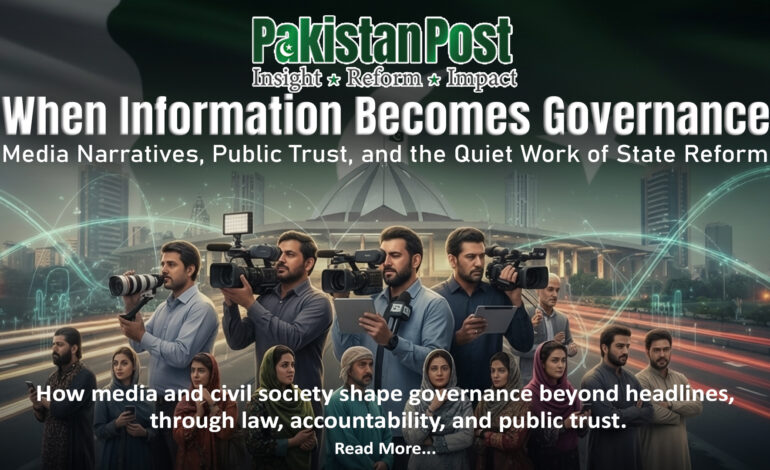
Media institutions must move beyond episodic reporting and political spectacle. Coverage of policy initiatives, administrative reform, or law enforcement action should routinely integrate legal mandates, procedural safeguards, and rights implications. Governance literacy within the media is not a technical exercise; it is an essential instrument for safeguarding both democratic norms and national stability. By equipping the public with context and analysis, media outlets reduce the informational voids that extremist actors exploit.
Civil society, similarly, must engage constructively with state mechanisms. Its role is not oppositional for its own sake but complementary: identifying implementation gaps, representing marginalized voices, and offering evidence-based recommendations that strengthen institutional accountability. When civil society retreats from sustained engagement in sensitive governance domains, public debate thins, and extremist narratives gain disproportionate influence.
The imperative for Pakistan is clear. In a society where democratic freedoms coexist with persistent security threats, the public sphere cannot be left unmanaged. The government must institutionalize transparency through accessible policy documents, structured consultation mechanisms, and timely public communication. Media must be oriented toward analytical rigor, and civil society must reclaim its role as a proactive interlocutor in governance.
This is not a matter of restricting rights, but of harnessing them. Freedom of expression is valuable precisely because it shapes trust, legitimacy, and the capacity of the state to act effectively. When expression is exercised without context, or exploited by actors hostile to the constitutional order, it undermines the very democracy it is meant to sustain. When it is managed strategically—through informed media, engaged civil society, and transparent governance—it becomes a force multiplier, strengthening institutions, reinforcing public trust, and preempting the destabilizing impact of extremist manipulation.
In Pakistan, the management of the public sphere is no longer optional; it is an existential imperative for the stability of democracy. Freedom of expression must coexist with deliberate, systemic strategies that ensure the public remains informed, empowered, and resistant to narratives that seek to subvert the state. In this balance lies the future of Pakistan’s democratic resilience.
A Public Service Message