

E-Cigarettes in Pakistan: What the World Can Teach Us

By Sadia Majeed
“Balancing Harm and Protection: How Pakistan Can Navigate the E-Cigarette Debate”
E-cigarettes are no longer a niche product; they are rapidly becoming a public health conundrum. Marketed as a safer alternative to smoking, these devices have captured the attention of Pakistan’s youth while offering adults a potential path to quit combustible tobacco. Yet the country lacks a coherent regulatory framework, leaving policymakers at a crossroads. Should Pakistan follow India’s strict ban, adopt the UK’s harm-reduction strategy, or craft its own evidence-based path guided by global standards? The decisions made today could shape the health and habits of a generation.
The rise of electronic nicotine delivery systems commonly known as e-cigarettes has transformed the global landscape of tobacco consumption. Once marketed as a “safer alternative” to smoking, these devices now sit at the center of a heated debate over public health, regulation, and youth addiction. Pakistan, with its high rates of tobacco use and a largely unregulated e-cigarette market, faces a critical policy moment. Should the country follow India’s strict prohibition, adopt the United Kingdom’s harm-reduction model, or chart a unique path informed by the World Health Organization’s guidance? The stakes are high: missteps risk both public health and the emergence of informal markets.
Pakistan’s Current E-Cigarette Landscape
Pakistan’s e-cigarette market is largely unregulated, fragmented, and opaque. Imported products often sold through informal channels bypass taxation, labeling requirements, and age verification. While official data on e-cigarette prevalence remain limited, surveys suggest rising experimentation among youth, particularly in urban centers (Khan, Ahmed, & Farooq, 2021). Social media marketing, celebrity endorsements, and attractive flavors such as mango, mint, and chocolate appeal strongly to teenagers. The regulatory vacuum has created a classic dilemma: balancing adult access for smoking cessation against preventing youth addiction.
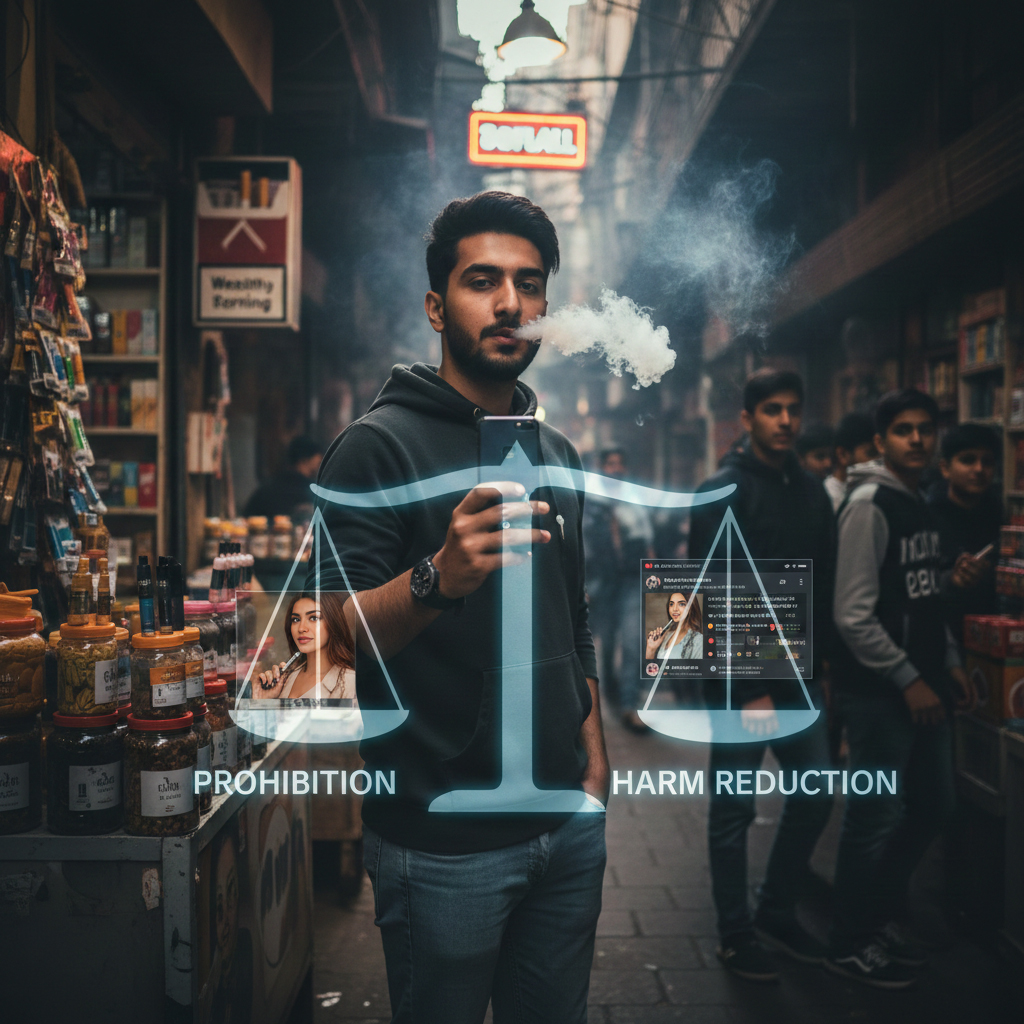
In contrast, conventional tobacco products have long been subject to legal restrictions in Pakistan, such as age limits and graphic health warnings. Yet enforcement is uneven, and illicit trade is widespread (WHO, 2020). E-cigarettes, as a newer technology, have largely escaped scrutiny. Policymakers must now weigh the evidence from global models to avoid repeating mistakes seen elsewhere.
India: The Case for Precautionary Prohibition
India adopted one of the world’s strictest approaches to e-cigarettes in 2019, banning their production, import, sale, and advertisement (Ministry of Health and Family Welfare [MoHFW], 2019). The ban was motivated by rising youth usage and concerns over long-term health impacts, which remain incompletely understood.
The Indian regulatory model emphasizes precaution over harm reduction. Enforcement involves criminal penalties for violations, including fines and imprisonment for retailers and distributors. Public awareness campaigns accompany the ban, highlighting the risks of nicotine addiction and framing e-cigarettes as a public health hazard rather than a consumer convenience.

However, the Indian model is not without challenges. Enforcement is uneven across states, with some urban centers seeing continued black-market sales. Critics argue that outright bans can push demand underground, making products harder to monitor and raising the risk of counterfeit devices. Nonetheless, India’s approach sends a clear signal: the government prioritizes preventing youth initiation over facilitating adult cessation through e-cigarettes.
The United Kingdom: Harm Reduction in Practice
By contrast, the United Kingdom has embraced a regulated harm-reduction model. Public Health England (PHE) endorses e-cigarettes as a tool for adult smokers to quit combustible tobacco, while maintaining restrictions on advertising, product standards, and sales to minors (PHE, 2022).

Evidence from the UK suggests that e-cigarettes can aid smoking cessation. For instance, a population study found that adult smokers using e-cigarettes were significantly more likely to quit or reduce smoking compared with those relying solely on nicotine replacement therapies (Brown et al., 2021). Crucially, UK authorities distinguish between adults seeking cessation and youth experimentation, implementing age verification and monitoring programs to prevent underage access.
WHO Guidance: Global Best Practices
The World Health Organization provides a framework for countries navigating e-cigarette regulation. WHO recommends prohibiting sales to minors, enforcing marketing restrictions, establishing product quality standards, and integrating e-cigarettes into broader tobacco control strategies (WHO, 2020).

WHO also cautions against over-reliance on harm-reduction narratives without robust evidence. While e-cigarettes may support adult smoking cessation, insufficient regulation can normalize nicotine use and undermine long-term public health gains. Surveillance, data collection, and public education are therefore essential components of any national policy.
Lessons for Pakistan: Comparative Insights
When examining India, the UK, and WHO recommendations, several key contrasts emerge. The table below illustrates how regulatory strategies differ and what Pakistan can learn from each:
| Aspect | India | United Kingdom (UK) | WHO Guidance | Proposed Pakistan Policy |
| Regulatory Approach | Complete prohibition of production, import, sale, and advertising | Harm-reduction: regulated access for adults | Evidence-informed regulation; restrict youth access, set quality standards | Hybrid: regulated adult access + youth protection |
| Youth Access | Strict ban; penalties for violations | Age verification, marketing restrictions | Prohibit sales to minors | Mandatory age verification; ban flavored products appealing to minors |
| Adult Access | Restricted (effectively banned) | Encouraged as cessation aid under supervision | Allowed with safety oversight | Licensed retail sales with monitored adult access |
| Product Standards | Limited formal standards; enforcement gaps | Product quality control & technical standards | Establish safety and technical standards | Adopt WHO-aligned standards; monitor imports & sales |
| Advertising & Marketing | Complete ban on promotion | Restricted; no misleading claims | Restrict advertising targeting minors | Ban youth-targeted marketing; regulate online/social media ads |
| Enforcement | Criminal penalties for retailers and distributors; variable effectiveness | Regulatory oversight with monitoring programs | Emphasize surveillance and data collection | Dedicated regulatory body; inspections and compliance monitoring |
| Public Awareness | Campaigns highlighting health risks | Campaigns supporting adult cessation & youth prevention | Integrate into broader tobacco control strategy | Nationwide awareness campaigns targeting adults & youth |
This table provides a concise snapshot for policymakers and readers alike, demonstrating that no single model is perfect. India’s strict ban emphasizes youth protection but risks black-market growth, while the UK approach prioritizes adult cessation with careful monitoring. WHO guidance emphasizes flexibility and evidence-based regulation. Pakistan’s unique context calls for a hybrid policy that incorporates the strengths of each approach while mitigating weaknesses.
Conclusion
Pakistan stands at a crossroads in e-cigarette regulation. Lessons from India, the UK, and WHO underscore the need for evidence-informed, context-specific policies. A total ban risks fueling black markets, while unregulated access endangers youth and public health. A balanced framework—integrating age restrictions, product standards, advertising controls, public education, and enforcement—can provide immediate protection and long-term benefits. Flexibility, monitoring, and public engagement will be key to ensuring that Pakistan’s regulatory choices reflect both scientific evidence and social realities.