Power Defines Logic: A New Strategic Communication

By: Ijaz Naser

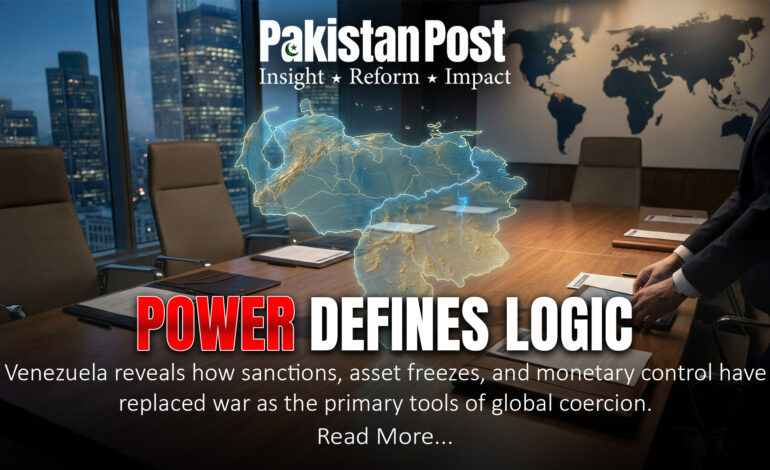
What has unfolded in Venezuela is more than an isolated crisis—it represents a structural shift in global power dynamics that reverberates far beyond the Western Hemisphere. Repeatedly framed as an exceptional response to extraordinary governance collapse, humanitarian distress, and criminalized political authority, the international reaction has served to reassure observers that the rules-based order remains intact. Yet such framing is increasingly untenable. Venezuela does not occupy the margins of international politics; it exposes the core operational logic of a system where sovereignty can be conditioned, delegated, or hollowed without formal warfare. Resource seizure, financial coercion, and narrative-based delegitimization are no longer extraordinary instruments but normalized tools of statecraft. The deeper implication is not that Venezuela could happen anywhere; rather, the international system has internalized conditions under which medium and smaller powers can be subordinated unless they proactively safeguard strategic autonomy.
For states such as Pakistan, the lessons are immediate and consequential. The logic demonstrated by the U.S. actions in Venezuela—combined with decades of sanctions, asset freezes, and selective enforcement of international law—signals that sovereignty can no longer be assumed to offer protection against coercion. As the Russian Deputy Chairman of the Security Council recently remarked, in a world where financial networks, narrative legitimacy, and foreign-held reserves can be weaponized, nuclear deterrence may constitute the only remaining insurance of sovereignty. For medium and smaller powers, this paradox presents both a strategic threat and a guideline: unless a state can project credible deterrence—nuclear or otherwise—it remains vulnerable to resource predation and subordination within a system where power defines legitimacy.
The post–Cold War evolution of this paradigm was gradual but decisive. In Iraq, 2003, the U.S. fused allegations of terrorism, weapons proliferation, and moral obligation to justify intervention. When empirical underpinnings collapsed, occupation persisted, revealing that sovereignty could be suspended through narrative authority rather than collective legal consensus. Iraq marked the institutionalization of coercion without apology—a blueprint in which direct military conquest became secondary to control over resources, revenues, and governance mechanisms. Financial sanctions, regulatory reach, and external recognition mechanisms gradually replaced battlegrounds as primary instruments of influence. Venezuela now represents the matured form of this strategy, where sovereignty remains intact in principle but conditional in practice.
Medium and smaller states are particularly vulnerable under this model. Venezuela’s experience demonstrates that state-owned assets can be immobilized abroad, access to international finance curtailed, and policy autonomy neutralized without conventional warfare. For countries like Pakistan, these lessons are stark: nominal independence is insufficient without structural resilience across financial, technological, and strategic dimensions. Sovereignty has evolved into a function of defensive depth—control over critical resources, insulation from coercive financial measures, and credible deterrent capabilities that signal consequences to any potential aggressor.
South Asia and Middle East Implications
The Venezuelan precedent carries profound implications for South Asia and the Middle East, regions where medium and lower-sized powers already operate under significant structural vulnerabilities. In South Asia, Pakistan faces a dual strategic challenge: India’s growing conventional and nuclear capabilities, coupled with Washington’s global coercive strategies, create a layered environment in which sovereignty can be undermined indirectly, through financial and narrative mechanisms, even without conventional confrontation. Afghanistan’s ongoing instability, meanwhile, highlights how power vacuums in proximate states can become instruments for external influence, reinforcing the lesson that buffer-state vulnerabilities can amplify strategic exposure.
In the Middle East, the logic is equally acute. Regional states such as Iraq, Lebanon, and Syria have long experienced coercive interventions under the guise of sanctions, resource control, and narrative delegitimization. The conditional sovereignty imposed on these states mirrors Venezuela’s situation and underscores the fact that smaller powers are often compelled to operate within externally defined parameters. For Pakistan, this means that strategic planning must internalize the likelihood that regional resource flows, financial access, and diplomatic recognition may be weaponized, and that deterrence and resilience strategies must be multidimensional—spanning military, financial, and diplomatic spheres.
The convergence of these dynamics presents both risks and strategic pathways. Medium powers in South Asia and the Middle East can no longer rely solely on formal recognition or territorial integrity. They must anticipate systemic coercion and develop mechanisms to maintain operational autonomy. Pakistan’s geographic and strategic positioning between India, China, Afghanistan, Iran, and the Gulf states amplifies both its vulnerabilities and its opportunities for strategic partnerships that can offset potential coercion. The emerging regional environment demands foresight: integration with global trade and finance must be accompanied by mechanisms of redundancy, insulation, and mutual strategic assurance.
India, Afghanistan, and China: Strategic Scenarios
The interaction between India, Afghanistan, and China exemplifies the regional complexities for medium powers. India’s ambitions, reinforced by technological modernization, conventional superiority, and nuclear capability, create a structural environment in which Pakistan must operate defensively yet proactively. In the absence of credible deterrence and strategic partnerships, India could exploit financial leverage, narrative influence, and proxy mechanisms to limit Pakistan’s autonomy. Conversely, Pakistan’s cooperation with China—through initiatives such as the China-Pakistan Economic Corridor (CPEC), regional payment systems, and shared military exercises—can provide critical strategic depth. By developing parallel financial networks and alternative trade channels, Pakistan can insulate itself from unilateral coercive actions, including potential secondary sanctions or resource denial strategies by third parties.
Afghanistan’s ongoing instability and its porous borders underscore another dimension of strategic risk. Pakistan’s ability to influence or stabilize its western neighbor remains critical to preserving internal security and regional autonomy. However, the risk that external actors exploit Afghan instability to pressure Pakistan is significant. The new logic of power—as demonstrated in Venezuela—implies that narrative framing, sanctions, or financial restrictions could serve as instruments of coercion without direct military action. Strategic planning must therefore integrate border security, intelligence sharing, and proactive diplomacy to neutralize potential external leverage through Afghanistan.
China’s role is central. Beijing’s pursuit of alternative payment systems, regional trade corridors, and security cooperation reflects a broader strategy to safeguard sovereignty for both itself and partner states. By collaborating with China, Pakistan can strengthen its insulation against financial coercion, enhance trade diversification, and access technological capabilities that reinforce strategic autonomy. Such partnerships also create collective deterrence: coercive actions against Pakistan would incur both direct and indirect costs for China, thereby strengthening the credibility of Pakistani independence in decision-making.
Nuclear Doctrine and Strategic Deterrence
The recent commentary by Russia’s Deputy Chairman of the Security Council underscores a stark reality: nuclear deterrence may be the only remaining safeguard for sovereignty in a world where financial networks, global narratives, and international legitimacy can be weaponized. For medium powers, credible nuclear capability is not an instrument of aggression but a structural guarantee. Pakistan’s nuclear doctrine must therefore prioritize survivability, second-strike capability, and credibility. The logic is clear: the mere possession of retaliatory capacity ensures that coercive manipulation of resources, finance, or diplomatic recognition carries prohibitive risk for potential adversaries.
However, nuclear deterrence alone is insufficient. It must be embedded in a comprehensive framework of strategic depth. This includes conventional defense capabilities calibrated to ensure that coercive threats cannot exploit territorial vulnerability, and advanced intelligence capabilities to anticipate emergent threats from both state and non-state actors. By combining nuclear deterrence with conventional readiness, Pakistan can create a layered security environment that mitigates the new forms of coercion highlighted by Venezuela, where sovereignty is conditional and power defines legitimacy.
Financial Independence and Alternative Architectures
The weaponization of financial systems through sanctions, asset freezes, or secondary restrictions has become a normalized instrument of power. Venezuela’s experience demonstrates that medium and smaller powers must secure alternative financial architectures to preserve autonomy. For Pakistan, this entails three key measures:
- Diversified Trade and Payment Systems: Participation in alternative settlement systems, such as those pioneered by China, along with regional clearing mechanisms, can reduce reliance on a single global currency and minimize exposure to unilateral economic coercion. Commodity-based exchanges, bilateral clearing arrangements, and regional reserve pooling can serve as buffers against external financial pressure.
- Strategic Reserves and Resource Control: Ensuring adequate reserves in energy, food, and critical commodities, combined with effective governance over state-owned assets, provides leverage and mitigates the material impact of external sanctions. Venezuela’s immobilized state assets highlight the consequences of inadequate reserve management and underscore the need for proactive safeguarding of sovereign wealth.
- Regulatory and Institutional Resilience: Domestic financial regulations, robust banking frameworks, and cyber-secured financial networks enable operational continuity even under systemic external pressure. Embedding transparency and accountability within these systems also enhances credibility, preventing unilateral interventions justified on the grounds of corruption or mismanagement.
Strategic Alliances and Defense Coordination
Alliances remain essential instruments for medium powers to counter the coercive logic of larger actors. Pakistan must cultivate relationships with regional and global partners to operationalize deterrence beyond its own capabilities:
- China: Beyond economic partnership, strategic military coordination, joint exercises, and intelligence sharing reinforce collective security. Such alliances create shared stakes in regional stability and render unilateral coercion more costly.
- Regional Cooperation: Pakistan’s engagement with other medium powers in South Asia, Central Asia, and the Gulf region can strengthen collective bargaining power in trade, defense, and diplomacy. Shared infrastructure projects, technological exchange, and coordinated defense initiatives serve as practical deterrents.
- Global Platforms: Participation in multilateral institutions, even when imperfect, offers narrative and diplomatic leverage to counter attempts at delegitimization. By actively shaping international discourse, medium powers can influence normative interpretation and limit the scope of unilateral coercion.
Defense coordination must integrate conventional and nuclear capabilities with cyber, intelligence, and economic resilience. Pakistan’s strategic posture should therefore emphasize flexibility, layered deterrence, and redundancy—ensuring that no single vector of coercion can compromise sovereignty.
Operationalizing Sovereign Resilience
The normalization of sanctions, resource seizure, and narrative-based delegitimization demands proactive adaptation. For medium powers like Pakistan, operationalizing resilience involves:
- Predictive Strategic Planning: Anticipating potential coercive moves and identifying vulnerabilities across military, financial, and diplomatic domains. Scenario modeling for India, Afghanistan, and regional powers provides actionable insights.
- Structural Hedging: Building redundancy into critical infrastructure, supply chains, and trade networks to ensure that external coercion cannot cripple essential functions.
- Strategic Communication: Establishing credibility internationally through narrative management, transparent governance, and diplomatic engagement, signaling both deterrence and legitimacy.
- Legal and Normative Innovation: Crafting treaties, bilateral agreements, and regional frameworks that operationalize mutual defense, financial independence, and recognition protocols to prevent coercion by more powerful states.
Conclusion: Sovereignty in a Conditional World
The Venezuelan episode, the systemic weaponization of finance, and the selective enforcement of legality reveal an international system where power defines logic, and rules operate only insofar as they serve the interests of dominant actors. For medium and smaller powers, the lessons are stark: sovereignty is no longer guaranteed by formal recognition alone. Effective independence requires layered deterrence, diversified alliances, financial resilience, and credible strategic signaling. Nuclear capability, while not an instrument of aggression, remains a central pillar of such deterrence.
Pakistan’s strategic imperative is to internalize these lessons: safeguard resource ownership, preserve decision-making autonomy, and cultivate partnerships that reinforce structural independence. In an era where imperialism may operate under the guise of legality, coercion, and narrative manipulation, only states that anticipate, diversify, and insulate can maintain sovereignty, honor, and dignity. Power now defines not only the end objective of states but also the very terms under which sovereignty is realized, and the survival of medium powers depends on their capacity to translate this logic into operational, financial, and strategic resilience.