Fuel Dilemma and the Political Economy

By Sadia Majeed

In the closing months of 2025, Pakistan stands at an extraordinary paradox. Citizens pay among the highest petrol prices in South Asia, yet the fuel in their tanks is substandard by global standards. While most of the world has transitioned to Euro-V or Euro-VI fuel—benchmarks that sharply limit sulfur and toxic emissions—Pakistan still clings to the obsolete Euro-II standard, introduced in Europe nearly thirty years ago. This discrepancy is more than a matter of outdated technology. It exposes the deep-rooted regulatory capture, policy inertia, and economic inefficiency that define Pakistan’s energy governance. The result is a perfect storm: dirty air, chronic public-health crises, and a distorted energy market where citizens pay a premium for poison.
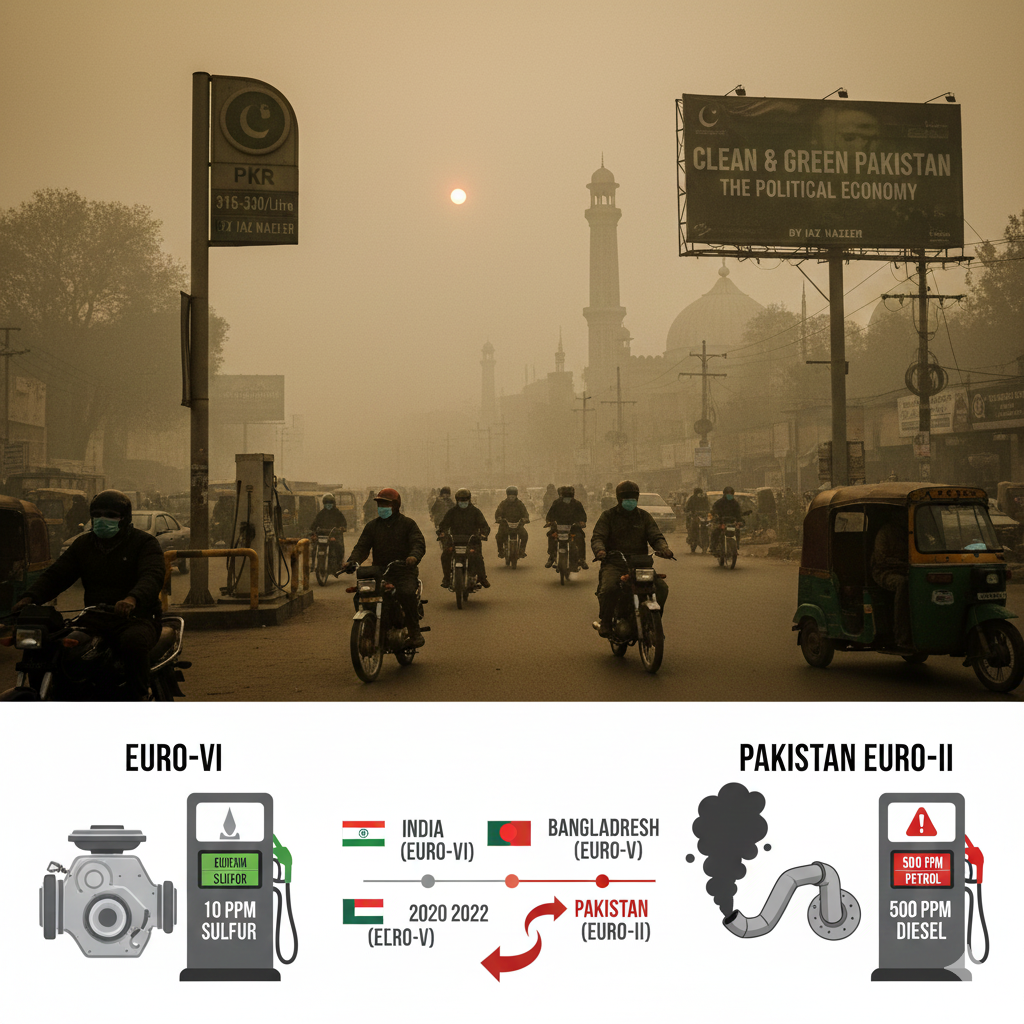
The Euro emission standards—from Euro-I in 1992 to Euro-VI in 2020—were designed by the European Union to limit pollutants such as sulfur dioxide, nitrogen oxides, and particulate matter emitted from fuel combustion. Each successive stage required cleaner fuels and improved engine technologies. Under Euro-VI, permissible sulfur content in petrol and diesel is capped at 10 parts per million (ppm). Pakistan’s Euro-II specification, by contrast, allows up to 500 ppm in petrol and 5,000 ppm in diesel. This chemical difference translates into a vastly higher emission load of toxic particles per litre burned.
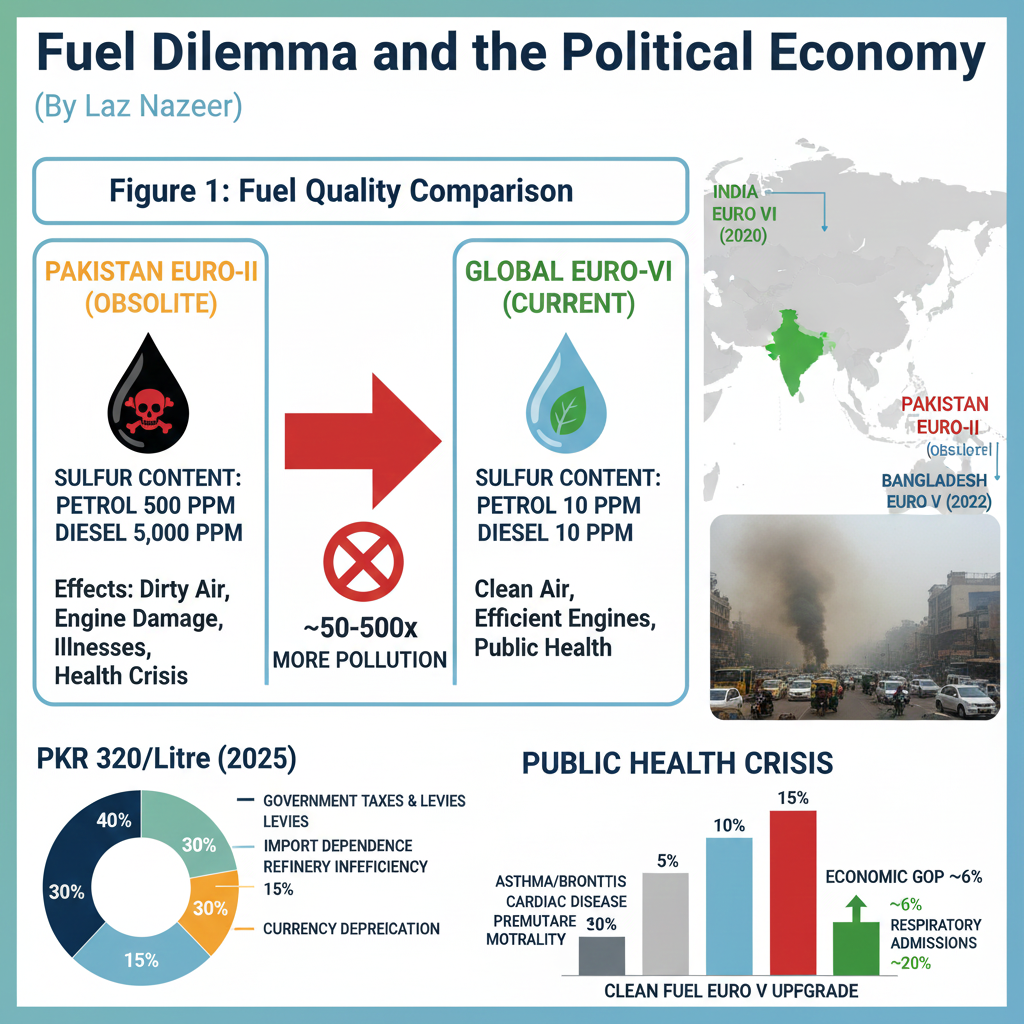
India adopted Euro-VI equivalent fuel nationwide in 2020, Bangladesh shifted to Euro-V in 2022, while Pakistan remains stuck at Euro-II. In effect, the country’s transport sector runs on fuel chemistry abandoned by Europe before the turn of the millennium.
Pakistan’s retail petrol price, hovering around PKR 315–330 per litre in late 2025, is among the region’s highest. Yet this price does not reflect fuel quality—it reflects the structural inefficiencies of the country’s energy system. High taxes on petroleum products, import dependence for refined fuels, outdated domestic refineries, and currency depreciation combine to push retail prices upward. The Oil and Gas Regulatory Authority and the Ministry of Energy continue to set prices based on international benchmarks while overlooking specification upgrades that could reduce pollution and engine inefficiency.
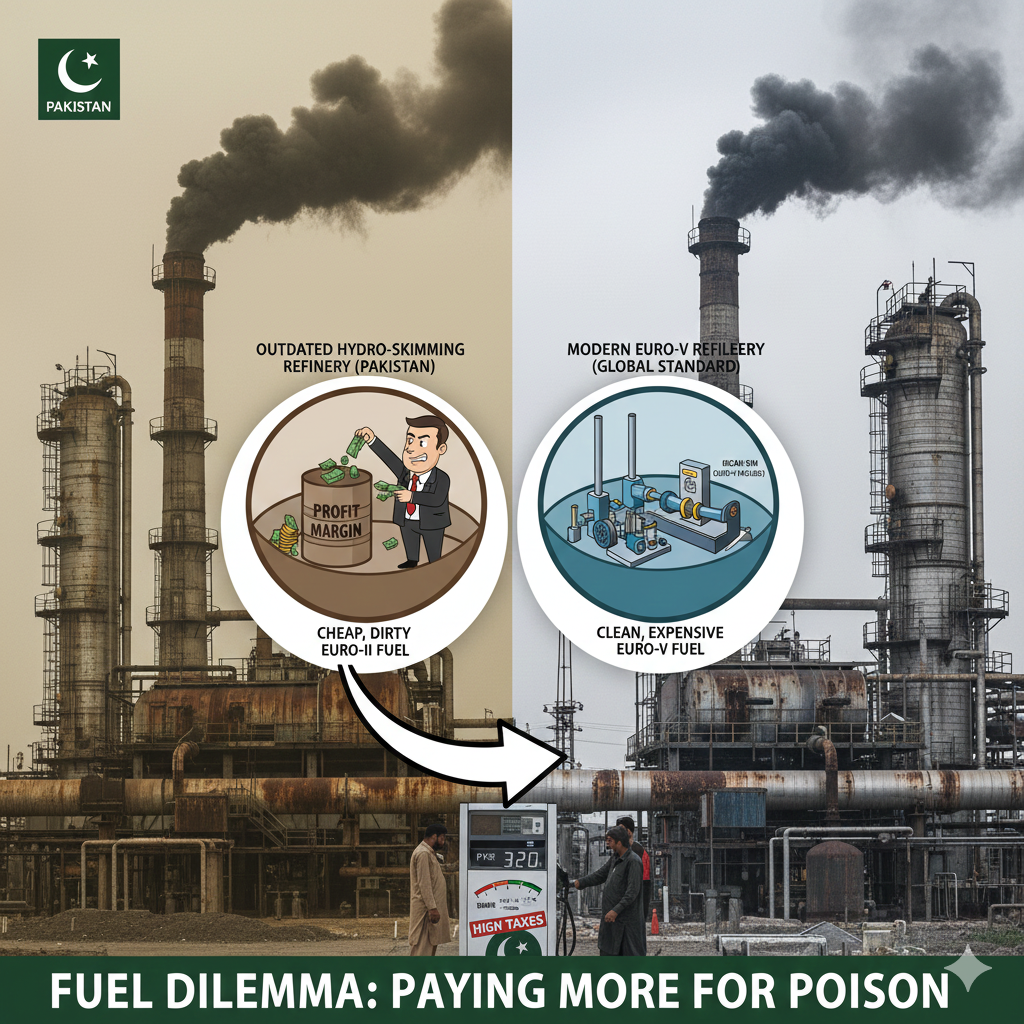
The country’s major refineries largely operate on obsolete hydro-skimming technology incapable of producing Euro-V fuels without major investment. Industry lobbies have resisted modernization, arguing it would raise costs. In practice, this allows refineries to maintain profit margins by selling cheaper, dirtier fuel—while the government imposes taxes that keep pump prices artificially high. Pakistanis thus pay more not for cleaner energy or infrastructure but to sustain an outdated and protectionist fuel economy.
The consequences of Euro-II fuel extend far beyond vehicle efficiency—they are visible in the haze that blankets Lahore, Karachi, and Faisalabad every winter. High-sulfur fuels emit sulfate aerosols that intensify ambient air pollution, driving particulate concentrations far above WHO guidelines. Medical data link these emissions to surging cases of asthma, bronchitis, cardiac disease, and premature mortality. According to World Bank estimates, Pakistan loses over 6% of GDP annually to air-pollution-related health costs and productivity losses. The Pakistan Medical Association attributes one in every five respiratory admissions in Punjab hospitals to vehicular and fuel-based pollutants.
In climate terms, Euro-II fuel is a carbon-intensive relic. Its high sulfur content reduces engine efficiency, producing greater carbon dioxide and black-carbon emissions per kilometre. These emissions undermine Pakistan’s commitments under its Nationally Determined Contributions to the Paris Agreement, which target a 20% reduction in greenhouse-gas intensity by 2030. Dirty fuel thus exacts a triple cost: economic, environmental, and epidemiological.
The persistence of Euro-II fuel cannot be explained by technical delay alone. It reflects a classic case of regulatory capture—where industry actors influence or control the very agencies meant to regulate them. Refinery associations and oil-marketing companies wield significant leverage over pricing and specification policy. Every proposal for an upgrade—whether from the Pakistan Environmental Protection Agency or the Climate Change Ministry—has been diluted by lobbying from the energy sector. Even when international partners offered financing for refinery modernization, political resistance and bureaucratic indecision stalled progress.
Institutionally, responsibility for fuel quality is fragmented across multiple bodies: OGRA, the Ministry of Energy, the Ministry of Climate Change, and provincial EPAs. This institutional fragmentation ensures that no single entity bears accountability. Environmental standards remain recommendations, not binding laws, allowing the continuation of outdated specifications under the guise of affordability.
Pakistan’s stagnation stands in stark contrast to regional reform trajectories. India’s fuel upgrade program, completed in 2020 at a cost of USD 6 billion, resulted in nationwide availability of ultra-low-sulfur fuel and measurable declines in urban pollution levels. China’s enforcement of National VI standards in 2021 reduced urban sulfur emissions by nearly 70% within three years. Sri Lanka and Bangladesh phased in Euro-IV and Euro-V fuels between 2021 and 2023 through coordinated refinery and import reforms. By contrast, Pakistan’s Refinery Policy 2023 promised a gradual shift to Euro-V by 2027 but lacked binding milestones, transparency, or financing mechanisms. Without credible enforcement, the timeline remains aspirational.
This technological lag isolates Pakistan from emerging regional decarbonization frameworks and deters foreign investment in green mobility and electric-vehicle infrastructure, both of which rely on cleaner baseline fuels.
Successive governments have proclaimed their commitment to a “clean and green” Pakistan, yet policy blindness persists. The contradiction between high fuel prices and dirty energy reveals a deeper governance pathology: short-term fiscalism over long-term sustainability. Instead of demanding refinery upgrades or revising emission standards, policymakers prioritize immediate revenue from petroleum levies—a reliable but regressive source of fiscal income. Environmental health rarely figures into economic decision-making, despite its measurable macroeconomic cost.
Public access to information is another casualty. Fuel specification data, refinery sulfur output, and emission inventories are not publicly disclosed. Citizens cannot verify the quality of the fuel they purchase. This transparency deficit perpetuates an accountability gap in which pollution continues unchecked while consumers foot the bill. In essence, Pakistan’s fuel regime reflects a wider pattern of environmental governance failure—a state more responsive to industrial lobbies than to its citizens’ lungs.
Pakistan’s continued reliance on Euro-II fuel is not a technical oversight—it is a policy choice rooted in governance inertia and industrial protectionism. The nation’s motorists, commuters, and children inhale the consequences daily while paying prices that should guarantee the cleanest energy available. This contradiction captures the moral dimension of Pakistan’s environmental crisis: when a state extracts high taxes for substandard fuel, it converts economic inefficiency into environmental injustice. The right to breathe clean air is as fundamental as the right to clean water or safe food. If Pakistan is serious about sustainable growth and climate resilience, reform must begin at the pump. Clean fuel is not a luxury; it is the first test of honest governance.
A Public Service Message: