
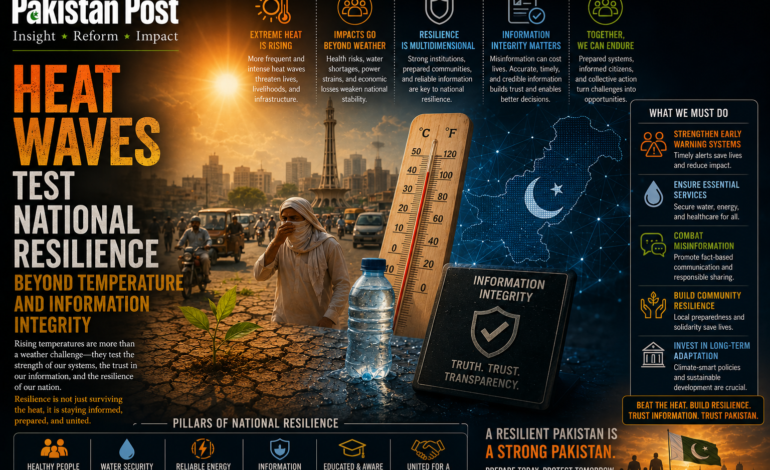
Heat Waves Test National Resilience Beyond Temperature and Information Integrity


Extreme heat is no longer merely an environmental phenomenon measured by rising temperatures and broken meteorological records. It has become a multidimensional governance challenge where climate risk intersects with public health, national security, critical infrastructure, digital communications, and geopolitical competition. Across continents, prolonged heat waves are exposing not only the physical vulnerability of societies but also the fragility of information ecosystems upon which emergency response depends. In parallel, the rapid evolution of artificial intelligence, social media algorithms, and coordinated influence campaigns has transformed extreme weather into an information battlefield where false narratives can spread faster than official warnings, weakening institutional credibility precisely when public trust becomes most essential.
Recent years have demonstrated that heat emergencies are increasingly accompanied by waves of misinformation. Fabricated weather forecasts circulate on encrypted messaging applications before official meteorological bulletins are released. Manipulated satellite imagery exaggerates or distorts atmospheric conditions. Artificial intelligence generated videos falsely depict collapsing infrastructure, imaginary government failures, or fabricated casualty figures. Conspiracy theories claim that heat waves are manufactured through secret technologies, while pseudoscientific narratives dismiss scientifically verified climate trends as political manipulation. These narratives are rarely isolated acts of misinformation. Increasingly, they form part of coordinated digital ecosystems that exploit uncertainty, amplify emotional reactions, and undermine confidence in institutions responsible for protecting public safety.
The strategic implications extend well beyond climate communication. During severe heat emergencies, public compliance with government advisories directly affects mortality, hospital capacity, electricity demand, water consumption, workplace productivity, and emergency service performance. When citizens question the authenticity of official forecasts or perceive health warnings as politically motivated, behavioural responses change. Individuals delay seeking medical assistance, ignore evacuation or cooling centre guidance, spread contradictory advice within communities, and contribute to panic purchasing of essential commodities. Information disorder therefore becomes a force multiplier that transforms environmental hazards into governance crises.
International experience increasingly confirms this relationship. During successive European heat waves, public authorities encountered widespread online misinformation regarding cooling methods, electricity shortages, water restrictions, and alleged government concealment of temperature data. Several European fact-checking organisations documented coordinated circulation of manipulated weather maps designed to question the legitimacy of official climate reporting. Although many individual posts appeared insignificant, their cumulative effect complicated public communication strategies during periods requiring consistent behavioural guidance.
The United States has witnessed similar dynamics. Federal emergency management agencies, meteorological institutions, and public health authorities have repeatedly confronted misinformation questioning heat alerts, exaggerating power grid failures, or falsely attributing extreme temperatures to engineered weather manipulation. Researchers examining digital behaviour during recent heat emergencies found that misleading information often achieved higher engagement than scientifically verified guidance because emotionally charged content spreads more efficiently across algorithm-driven platforms. This creates a persistent asymmetry whereby correction efforts frequently reach audiences after misinformation has already shaped public perception.
Australia has experienced recurring disinformation surrounding bushfires and extreme heat events, where false claims regarding the causes of disasters complicated emergency response and diverted public attention from verified safety information. Emergency management agencies increasingly regard information management as an operational function rather than simply a communications activity. Public messaging now requires continuous monitoring of emerging digital narratives alongside traditional hazard forecasting.
South Asia presents additional complexity because heat emergencies frequently coincide with water shortages, electricity instability, urban congestion, and socio-economic vulnerability. During regional heat waves, rumours concerning power rationing, contaminated water supplies, hospital shortages, and manipulated temperature reporting have circulated widely across social media platforms. In densely populated urban environments, misinformation can influence millions within hours, placing additional pressure on already strained emergency response systems.
The Middle East provides another instructive case where extreme temperatures intersect with geopolitical competition and information operations. Digital narratives surrounding infrastructure resilience, water scarcity, energy security, and government preparedness are increasingly amplified by regional political tensions. Heat emergencies therefore become opportunities for domestic and foreign actors seeking to influence public confidence or political stability.
Artificial intelligence is accelerating this challenge in unprecedented ways. Generative AI systems now enable the rapid creation of realistic images, convincing audio recordings, fabricated government announcements, counterfeit news broadcasts, and synthetic videos that can deceive audiences during fast-moving emergencies. Unlike earlier forms of misinformation, AI-generated content can be produced at scale, tailored for specific demographic groups, translated instantly into multiple languages, and distributed through automated networks with minimal technical expertise.
Deepfake technologies introduce particular concern for emergency communications. A fabricated video apparently showing a senior government official announcing false evacuation orders, electricity blackouts, or water contamination could generate widespread confusion before verification mechanisms become effective. Similarly, counterfeit audio messages impersonating meteorological authorities may encourage populations to disregard genuine health advisories.
Yet artificial intelligence also offers significant defensive capabilities. Advanced machine learning systems increasingly support real-time detection of coordinated influence campaigns by identifying abnormal posting behaviour, bot networks, synthetic content, manipulated imagery, and cross-platform amplification patterns. Natural language processing enables authorities to identify emerging misinformation themes before they achieve viral reach, while predictive analytics can estimate which false narratives are most likely to influence vulnerable populations.
Leading international technology companies, research institutions, and emergency management organisations are investing heavily in AI-assisted verification systems capable of authenticating satellite imagery, identifying manipulated multimedia, and monitoring coordinated disinformation campaigns across multiple digital platforms simultaneously. Such technologies cannot replace human judgment, but they substantially improve situational awareness during rapidly evolving emergencies.
The strategic challenge lies in integrating technological capabilities with institutional coordination. Information integrity during heat emergencies requires seamless cooperation among meteorological agencies, disaster management authorities, health ministries, telecommunications regulators, cybersecurity institutions, intelligence organisations, digital platforms, and professional news organisations. Fragmented communication creates information vacuums that misinformation rapidly exploits.
Professional journalism therefore occupies a strategically significant position within climate resilience. Responsible news organisations increasingly function as trusted intermediaries translating scientific forecasts into accessible public guidance while independently verifying claims circulating online. Editorial verification standards become especially important during heat emergencies when inaccurate reporting may directly influence life-saving decisions.
Risk communication itself requires careful calibration. Public messaging that exaggerates hazards may generate unnecessary panic, while overly cautious language risks complacency. Behavioural science increasingly demonstrates that effective emergency communication combines scientific accuracy with practical guidance, emotional credibility, and consistent repetition across trusted institutional voices. Mixed messaging from different government agencies significantly reduces compliance regardless of the scientific quality of individual statements.
Pakistan faces particularly significant vulnerabilities within this evolving landscape. Climate projections consistently identify the country among those highly exposed to prolonged heat stress, urban heat island effects, glacial variability, water scarcity, and climate-related public health challenges. Simultaneously, Pakistan possesses one of the world’s fastest-growing digital populations, characterised by extensive social media use, rapidly expanding smartphone penetration, and widespread reliance upon messaging applications for news consumption.
These characteristics create opportunities for rapid dissemination of official advisories but equally facilitate rapid circulation of misinformation. False weather warnings, fabricated electricity schedules, manipulated government notifications, counterfeit health recommendations, and politically motivated narratives can spread nationally within hours. The challenge is intensified where digital literacy remains uneven and trust in official communication varies across different demographic and regional groups.
Institutionally, Pakistan possesses several components necessary for effective climate information governance. Meteorological forecasting capabilities have improved considerably over recent decades. Disaster management structures operate at national and provincial levels. Public health institutions possess emergency response mechanisms. Telecommunications regulation has expanded digital oversight capacity. Nevertheless, these capabilities often operate within separate administrative frameworks rather than an integrated information resilience architecture.
Inter-agency coordination remains an important area for institutional strengthening. During prolonged heat emergencies, information produced by meteorological authorities should flow seamlessly into health advisories, disaster response planning, provincial implementation, local government communication, and media engagement. Delays or inconsistencies between institutional messaging create uncertainty that misinformation readily exploits.
Mainstream media likewise requires stronger integration within national emergency communication planning. Television broadcasters, radio networks, newspapers, and digital news platforms remain among the most influential sources of verified information during national emergencies. Structured information-sharing protocols between scientific institutions and professional media can improve reporting accuracy while reducing opportunities for speculative coverage.
Pakistan’s cybersecurity institutions also face expanding responsibilities. Coordinated foreign influence operations increasingly exploit domestic crises to amplify political polarisation, undermine institutional legitimacy, and weaken public confidence. Heat emergencies may provide convenient opportunities for hostile actors to circulate fabricated narratives concerning infrastructure failures, governance incompetence, or social instability. Detecting such campaigns requires close collaboration between cybersecurity agencies, intelligence organisations, telecommunications authorities, and digital platforms while respecting constitutional protections and democratic freedoms.
Digital platform governance represents another critical dimension. Algorithmic recommendation systems frequently prioritise emotionally engaging content irrespective of factual accuracy. Consequently, sensational misinformation often outperforms verified public health guidance. International regulatory discussions increasingly focus on transparency obligations for large platforms regarding algorithmic amplification, coordinated inauthentic behaviour, political influence operations, and emergency information prioritisation. Pakistan can benefit from these evolving international regulatory experiences while adapting approaches to domestic legal and constitutional frameworks.
Behavioural insights should also become central to emergency communication strategy. Scientific evidence consistently demonstrates that individuals rarely respond solely to factual information. Social identity, community trust, cultural norms, emotional framing, and perceived institutional credibility significantly influence behavioural decisions during emergencies. Public communication campaigns should therefore incorporate behavioural science alongside meteorological expertise to maximise compliance with heat protection guidance.
Educational institutions possess equally important long-term responsibilities. Climate literacy, digital literacy, and media literacy increasingly represent interconnected components of national resilience. Citizens capable of evaluating information sources, recognising manipulated content, understanding scientific uncertainty, and verifying official advisories become substantially less vulnerable to misinformation campaigns. Such educational investment strengthens democratic resilience beyond climate emergencies alone.
International cooperation will become increasingly important because information operations transcend national borders. Cross-border bot networks, coordinated influence campaigns, and synthetic media frequently operate across multiple jurisdictions simultaneously. Collaboration among meteorological organisations, cybersecurity agencies, academic institutions, technology companies, and international organisations can improve early warning, technical capacity, and shared threat intelligence.
For Pakistan, an integrated National Climate Information Strategy should therefore be viewed not merely as a communication initiative but as critical national resilience infrastructure. Such a strategy should establish unified emergency communication protocols linking meteorological forecasting, disaster management, health advisories, provincial implementation, cybersecurity monitoring, telecommunications regulation, intelligence assessment, and professional media engagement within a common operational framework. Artificial intelligence should support continuous monitoring of misinformation trends, multilingual fact-checking, synthetic media detection, and behavioural analysis while remaining subject to transparent legal safeguards and independent oversight.
Strategic communication capabilities should extend beyond reactive myth correction toward proactive public engagement throughout the year. Regular climate education campaigns, transparent publication of scientific methodologies, open access to meteorological data, trusted spokesperson development, and partnerships with universities, civil society organisations, healthcare professionals, and local community leaders can strengthen institutional credibility before emergencies occur. Public trust accumulated during normal periods becomes indispensable during crises.
The growing convergence of climate risk and information warfare demands that policymakers reconsider traditional distinctions between environmental governance, public health, cybersecurity, strategic communications, and national security. Heat waves will continue increasing in frequency and intensity as global temperatures rise. Simultaneously, artificial intelligence will continue reducing the cost and increasing the sophistication of digital deception. The central policy question is therefore no longer whether misinformation will accompany future heat emergencies, but whether institutions possess sufficient resilience to maintain public trust when accurate information becomes as strategically important as electricity, water, or emergency medical care. Nations capable of protecting both physical infrastructure and information integrity will be better positioned to safeguard lives, maintain social cohesion, preserve democratic confidence, and strengthen national resilience in an era where the most dangerous consequences of extreme heat may emerge not only from the atmosphere, but also from the digital battles fought over public perception.
A Public Service Message