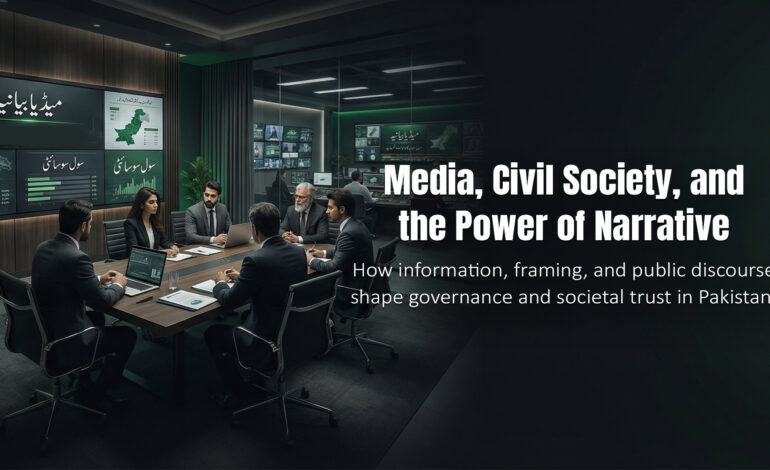
Media, Society, and the Power of Narrative: Disruption, Reconstruction, and Civil Society’s Dependence

By Ijaz Naser

The media is no longer a mere conveyor of news; it is an architect of perception, a catalyst for societal transformation, and, at times, a force of disruption. In Pakistan, as elsewhere, the interplay between media institutions, civil society, and public consciousness demonstrates the dual nature of influence: the same platforms that amplify awareness, accountability, and reform can also propagate fragmentation, polarization, and mistrust. Today, media determinism—the idea that media structures shape societal behavior, priorities, and discourse—is at its peak. How societies respond to crises, engage with policy debates, or mobilize around social causes is increasingly mediated by the framing, selection, and emphasis imposed by the media itself. Civil society, while striving to nurture resilience and informed citizenry, is heavily dependent on media channels for visibility, legitimacy, and impact. The relationship is symbiotic, yet inherently fragile, raising urgent questions about governance, responsibility, and strategic engagement.
The disruptive potential of media becomes evident during high-stakes national incidents. Take, for instance, the January 2026 Peshawar explosion, which highlighted the rapid shaping of public perception long before official statements or investigative reports were fully available. Headlines, broadcast visuals, and commentary frames directed public attention toward certain interpretations of the event, assigning culpability, prioritizing specific narratives, and marginalizing alternative perspectives. In such moments, media acts as both agenda-setter and amplifier, determining which voices dominate and which are silenced or delayed. The consequences extend beyond misinformation; they influence public sentiment, policy pressure, and civic behavior. Communities may react emotionally, mobilize support or opposition prematurely, or recalibrate trust in institutions based on partial representation, demonstrating the structural power of media in societal dynamics.
At the same time, media plays a central role in societal reconstruction. When crises subside, or when systemic challenges demand reform, media channels provide a platform for knowledge dissemination, debate, and coordination. Civil society organizations depend on media coverage to amplify research findings, mobilize resources, and influence policy frameworks. Campaigns for education reform, environmental protection, or social justice gain traction only when media can frame the issues compellingly and communicate them to broad audiences. Media’s interpretive role shapes not just awareness but perception of urgency, legitimacy, and scale. In effect, the capacity of civil society to enact meaningful change is intertwined with the reach, credibility, and framing choices of media institutions.
The peak of media determinism is evident in the globalized context. International coverage, comparative narratives, and transnational issue framing influence local policy discourse and civic priorities. Global media narratives around climate, migration, economic crises, or regional security inform public sentiment in Pakistan, shaping both citizen expectations and policy agendas. Civil society must navigate this dual-layered ecosystem: interpreting local realities while positioning them within global discourse, using media as both a lens and a lever. Organizations that fail to understand the media’s shaping power risk misalignment, reduced visibility, or co-optation by pre-existing narrative flows.
However, reliance on media also introduces vulnerabilities. Civil society often adapts its strategy to media imperatives—timing releases for peak coverage, framing messages for impact, and emphasizing simplicity over nuance. While these strategies enhance reach, they may compromise depth, analytical rigor, or long-term impact. Additionally, the media ecosystem can selectively amplify perspectives, prioritizing conflict, drama, or sensationalism over systematic analysis, thereby constraining civil society’s ability to cultivate informed, deliberative engagement. The structural imbalance means that societal reconstruction efforts depend on media platforms whose internal imperatives—audience retention, editorial positioning, competitive advantage—may not fully align with civic objectives.
Understanding the duality of disruption and reconstruction requires a systematic assessment of media functions and civil society interactions. Below is a visual framework mapping Media Functions → Civil Society Dependency → Risks → Recommended Interventions, which illustrates the structural interplay:
| Media Functions | Civil Society Dependency | Risks / Vulnerabilities | Recommended Interventions |
| Agenda-Setting & Framing – selects which events, actors, and interpretations are visible | Civil society relies on media to highlight societal issues, policy gaps, and campaigns | Partial framing can marginalize issues, create biased perceptions, or distort urgency | Develop partnerships with media houses to ensure context-rich framing; train civil society in narrative strategy; diversify media engagement to multiple outlets |
| Amplification – repetition and prominence extend content reach | Civil society depends on amplification to scale awareness, mobilize public action, and influence policy | Over-amplification of sensational or incomplete content can mislead audiences; corrective messaging may lag | Establish rapid-response communication protocols; pre-plan messaging strategies; use advisory units within media for ethical amplification |
| Legitimization – coverage confers credibility and urgency | Civil society gains visibility, credibility, and trust through media coverage | Selective legitimization can favor certain organizations or narratives; reduces perceived neutrality | Co-create editorial standards with media; leverage multiple media platforms for balanced visibility; monitor reach and credibility metrics |
| Narrative Interpretation – analysis, commentary, and editorial positioning | Civil society depends on media interpretation to contextualize events for the public | Misinterpretation or biased commentary can influence civic perception negatively | Collaborate on joint analytical pieces; fact-based op-eds; establish advisory networks for thematic guidance |
| Conflict & Crisis Highlighting – coverage during high-stakes incidents | Civil society requires timely reporting for relief efforts, advocacy, and policy influence | Media focus on conflict/sensationalism can heighten panic, polarization, or misinformation | Implement pre-agreed communication frameworks for crises; media literacy campaigns; coordinate fact-checking with civil society |
| Trend Identification – highlighting emerging social, political, or economic issues | Civil society relies on media to anticipate societal needs and policy windows | Trends may be misrepresented, leading to misaligned advocacy or resource allocation | Maintain joint monitoring dashboards; early-warning systems; structured engagement to validate emerging trends |
| Public Engagement & Debate Facilitation – hosting discussions, interviews, and debates | Civil society leverages forums for participatory policy shaping and awareness campaigns | Limited participation or selective voices can narrow debate; reinforce echo chambers | Institutionalize multi-stakeholder discussion platforms; ensure transparency in representation; integrate evidence-based commentary |
Structural insights from this framework emphasize that civil society’s effectiveness is directly linked to the media ecosystem’s integrity and strategic engagement capacity. Media acts as filter, amplifier, legitimizer, and interpreter; civil society depends on these functions to achieve reach, credibility, and societal impact; risks arise when framing, amplification, or trend selection is misaligned with civic objectives; and interventions range from literacy programs to coordinated partnerships, ensuring ethical amplification, timely corrections, and evidence-driven engagement.
Evidence indicates that societies capable of leveraging media constructively achieve higher resilience in governance, social cohesion, and policy adoption. International case studies—from post-conflict reconstruction in Southeast Asia to public health campaigns in sub-Saharan Africa—demonstrate that strategic partnerships between media and civil society amplify effectiveness, reduce polarization, and enhance civic trust. In Pakistan, recent campaigns on public health awareness, disaster response, and educational initiatives show measurable impact when media coverage is timely, consistent, and analytically robust. Conversely, episodes of fragmented or sensationalized reporting correlate with public confusion, policy missteps, and reduced trust in both media and civil society institutions.
Ultimately, media’s dual role—as both disruptor and reconstructive agent—defines the contemporary landscape of societal influence. Civil society cannot operate in isolation; its strategies, messaging, and impact are interdependent with media structures, norms, and practices. Recognizing this reality, organizations must invest in media engagement as a strategic capability, building expertise, networks, and protocols that allow them to navigate disruption while amplifying constructive narratives. Policymakers and regulators, meanwhile, should support frameworks that incentivize ethical, evidence-based reporting, and provide mechanisms for collaborative engagement between media institutions and civic actors. When media and civil society operate in concert, public discourse becomes more resilient, informed, and capable of supporting societal reconstruction even amid crisis and contestation.
In conclusion, the media in Pakistan today shapes societal perception, frames policy debates, and determines which voices are heard and which are marginalized. Civil society depends on this power, yet must recognize the structural imperatives and risks inherent in such dependence. By developing strategic engagement mechanisms, investing in literacy and training, and fostering ethical collaboration, Pakistan can harness the transformative potential of media. The goal is not to constrain the media, but to align its influence with societal resilience, ensuring that disruption does not dominate reconstruction, and that civil society can operate with both visibility and efficacy in the evolving architecture of narrative power. The future of civic engagement, public trust, and social cohesion will hinge on the ability of media and civil society to co-construct a discourse that is informed, balanced, and capable of guiding societal priorities in a complex and interconnected world.
A public service message