Great Power Rivalry and the Unraveling of the Twentieth-Century World Order

By Ijaz Naser
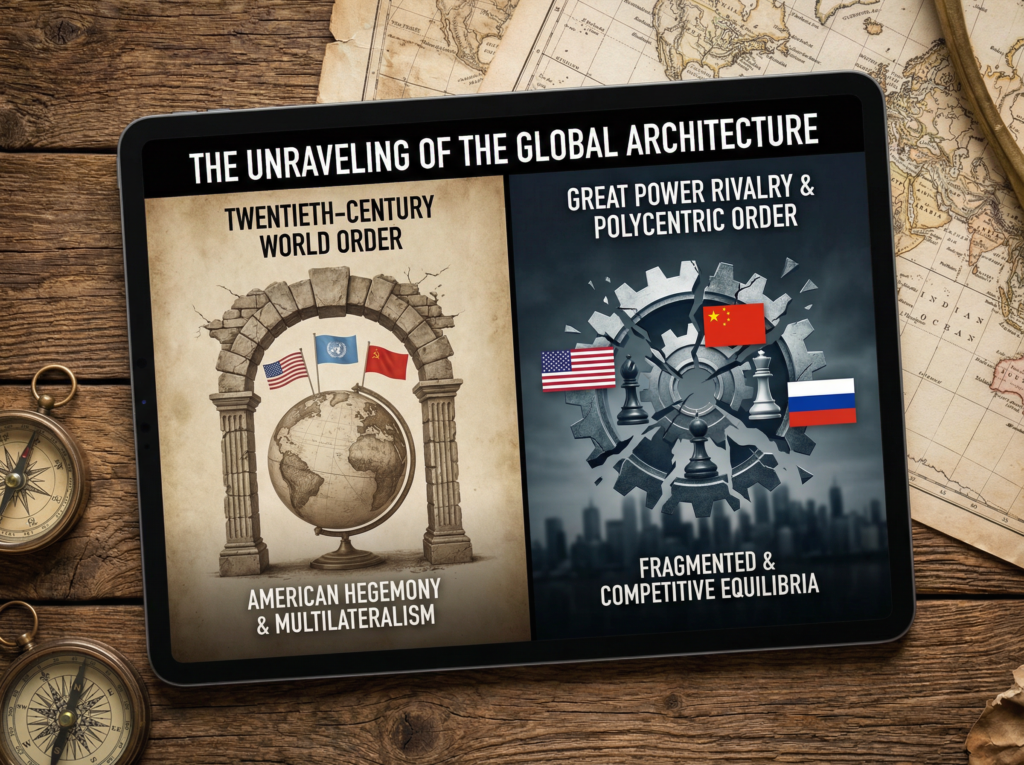
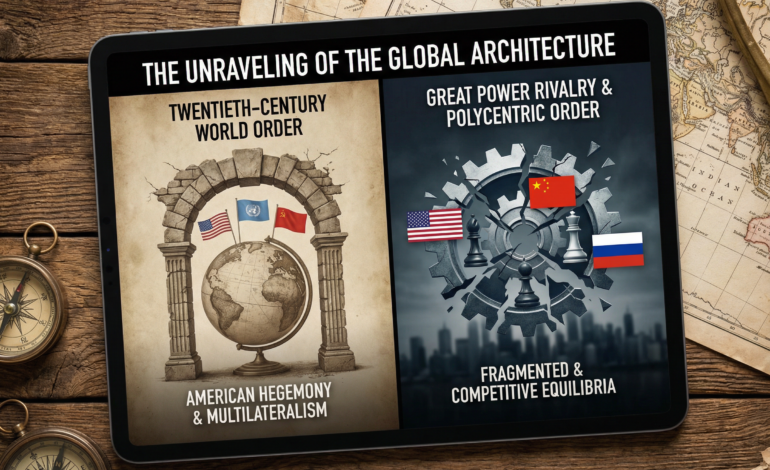
The contemporary international system transcends episodic volatility; it endures a profound structural metamorphosis. The much-discussed “great power rivalry” encompassing the United States, China, and Russia constitutes not a transient clash of influence or ideology, but the inexorable dissolution of the global architecture forged in the crucible of World War II and buttressed by the Cold War’s denouement. For nearly eight decades, this edifice rested on foundational pillars: American hegemony, robust multilateral institutions, calibrated strategic predictability among nuclear-armed states, and the ostensibly universal imprimatur of liberal norms. These tenets, once axiomatic, now teeter on the brink of obsolescence. Emerging in their stead is a polycentric order, fragmented and fiercely competitive, predicated less on consensual rules than on mercurial power equilibria and expedient, situational coalitions. This transition, far from teleological, unfolds amid accelerating asymmetries—technological, demographic, and economic—that defy linear prognostication. For strategists and policymakers, the imperative is clear: to diagnose this unraveling not as aberration, but as the harbinger of a new, precarious normalcy.
At this pivot stands the United States, ensnared in a poignant dialectic between nostalgic guardianship of its liberal international order and the pragmatic exigencies of a multipolar reality. Contemporary U.S. foreign policy embodies this schism acutely: an unyielding aspiration to perpetuate the post-1945 framework—epitomized by Bretton Woods institutions, NATO, and the liberal trading regime—clashes with a resurgent realpolitik, most vividly incarnated during the Trump presidency. Trumpian diplomacy—characterized by “America First” transactionalism, tariff volleys against Beijing, NATO summit rebukes, and affinity with illiberal strongmen—did not materialize ex nihilo. It crystallized broader recalibrations: domestic disillusionment with globalization’s uneven fruits, resurgent economic nationalism, and the sobering acknowledgment that unipolar dominion, proclaimed triumphant in 1991, has irrevocably waned. Multilateral fora like the WTO, once instruments of U.S. leverage, now constrain as much as they empower, ensnaring Washington in disputes with erstwhile clients. Yet this reversion to sovereignty-centric power politics falters against twenty-first-century headwinds. Historical analogies abound: the interwar retreat from Wilsonian idealism yielded to isolationism, only to confront Axis aggression. Today, superimposing mid-century paradigms upon a digitized, interdependent globe engenders paradoxes—sanctions boomerang via supply-chain disruptions; alliance skepticism invites free-riding without deterrence.
Preeminent among these constraints is the seismic redistribution of global capabilities. The unipolar interlude permitted the U.S. to orchestrate terms across military, economic, and normative domains. That epoch has lapsed. China’s trajectory exemplifies systemic contestation: beyond GDP parity thresholds, Beijing erects counter-hegemonic sinews. The Belt and Road Initiative (BRI), spanning 150+ nations with $1 trillion in commitments, circumvents Western finance; BRICS+ now encompasses a quarter of global GDP, incubating de-dollarization; the Asian Infrastructure Investment Bank (AIIB) rivals the World Bank; and yuan swap lines with 40 partners erode SWIFT hegemony. These architectures eschew frontal assault on the extant order, opting instead for insidious erosion—offering developing states bifurcated choices that dilute U.S. coercive efficacy. Sanctions on Huawei or Russian energy, once paradigm-shifting, now elicit circumvention via parallel digital ecosystems and commodity rerouting. Empirical evidence underscores this: post-2018 U.S. tariffs, China’s global trade share climbed to 14%, while compliance with extraterritorial measures wanes in the Global South.
Russia, by contrast, personifies asymmetric disruption. Bereft of China’s scale, Moscow masters entropy: the 2022 Ukraine incursion fused hybrid warfare—drone swarms, Wagner mercenaries—with energy coercion, spiking European gas prices 400%. Cyber forays (e.g., SolarWinds) and disinformation amplify this, preying on NATO fissures, institutional torpor, and the West’s selective indignation over atrocities—from Xinjiang to Gaza. For Washington, deterrence demands transatlantic solidarity; yet unilateralist impulses—evident in Afghan withdrawal acrimony—erode it. Endogenous fissures compound these exogenous pressures. The liberal order’s longevity hinged on domestic concord: elites, bureaucracies, and polity concurred that global stewardship advanced parochial interests. This covenant has ruptured. Deindustrialization hollowed the Rust Belt; inequality metrics rival Gilded Age peaks; 20-year quagmires in Iraq and Afghanistan exacted 7,000 U.S. lives and $8 trillion, breeding “forever war” fatigue. Trump’s MAGA ethos, far from outlier, channels this zeitgeist—polls reveal 60% of Americans now prioritize domestic renewal over abroad adventures. Policymakers thus navigate straitened straits: interventions demand ledger-line justifications, not Kantian abstractions. This engenders policy myopia, privileging quarterly tariffs over decade-spanning alliances, as seen in AUKUS frictions and QUAD hesitations.
From the vantage of strategic convocations—RAND, CSIS, Chatham House—the enigma transcends policy critique; it probes adaptation heuristics under duress. Decision cycles compress: Telegram dispatches from Kyiv outpace NSC briefs; TikTok amplifies Taiwan Strait saber-rattling. Diplomacy devolves to firefighting—Ukraine grain deals, Houthi interdictions—supplanting doctrinal husbandry like the Quadrennial Defense Review. This favors bricolage over Bismarckian orchestration, inverting Clausewitzian logic where friction now accelerates, not retards, tempo. Think tanks must furnish not mere forecasts, but resilient frameworks: scenario lattices modeling “no-limits” Sino-Russian pacts unraveling under Uyghur-Tatar tensions, or U.S. midterms pivoting Indo-Pacific postures. Parallelly, the rules-based order atrophies. Pillars like the UN Security Council, paralyzed by veto geometry; WTO appellate paralysis post-2019; moribund INF Treaty evisceration—were engineered for great-power buy-in. Today, invocation is instrumental: U.S. decries South China Sea reclamations yet champions Golan annexation; Russia flouts Minsk while decrying Kosovo. Governance metastasizes into minilateralism: G7 morphs to G20+; CPTPP supplants TPP; I2U2 (India-Israel-UAE-U.S.) prototypes issue silos. This flexibility begets fragility—lacking universality, alignments prove ephemeral, as evidenced by Saudi BRICS flirtations amid U.S. Yemen reticence.
Nowhere does this portend graver peril than nuclear vicissitudes. The twentieth-century pax atomica, for all bipolar brinkmanship, reposed on mutual assured destruction’s grim mutuality: SALT/START dyads, Moscow-Washington hotline, tacit no-first-use shibboleths. These scaffolds splinter. China’s arsenal surges from 350 to 1,000 warheads by 2030 (Pentagon estimates), jettisoning minimalism for parity; Russia’s Poseidon doomsday torpedoes and tactical nukes in Kaliningrad normalize escalatory rhetoric; America’s Sentinel ICBMs and Columbia-class subs confront dual-peer deterrence sans doctrinal scaffolding. Hypersonic gliders (Avangard, DF-17) and fractional orbital bombardment systems (FOBS) vitiate missile shields, while cyber-AI-space nexuses—e.g., U.S. Space Force’s orbital constellations—efface war thresholds. This tripolar nuclearity, sans historical precedent, incubates inadvertence: Sino-Russian no-first-use pledges clash with U.S. extended deterrence; Taiwan contingencies risk “use it or lose it” imperatives. Think tanks proffer urgency: revive Track II dialogues, codify AI arms norms via UN GGE.
The U.S.-China-Russia axis defies triangular simplicities, manifesting as transactional flux. Beijing-Moscow entente—joint patrols in Japan Sea, SCO summits—hedges dependencies; U.S.-China commerce, $690 billion bilateral, thwarts Schumpeterian divorce. Crises—Pelosi’s Taipei jaunt, Prigozhin mutiny—rehearse perpetuity, embedding rivalry in routine: chip wars segue to rare-earth embargoes; Nord Stream sabotage segues to Baltic undersea cables. This eclipses Cold War binarism: ideologies blur (China’s “socialism with markets”); institutions wither; enforcement wavers. Trumpism—burden-sharing ultimatums, tariff diplomacy—mirrors cum catalyzes, == proffering no holistic alternative. Reviving yesteryear is chimerical; the quandary is equilibrating sans cataclysm. Change hurtles—alliances refract (France’s AUKUS ire), lexicon weaponizes (“genocide” selectively deployed), domains converge (Starlink in Ukraine). Peace-war binaries dissolve into hybrid continuum.
For think-tank cognoscenti, the mandate evolves: forsake order’s idolatry for contestation’s mastery. Chart constraints—fiscal cliffs capping 3% GDP defense; demographic windows closing by 2035. Anticipate vectors: African BRI debt-traps fueling Global South realignments; quantum decryption upending cryptography. Confront perils: unstable deterrence demanding “entangled” arms talks; negotiable norms birthing “forum shopping” in lawfare. The emergent order will repudiate twentieth-century contours, sculpted by perspicacious assimilation of its precepts. In this revamping—not orchestrated, but accretive via crises, imbalances, decay, mistrust—the U.S.-China-Russia fulcrum entrenches, not resolves. Strategic acumen, not inertia, will delineate survivors.