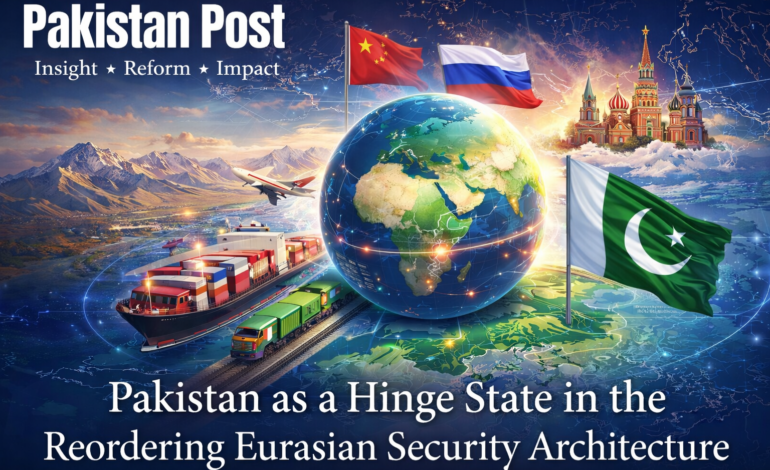
Pakistan as a Hinge State in the Reordering Eurasian Security Architecture

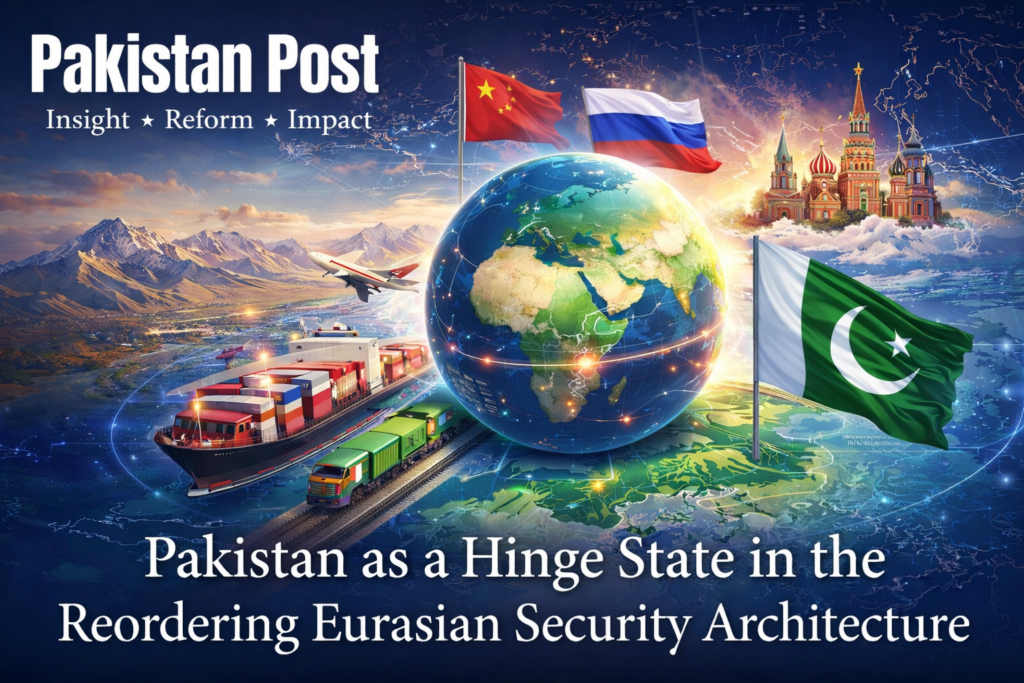
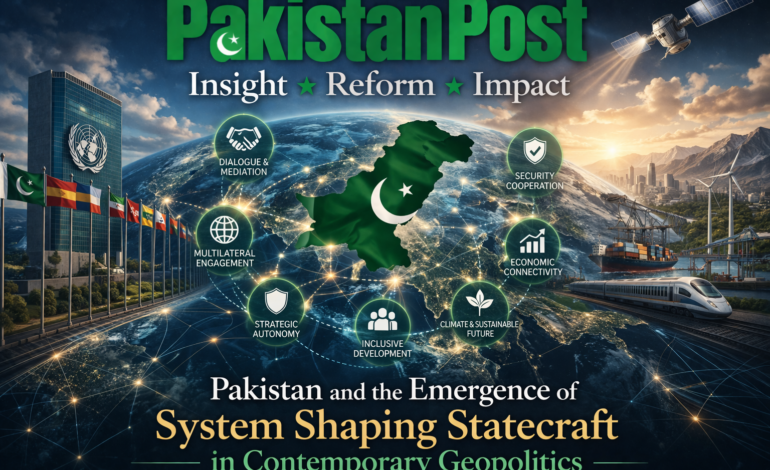
The geopolitical identity of the Islamic Republic of Pakistan is undergoing a subtle but consequential redefinition. Once treated largely as a buffer zone between competing great powers and regional blocs, it is increasingly being interpreted by strategists as a “hinge state” embedded within the shifting tectonics of Eurasian security. This is not a rhetorical upgrade but a structural repositioning shaped by three simultaneous pressures: the volatility of the Gulf security environment, the westward expansion of China’s connectivity and influence architecture through China’s Belt and Road ecosystem, and the recalibration of United States strategic priorities toward Indo-Pacific competition with United States.
What distinguishes a buffer from a hinge is agency. A buffer absorbs pressure; a hinge transmits, redirects, and in some cases modulates it. The question now being asked in diplomatic and strategic circles is whether Pakistan is quietly shifting from the former role to the latter, and whether this shift is intentional, sustainable, or structurally imposed by geography and circumstance.
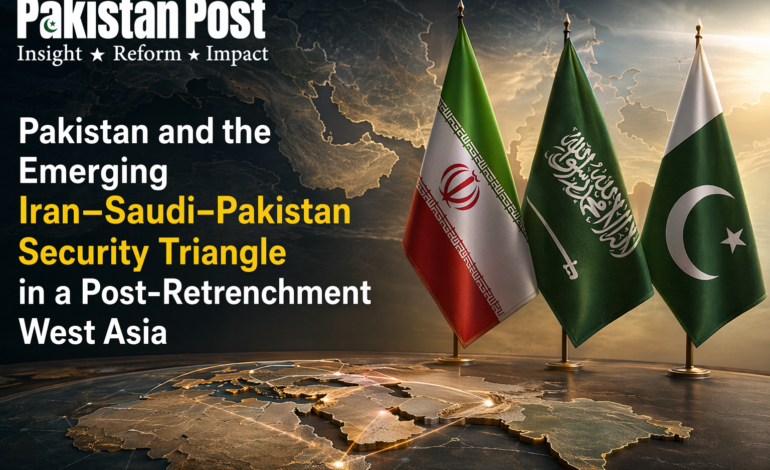
The Gulf region remains the first vector of this transformation. The strategic landscape stretching from the Strait of Hormuz to the Arabian Sea is no longer governed by stable deterrence patterns. Instead, it is defined by intermittent escalation cycles involving Iran, Saudi Arabia, and a shifting set of external guarantors. In this environment, Pakistan’s geographic proximity to the Gulf is no longer a passive attribute. It is becoming an operational factor in maritime security calculations, energy route diversification, and crisis mediation frameworks.
Historically, Pakistan’s relationship with Gulf monarchies has been anchored in labor flows, remittances, and security cooperation. However, the current phase introduces a more complex layer: diplomatic brokerage and de-escalatory signaling in moments of heightened tension. While Islamabad does not possess the hard power capacity to enforce regional outcomes, its value is increasingly derived from its ability to remain simultaneously engaged with multiple competing actors without full alignment to any single pole. This positioning gives Pakistan a limited but non-trivial role in crisis moderation dynamics, particularly in scenarios where communication channels between rival Gulf states become constrained.
Parallel to this, China’s westward strategic expansion under the Belt and Road Initiative has further embedded Pakistan into a continental connectivity logic that extends well beyond bilateral infrastructure projects. The China–Pakistan Economic Corridor has evolved from a transport and energy initiative into a broader strategic corridor linking western China to the Arabian Sea. This creates a geographic continuity that integrates Pakistan into China’s energy security and trade resilience planning. For Beijing, access to warm-water maritime routes through Pakistan reduces vulnerability to maritime chokepoints dominated by US-aligned naval forces.
Yet this integration is not purely economic. It introduces a security dimension that increasingly overlaps with maritime surveillance, port security, and dual-use infrastructure development. The port of Gwadar, while officially commercial, is frequently discussed in strategic literature as a potential node in a wider maritime awareness and logistics network. Whether or not this fully materializes, the perception of such a trajectory itself reshapes regional calculations, particularly in New Delhi and Washington.
The Indo-Pacific framework, driven largely by the United States and its regional partners, adds a third layer of complexity. As Washington recalibrates its global posture, prioritizing maritime containment strategies and technological competition with China, South Asia is no longer viewed in isolation but as part of a broader Indo-Pacific continuum. In this continuum, Pakistan’s geographic alignment with China introduces strategic ambiguity into US regional planning. However, this does not translate into simple alignment or antagonism. Instead, it produces a triangular tension where Pakistan must continuously manage perceptions, avoid over-dependence, and maintain diplomatic elasticity.
India, meanwhile, remains the primary reference point in South Asian strategic equilibrium. The security competition between Pakistan and India continues to define deterrence postures, military modernization trajectories, and crisis behavior patterns. However, even this bilateral dynamic is now embedded within a wider multi-theater system where external alignments, technology transfers, and cyber capabilities increasingly influence escalation thresholds.
The key analytical shift lies in understanding that Pakistan’s strategic value is no longer defined solely by its rivalry with India or its alignment with China. Instead, it is defined by its positionality at the intersection of three overlapping systems: Gulf security instability, Eurasian connectivity expansion, and Indo-Pacific strategic competition. This intersection produces both opportunity and constraint.
On the opportunity side, Pakistan gains diplomatic relevance disproportionate to its economic constraints. Its participation in regional dialogues, crisis communications, and transit-oriented initiatives gives it visibility in forums where it would otherwise be marginal. The logic of connectivity enhances its relevance as a transit geography linking landlocked Central Asia, western China, and maritime trade routes extending into the Middle East.
However, the constraint side is equally significant. Structural dependence on external financing, energy imports, and security assistance limits Pakistan’s ability to convert geographic advantage into autonomous strategic leverage. This creates a persistent gap between perceived importance and actual capacity. In strategic terms, Pakistan is more central than it is powerful, and more connected than it is autonomous.
This asymmetry is particularly visible in economic statecraft. The promise of regional connectivity has not yet fully translated into sustained industrial upgrading or export diversification. As a result, Pakistan’s role as a corridor state risks becoming extractive rather than transformative, where transit value accrues to external partners more than domestic economic restructuring.
At the security level, the increasing convergence of conventional, cyber, and informational domains has introduced new forms of vulnerability. Hybrid conflict dynamics mean that strategic pressure no longer manifests only through military confrontation but also through economic coercion, narrative warfare, and infrastructure disruption. In this environment, Pakistan’s institutional capacity to manage multi-domain threats remains uneven, despite significant improvements in counterterrorism and internal security frameworks.
The broader Eurasian security architecture itself is in flux. The erosion of unipolar stability, the fragmentation of regional orders, and the rise of issue-based alignments have created a system in which middle powers and geographically pivotal states acquire disproportionate significance. Pakistan fits this category, but with a critical distinction: its internal political and economic volatility introduces uncertainty into external strategic calculations.
This uncertainty is both a liability and a form of leverage. It compels external actors to engage continuously rather than episodically, while also limiting Pakistan’s ability to act as a predictable node within larger systems. In classical geopolitical terms, unpredictability reduces reliability but can increase relevance.
The deeper question is whether Pakistan can institutionalize its emerging “hinge” role or whether it will remain a reactive geography shaped by external pressures. Institutionalization would require sustained economic stabilization, energy security diversification, and a coherent foreign policy doctrine that balances relations across competing blocs without overexposure to any single dependency.
Absent this, the hinge may remain functional but unstable, transmitting regional pressures without effectively shaping their outcomes. In such a scenario, Pakistan’s strategic centrality would persist, but its ability to convert centrality into influence would remain constrained.
Ultimately, the transformation from buffer to hinge is not a completed transition but an ongoing negotiation between geography and agency. The Eurasian security system is still forming, not settled. In this fluid environment, Pakistan occupies a space that is at once structurally important and strategically contested.
Whether this space becomes a platform for influence or a corridor of vulnerability will depend less on geography than on governance, less on alignment than on adaptability, and less on position than on capacity to convert position into durable strategic outcomes.
A Public Service Message