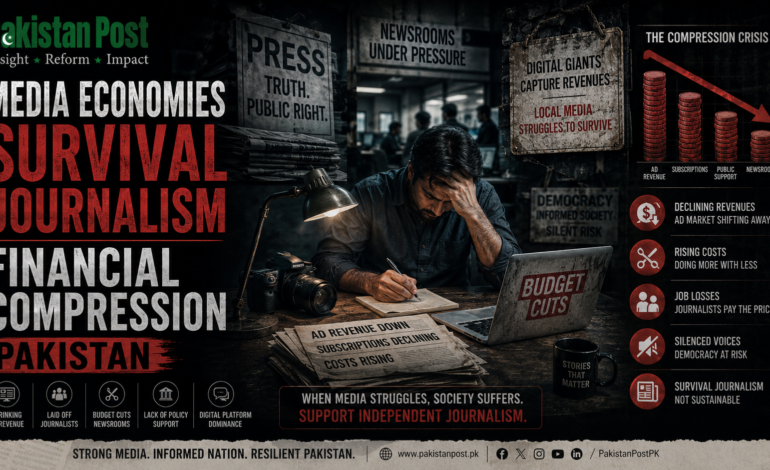
Media Economies Survival Journalism Financial Compression Pakistan


Pakistan’s media economy is entering a phase of structural contraction that is reshaping journalism from a public interest institution into a survival driven enterprise. The classical economic model of news production, historically sustained through advertising revenues, institutional subscriptions, and cross subsidised broadcast financing, has been progressively destabilised by digital platform dominance, political pressure cycles, and macroeconomic fragility. What is emerging in its place is not a recalibrated media market but a compressed informational economy in which editorial decision making is increasingly subordinated to financial survival logic.
This transformation is neither sudden nor accidental. It is the cumulative outcome of declining print circulation, the migration of audiences to algorithmically governed digital platforms, and the erosion of predictable advertising ecosystems. Corporate advertisers now allocate budgets based on platform analytics rather than editorial credibility, while digital intermediaries capture disproportionate value from content distribution without assuming responsibility for content production costs. The structural imbalance has left traditional news organisations exposed to revenue volatility and strategic dependence.
Within this constrained environment, newsroom downsizing has become a systemic feature rather than an episodic adjustment. Editorial departments that once maintained investigative units, foreign correspondents, and specialised reporting desks are now increasingly operating with reduced staff, multi role assignments, and accelerated production cycles. The result is a gradual dilution of journalistic depth, particularly in areas requiring sustained inquiry such as governance accountability, financial oversight, and geopolitical reporting.
Investigative journalism, which traditionally functions as the watchdog mechanism of democratic accountability, is among the most affected segments. Its cost intensive nature, extended timelines, and legal exposure risks render it economically unattractive in a compressed media economy. Consequently, editorial priorities are shifting toward high frequency, low cost, engagement optimised content formats, including opinion driven commentary, short form digital reporting, and reactive news cycles. This shift represents not merely a stylistic change but a structural redefinition of journalistic purpose.
The rise of survival journalism has also altered the ethical and operational frameworks within news organisations. Financial insecurity introduces subtle but persistent pressures on editorial independence, whether through advertising influence, political signalling, or ownership aligned constraints. In environments where revenue streams are unstable, the boundaries between editorial autonomy and institutional survival become increasingly blurred. This creates a risk landscape in which content prioritisation may reflect financial necessity rather than public interest value.
Digital platform dependency further intensifies this structural vulnerability. As audience attention migrates to global platforms, domestic media organisations become reliant on algorithmic distribution systems that are externally governed and opaque in their operational logic. Visibility is no longer determined primarily by editorial judgement but by platform engagement metrics, which privilege sensationalism, emotional intensity, and rapid consumption formats. This structural incentive reshapes content production patterns, often at the expense of analytical depth and investigative rigour.
In Pakistan’s specific context, these dynamics intersect with political economy constraints that further complicate media sustainability. Advertising markets are not only shrinking but are also increasingly concentrated, creating asymmetrical dependencies between large media groups and major advertisers. Political influence, both direct and indirect, continues to shape the operational space of media organisations, particularly in relation to sensitive policy reporting, institutional critique, and geopolitical coverage. The combined effect is a narrowing of editorial space within which independent journalism can operate.
The geopolitical dimension adds an additional layer of complexity. In environments marked by regional tension, border sensitivities, and strategic competition narratives, media organisations often find themselves operating under heightened scrutiny. This can result in self censorship tendencies, risk avoidance behaviour, and editorial caution that further reduces investigative ambition. The informational environment thus becomes not only economically constrained but also strategically sensitive, shaping the boundaries of permissible discourse.
At the same time, the digital content economy has introduced new actors into the journalistic ecosystem. Independent content creators, monetised commentators, and platform native news aggregators now compete directly with traditional media institutions for audience attention. While this diversification has expanded informational access, it has also fragmented revenue streams and undermined the monopolistic position once held by legacy media organisations. The absence of uniform editorial standards across this expanded ecosystem further complicates public trust formation.
The cumulative effect of these pressures is the emergence of a dual layered media economy. At the top layer, a small number of large media conglomerates attempt to maintain institutional presence through hybrid funding models, including advertising, digital monetisation, and selective institutional support. At the bottom layer, a fragmented ecosystem of small outlets, freelance journalists, and digital creators operates under conditions of financial precarity, often relying on episodic funding, platform monetisation, or informal revenue channels. This stratification reflects deepening inequality within the media sector itself.
The consequences for information quality are increasingly visible. Reduced newsroom capacity limits fact checking depth, accelerates publication cycles, and increases reliance on secondary sources. This, in turn, raises the risk of informational inaccuracies, contextual simplification, and narrative distortion. In investigative domains, where verification requires time and resource investment, the decline in capacity is particularly consequential. Public accountability functions of journalism are therefore weakened not through censorship alone but through structural underfunding.
From an institutional perspective, this trajectory raises significant governance concerns. A weakened media ecosystem reduces the state’s capacity to rely on independent informational intermediaries for policy feedback, crisis reporting, and public sentiment analysis. In the absence of robust journalistic institutions, informational asymmetry between state actors and society can widen, increasing the risk of miscommunication and policy misalignment. This is particularly critical in contexts involving economic reform, security policy, and external relations.
The challenge is further compounded by the fact that digital monetisation models do not adequately compensate for high quality journalism. Advertising revenue from digital platforms is heavily concentrated among a small number of global technology companies, leaving domestic media organisations with limited bargaining power. Subscription models, while emerging in some segments, remain constrained by low willingness to pay and fragmented audience markets. Philanthropic funding for journalism is minimal and lacks structural continuity. The result is a systemic funding gap in public interest journalism.
Addressing this requires a structural rethinking of media financing architecture. One potential approach involves the establishment of independent public interest journalism funds, insulated from political influence and governed through transparent multi stakeholder frameworks. Such funds could provide competitive grants for investigative reporting, crisis journalism, and public accountability projects. However, institutional design would be critical to prevent capture and ensure editorial independence.
Tax based incentives for journalism production represent another policy avenue. By recognising investigative reporting as a public good, states can provide fiscal relief or credits to media organisations engaged in verified public interest journalism. This would require clear definitional frameworks and independent accreditation mechanisms to avoid misuse.
Hybrid revenue models combining subscriptions, institutional funding, and limited advertising diversification may also offer partial stabilisation. However, such models require audience trust restoration, which itself depends on sustained editorial credibility and consistent informational quality. This creates a circular dependency between financial sustainability and trust capital.
At the institutional level, strengthening newsroom autonomy is essential. Ownership structures that concentrate editorial control in politically or economically aligned entities pose long term risks to journalistic independence. Regulatory frameworks that promote transparency in media ownership, financial disclosures, and editorial governance can contribute to restoring public confidence in media institutions.
Training and capacity building also require urgent attention. The transition to digital first journalism requires new skill sets in data journalism, multimedia reporting, investigative techniques, and verification protocols. Without systematic investment in human capital development, the quality gap between global and domestic journalism ecosystems will continue to widen.
Ultimately, the survival of journalism in Pakistan is not merely an industry concern but a governance issue. A financially weakened media ecosystem undermines transparency, reduces accountability mechanisms, and weakens democratic oversight functions. In strategic terms, journalism is not only a communicative function but an institutional pillar of informational stability.
The policy imperative is therefore to move beyond reactive measures and toward structural reconstruction of the media economy. This requires coordinated interventions across regulatory frameworks, financial systems, institutional governance, and digital platform accountability. Without such intervention, the trajectory of survival journalism will continue, gradually eroding the depth, independence, and credibility of the informational ecosystem.
The central risk is not the disappearance of media, but its transformation into a financially constrained, politically cautious, and structurally fragile system incapable of sustaining robust investigative functions. In such a scenario, the public sphere becomes informationally thinner, governance feedback loops weaken, and societal trust in mediated information continues to erode.
The strategic objective must therefore be the restoration of media as a viable public interest institution within a radically transformed digital economy. This requires not nostalgia for legacy models, but adaptive institutional innovation capable of reconciling financial sustainability with editorial independence in an increasingly complex informational age.
A Public Service Message