

Quantum Computing Reshapes Global Power Through Strategic Technological Competition

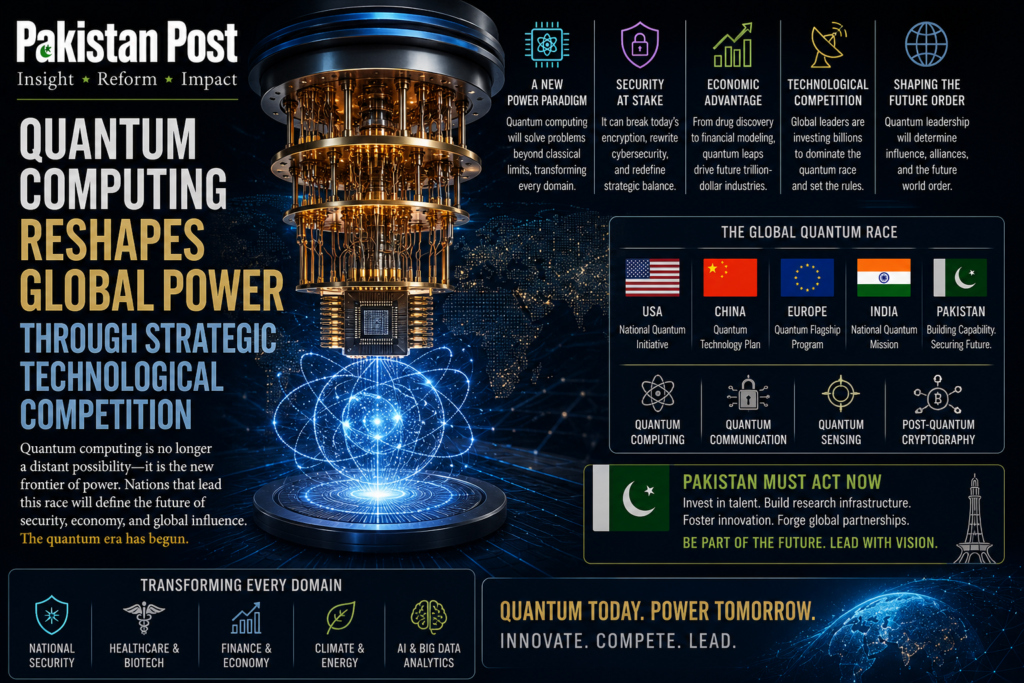
Quantum computing is rapidly evolving from a laboratory pursuit into one of the defining strategic technologies of the twenty first century. While practical fault tolerant quantum computers remain under development, governments and multinational corporations increasingly regard quantum technologies as essential components of future economic competitiveness, national security, scientific leadership and industrial resilience. Unlike previous waves of digital transformation driven primarily by software innovation, the quantum revolution combines advanced physics, mathematics, semiconductor engineering, cybersecurity, artificial intelligence, telecommunications and precision manufacturing into a highly integrated technological ecosystem. The nations that successfully develop this ecosystem are expected to shape future standards in computing, secure communications, defence innovation and scientific discovery, thereby influencing the global balance of technological power.
The international race for quantum leadership extends far beyond building increasingly powerful quantum processors. It encompasses the creation of research institutions, specialised educational systems, venture capital ecosystems, semiconductor capabilities, intellectual property portfolios, industrial partnerships and national security frameworks capable of sustaining technological leadership over several decades. According to the Organisation for Economic Co operation and Development, quantum technologies have become a strategic priority because they promise transformational advances across finance, pharmaceuticals, logistics, climate modelling, materials science, healthcare, manufacturing and national defence. The World Intellectual Property Organization has similarly documented accelerating patent activity related to quantum computing, quantum communication and quantum sensing, reflecting growing commercial confidence in the technology’s long term potential.
The United States continues to maintain one of the world’s most comprehensive quantum innovation ecosystems. The National Quantum Initiative Act established a coordinated national framework linking federal agencies, research laboratories, universities and private industry. Significant funding supports research conducted through institutions such as the Department of Energy, the National Science Foundation and the National Institute of Standards and Technology. Major technology companies including IBM, Google, Microsoft, Amazon and Intel have invested billions of dollars in quantum hardware, cloud based quantum services and quantum software development. Venture capital investment has further accelerated commercial innovation by supporting specialised startups working on superconducting qubits, trapped ion systems, quantum networking and quantum algorithms. This combination of government policy, industrial capability and academic excellence has enabled the United States to remain at the forefront of quantum research while strengthening broader technological competitiveness.
China has adopted an equally ambitious but centrally coordinated strategy. Quantum technology has been incorporated into successive national science and technology plans, supported by extensive public investment and state backed research institutions. Chinese researchers have achieved internationally recognised milestones in quantum communication, including satellite based quantum key distribution and long distance quantum networks. The country’s investment in the National Laboratory for Quantum Information Sciences illustrates its determination to reduce technological dependence while expanding indigenous scientific capability. China’s strategy integrates civilian research with broader industrial and national security objectives, reflecting an understanding that quantum technologies may significantly influence future geopolitical competition.
The European Union has adopted a collaborative model through the Quantum Flagship programme, bringing together universities, research organisations and industrial partners across multiple member states. This long term initiative supports quantum computing, quantum communication, quantum simulation and quantum sensing while promoting cross border scientific collaboration. European policymakers increasingly recognise that technological sovereignty requires reducing strategic dependence on external suppliers in critical technologies. Complementary national programmes in Germany, France and the Netherlands reinforce this continental strategy by investing heavily in semiconductor research, advanced manufacturing and specialised workforce development.
Canada occupies a distinctive position due to decades of sustained investment in quantum science. Institutions such as the University of Waterloo and the Institute for Quantum Computing have established international reputations for excellence in quantum information research. Canadian companies including D Wave Systems, Xanadu and Photonic have emerged as globally recognised innovators in quantum hardware and photonic quantum computing. This experience demonstrates how sustained academic investment combined with targeted commercialisation policies can generate internationally competitive technology sectors even within middle sized economies.
The United Kingdom has similarly pursued an integrated national approach through its National Quantum Technologies Programme. Government investment has supported research hubs, industrial partnerships and commercialisation initiatives linking universities with private industry. Japan continues to leverage its established strengths in electronics, precision manufacturing and semiconductor technologies to advance quantum hardware development while integrating quantum research into broader industrial policy. Australia has achieved international recognition through pioneering research in silicon based quantum computing and quantum control technologies, supported by strong university research programmes and collaboration with industry.
India has significantly expanded its ambitions through the National Quantum Mission, recognising that quantum technologies will shape future scientific and economic competitiveness. Investments focus on quantum communication, quantum computing, quantum sensing and human capital development while encouraging collaboration between government laboratories, universities and emerging technology companies. Singapore has likewise established itself as an important regional innovation centre by combining advanced research funding with international scientific collaboration and strategic investment in digital infrastructure. Meanwhile, Gulf economies including Saudi Arabia, the United Arab Emirates and Qatar increasingly view quantum technologies as components of broader economic diversification strategies designed to reduce long term dependence on hydrocarbon revenues while expanding knowledge based industries.
This global competition illustrates that quantum leadership depends less on isolated scientific breakthroughs than on comprehensive national innovation systems. Research excellence must be supported by venture capital, intellectual property protection, specialised manufacturing capability, skilled human resources, industrial partnerships and long term policy continuity. Countries that integrate these components effectively are more likely to convert scientific discovery into sustained economic and strategic advantage.
Cybersecurity represents perhaps the most immediate strategic concern associated with quantum computing. Modern digital economies rely extensively on public key cryptographic systems that protect banking transactions, government communications, military information systems, healthcare records, cloud computing and electronic commerce. Many widely used encryption algorithms derive their security from mathematical problems that are computationally infeasible for classical computers to solve within practical timeframes. Large scale fault tolerant quantum computers could fundamentally alter this assumption by enabling algorithms capable of solving certain mathematical problems exponentially faster than existing supercomputers.
Although such quantum computers remain under development, governments increasingly recognise the urgency of preparing for future cryptographic disruption. The United States National Institute of Standards and Technology has led an extensive international process to standardise post quantum cryptographic algorithms designed to resist attacks from both classical and quantum computers. Governments, financial institutions and technology companies have begun planning complex migration strategies because replacing cryptographic infrastructure across national economies requires many years of coordinated implementation. The European Union, the United Kingdom, Australia, Japan and numerous other advanced economies have launched complementary initiatives supporting quantum resistant cybersecurity frameworks and secure digital infrastructure.
Quantum key distribution represents another promising area of development by enabling theoretically secure communication through principles of quantum mechanics. China has demonstrated extensive quantum communication networks, while European and Asian research programmes continue exploring secure satellite based quantum communication for governmental and strategic applications. Although widespread commercial deployment remains technically challenging and financially demanding, quantum communication increasingly forms part of broader national cybersecurity strategies intended to protect critical infrastructure against future technological threats.
Beyond cybersecurity, quantum technologies promise transformational applications across numerous sectors. Pharmaceutical companies anticipate accelerated drug discovery through quantum simulation of complex molecular interactions. Financial institutions expect improvements in portfolio optimisation, risk analysis and fraud detection. Logistics companies foresee enhanced optimisation of transportation networks, warehouse management and supply chain planning. Manufacturers anticipate more efficient materials design, industrial optimisation and predictive maintenance. Artificial intelligence researchers increasingly investigate how quantum algorithms may complement machine learning by improving optimisation, pattern recognition and computational efficiency for specialised applications.
Nevertheless, practical implementation remains constrained by substantial engineering challenges. Quantum systems require exceptionally stable operating environments, advanced error correction techniques and specialised semiconductor fabrication capabilities. Most existing quantum computers remain relatively small, susceptible to environmental interference and unsuitable for large scale commercial deployment. Consequently, international competition increasingly focuses not solely on immediate commercial returns but on establishing long term research ecosystems capable of overcoming these technical barriers through sustained scientific investment.
International patent filings and scientific publications demonstrate accelerating global activity. WIPO reports steady growth in quantum related intellectual property across computing, communication and sensing technologies. The OECD similarly documents increasing public investment among advanced economies while emphasising the importance of interdisciplinary collaboration involving physics, computer science, mathematics, engineering and materials science. Universities remain central to this ecosystem because quantum innovation requires highly specialised scientific expertise developed over many years of advanced education and research.
Talent has consequently become one of the most strategically valuable resources in the global quantum economy. Competition increasingly extends beyond laboratories into educational systems capable of producing physicists, engineers, mathematicians, computer scientists and cybersecurity specialists with advanced quantum expertise. Leading universities collaborate extensively with industry to ensure research addresses commercial challenges while creating opportunities for technology transfer and startup formation. Countries unable to develop sufficient domestic talent risk increased dependence on foreign technologies and diminished influence over future technological standards.
Export controls have emerged as another defining feature of the international quantum landscape. Several advanced economies have introduced restrictions affecting quantum technologies considered strategically sensitive. These measures reflect growing recognition that quantum computing possesses both civilian and military applications, making it a component of broader technological competition involving semiconductors, artificial intelligence, advanced manufacturing and secure communications. Strategic technology alliances increasingly seek to strengthen trusted supply chains while reducing vulnerabilities associated with excessive technological dependence.
For Pakistan, the emerging quantum era presents both significant challenges and meaningful opportunities. The country currently lacks extensive quantum research infrastructure, specialised semiconductor manufacturing capability and large scale commercial investment in advanced quantum technologies. Research activity remains concentrated within limited academic institutions, while industrial research and development expenditure remains comparatively low by international standards. University industry collaboration, technology transfer mechanisms and venture capital ecosystems require substantial strengthening to support advanced scientific innovation.
However, Pakistan need not attempt immediate competition in quantum hardware manufacturing. Such an objective would require enormous financial resources, sophisticated semiconductor ecosystems and decades of accumulated industrial expertise. A more realistic and economically sustainable strategy involves developing specialised capabilities within selected areas of the broader quantum value chain where barriers to entry remain comparatively lower.
Higher education should become the foundation of this strategy. Universities should strengthen programmes in physics, mathematics, computer science, electrical engineering, cybersecurity and semiconductor related disciplines while introducing specialised coursework in quantum information science. International academic partnerships with leading research institutions could facilitate faculty development, collaborative research and student exchange programmes. Government scholarships supporting advanced doctoral education in quantum related disciplines would gradually expand national scientific capacity.
Applied research offers another practical avenue for participation. Pakistani researchers could contribute to quantum algorithms, quantum software development, cryptographic research, optimisation techniques and quantum enabled cybersecurity applications without requiring immediate access to expensive quantum hardware. Cloud based quantum computing platforms increasingly allow researchers worldwide to experiment with quantum programming, algorithm development and computational modelling using remotely accessible quantum processors.
The country’s growing information technology sector provides additional opportunities. Software companies could develop expertise in quantum programming frameworks, hybrid quantum classical computing applications and post quantum cybersecurity solutions. Such capabilities would complement Pakistan’s expanding digital economy while creating opportunities to integrate into global technology supply chains. International technology companies increasingly seek skilled software developers capable of contributing to emerging quantum applications, presenting potential employment and export opportunities.
Public policy will play a decisive role in determining whether these opportunities are realised. A national quantum strategy should align educational reform, research funding, industrial innovation and cybersecurity planning within a coherent long term framework. Such a strategy need not involve exceptionally large financial commitments initially. Rather, it should prioritise carefully selected investments capable of generating cumulative scientific capability over time. Competitive research grants, university centres of excellence, public private partnerships and targeted international collaborations can produce substantial long term benefits when supported by consistent policy implementation.
Cybersecurity preparation deserves immediate attention. Government agencies responsible for digital governance, financial regulation, telecommunications and defence should begin evaluating migration pathways toward post quantum cryptography consistent with evolving international standards. Early planning will reduce future transition costs while strengthening resilience against emerging technological threats. Financial institutions, healthcare providers and operators of critical infrastructure should similarly assess long term cryptographic vulnerabilities within their digital systems.
Regional and international scientific cooperation will remain essential because quantum innovation increasingly depends upon collaborative research crossing national boundaries. Participation in multilateral scientific programmes, international conferences and collaborative research networks can significantly enhance domestic expertise while reducing technological isolation. Partnerships with universities and research institutions across Europe, North America, East Asia and the Middle East could facilitate knowledge transfer, joint publications and collaborative innovation benefiting all participants.
Ethical governance should accompany technological development. International organisations increasingly emphasise responsible innovation, transparency, research integrity and equitable access as quantum technologies mature. Regulatory frameworks must balance scientific progress with cybersecurity, privacy protection, intellectual property rights and international security considerations. Pakistan should actively participate in emerging international discussions concerning standards, governance and responsible technological development to ensure its interests are represented within evolving global regulatory frameworks.
The quantum revolution is unlikely to produce immediate economic transformation, but its long term implications may prove comparable to the emergence of the internet, artificial intelligence or semiconductor technologies. Countries that invest consistently in scientific capability, educational excellence, industrial collaboration and strategic planning today will likely shape tomorrow’s technological landscape. Those that delay risk widening technological dependence, reduced industrial competitiveness and diminished strategic autonomy.
For Pakistan, success will depend not upon attempting to replicate the scale of investment undertaken by larger economies but upon adopting a disciplined strategy focused on human capital, research excellence, digital resilience and carefully selected areas of comparative advantage. By integrating quantum technologies into broader national objectives encompassing education, cybersecurity, industrial innovation, advanced computing, international cooperation and digital transformation, Pakistan can gradually establish meaningful participation within the emerging global quantum economy. Such an approach would strengthen technological sovereignty, support sustainable economic development and enhance national security while positioning the country to benefit from one of the most consequential technological transitions of the twenty first century.
A Public Service Message