The Hormuz Exposure Tests Pakistan’s Energy Contingency Architecture

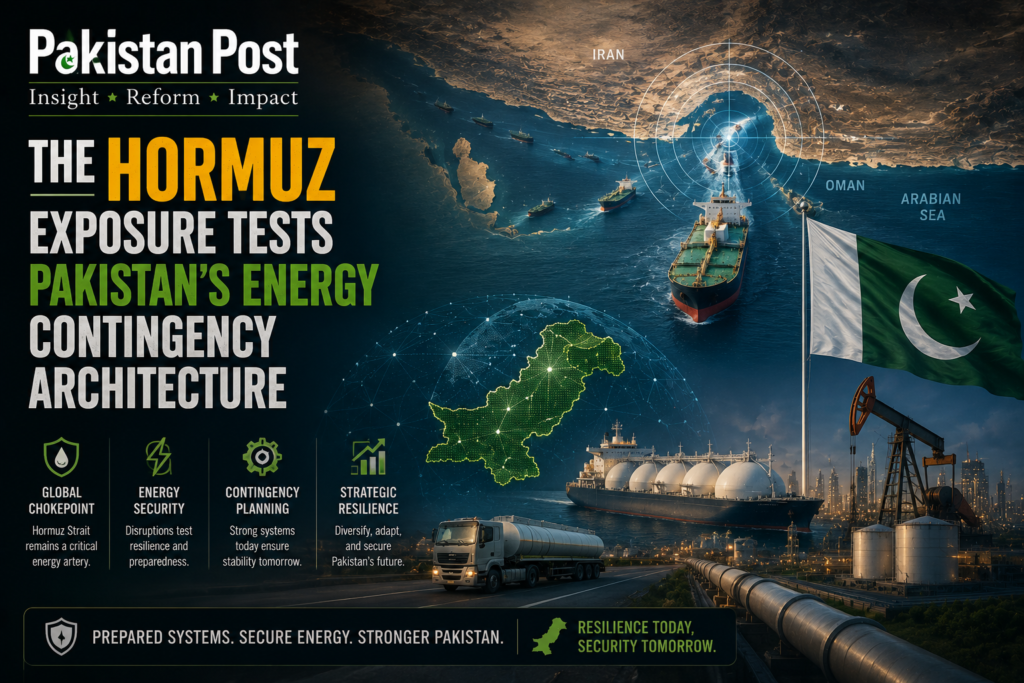
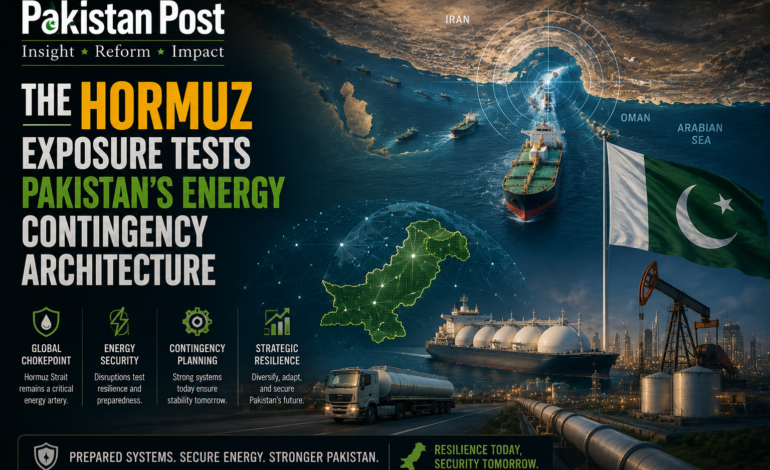
Pak Post views the Strait of Hormuz not as a distant maritime vulnerability but as a live stress test of Pakistan’s national economic security architecture. The disruption experienced during 2026 has already demonstrated how quickly a maritime chokepoint can migrate from naval geography into the domestic price system, foreign exchange market, transport network, electricity supply chain and political economy of a petroleum importing state. The Strait carried about 20.9 million barrels a day of oil in the first half of 2025, equivalent to roughly one fifth of global petroleum liquids consumption and more than one quarter of seaborne oil trade. During the first quarter of 2026, flows fell to 14.6 million barrels a day as disruption intensified. (U.S. Energy Information Administration) For Pakistan, the significance lies not merely in the quantity of hydrocarbons moving through the passage, but in the concentration of suppliers, shipping routes, refinery requirements, foreign currency payments and inventory arrangements that converge upon Karachi.
The central policy question is therefore not whether Pakistan can survive a temporary increase in crude prices. It is whether the state can preserve physical fuel availability, refinery continuity, foreign exchange liquidity and strategic mobility if maritime disruption persists for several weeks or develops into a prolonged regional contingency. The distinction is fundamental. A price shock can be absorbed through taxation, fiscal adjustment, inventory drawdown or temporary consumer relief. A physical supply interruption cannot be solved by administrative price controls. It requires cargo substitution, alternative suppliers, secure shipping, insurance capacity, refinery flexibility, inventory management and a command structure capable of making decisions before commercial inventories become critical.
Pakistan entered the present period with a petroleum system already characterised by substantial import dependence. The Pakistan Economic Survey 2025 to 26 records petroleum product demand rising by 3.5 percent during July to March, with transport accounting for 82.5 percent of total petroleum demand. Petroleum imports reached 13.64 million tonnes during the same period, compared with 13.17 million tonnes a year earlier. (Finance Division) This concentration creates a transmission mechanism that is unusually direct. A disruption at sea raises crude and product prices, increases freight and war risk premiums, enlarges the rupee cost of each cargo, raises the working capital requirement of importers and ultimately feeds into petrol, diesel, aviation fuel, electricity generation and the cost of moving goods.
The vulnerability is intensified by the structure of Pakistan’s geography. Imported crude and petroleum products arrive through maritime infrastructure centred on the Karachi region before moving through pipelines, storage depots, road transport and distribution networks into the national market. The country therefore possesses multiple layers of logistical dependence rather than one isolated exposure. A tanker delayed offshore can become a refinery scheduling problem. A refinery scheduling problem can become an oil marketing company inventory problem. An inventory problem can become a retail shortage. A retail shortage can become an inflationary episode with consequences far beyond the petroleum sector.
The experience of 2026 offers a warning precisely because the global market has demonstrated both scarcity and volatility. The United States Energy Information Administration reported that Brent crude reached $118 a barrel on April 29, 2026, before falling sharply as expectations of restored maritime flows increased. Daily price movements during April and May were approximately four times larger than in the corresponding months of 2025. (U.S. Energy Information Administration) Such volatility is particularly dangerous for Pakistan because the problem is not simply the average international price. Importers must finance cargoes at the moment of purchase, while domestic pricing, taxation and consumer affordability operate with different political and administrative timeframes. A sudden widening of the landed cost therefore creates a liquidity requirement before the corresponding domestic revenue adjustment has fully materialised.
Insurance constitutes another underappreciated transmission channel. When insurers classify a maritime corridor as a heightened war risk zone, the cost of transporting a cargo can rise even when the underlying commodity price is temporarily stable. Freight rates can simultaneously increase as shipowners demand compensation for longer routes, waiting time, security arrangements and heightened operational risk. Pakistan’s vulnerability therefore needs to be measured through landed cost rather than benchmark crude alone. The Ministry of Finance itself recognised during the 2026 disruption that freight, insurance costs, shipping routes and global petroleum prices had to be monitored alongside domestic stocks and import arrangements. (Finance Division)
This requires a fundamental change in the country’s energy dashboard. The state should stop treating crude price, petroleum stocks and import volumes as separate indicators. A national exposure model should combine crude availability, refined product stocks, tanker position, estimated arrival time, insurance premium, freight rate, supplier concentration, refinery utilisation, foreign exchange exposure and domestic consumption into one operational index. The dashboard should be updated daily during normal periods and continuously during a declared energy contingency. It should be accessible to the Petroleum Division, Finance Division, State Bank of Pakistan, Oil and Gas Regulatory Authority, Pakistan State Oil, Pakistan National Shipping Corporation, refineries, relevant maritime authorities and national security institutions through a controlled information architecture.
Inventory policy deserves equally serious reconsideration. Pakistan’s recent experience demonstrates that days of cover can provide temporary protection but cannot substitute for a strategic reserve system. In March 2026, government monitoring indicated diesel stocks of approximately 24 to 25 days of cover and crude stocks around 12 days, with additional cargoes being secured. (Finance Division) Those figures may be adequate for routine commercial management, but they should not automatically be interpreted as strategic resilience. Twelve days of crude cover is not equivalent to twelve days of national energy security when a refinery requires specific grades, tank capacity is finite, replenishment depends upon maritime arrival and product demand varies by geography and season.
Pakistan should therefore establish differentiated strategic inventory targets rather than one aggregate stock requirement. Crude oil should have a protected minimum reserve based on refinery configuration and import lead time. Petrol and diesel should have separate emergency thresholds because their strategic functions differ. Aviation fuel should be treated as a critical infrastructure reserve because aviation continuity has national security implications. LPG should receive its own contingency calculation because interruptions affect households and commercial users differently from liquid fuels.
The reserve itself should not remain a purely governmental asset. A strategic petroleum reserve can be designed through a hybrid system in which the state defines minimum physical inventories, oil marketing companies maintain mandated commercial buffers and selected private storage facilities become contractually available during emergencies. Strategic stocks could be financed through a modest levy during normal market conditions, supplemented by a revolving contingency facility. The principle should be that emergency inventory is an insurance instrument, not an annual fiscal burden to be repeatedly sacrificed when budgetary pressures intensify.
Refinery resilience is another critical weakness. Pakistan’s refineries cannot be assessed solely by installed capacity. Their strategic value depends upon crude compatibility, conversion capability, maintenance schedules, storage arrangements and the product mix required by the domestic market. During a Hormuz disruption, substituting one crude source for another may appear commercially straightforward but can produce technical constraints if the alternative grade is materially different. The state should therefore require each refinery to maintain a tested emergency crude substitution matrix identifying which alternative grades can be processed, at what throughput, with what yield consequences and under which technical conditions.
Supplier diversification should similarly move beyond diplomatic declarations. Pakistan should establish a procurement portfolio that assigns target shares to different geographical sources and grades, including Gulf suppliers and non Gulf alternatives where economically and technically feasible. Diversification should be evaluated through delivered cost, refinery compatibility, shipping duration, payment terms, sanctions exposure, insurance availability and reliability during regional crises. A cheaper cargo that cannot be insured or delivered during a contingency is not a resilient cargo.
Alternative maritime arrangements also require a more sophisticated approach. The assumption that Pakistan can simply replace Gulf cargoes with supplies from another region overlooks tanker availability, voyage duration, freight rates and port capacity. Longer voyages increase capital tied up in cargoes and reduce the number of vessels available for a given volume of trade. The government should therefore develop pre negotiated framework agreements with international suppliers, shipowners, insurers and trading houses that can be activated when Hormuz risk crosses predetermined thresholds. Such agreements should specify indicative volumes, vessel classes, delivery windows, payment mechanisms and emergency arbitration procedures.
Pakistan’s LNG exposure presents a parallel vulnerability. The Strait of Hormuz carried a substantial share of global LNG trade, principally associated with Qatari exports. (U.S. Energy Information Administration) Pakistan’s gas system is already exposed to LNG procurement, regasification availability, electricity demand and foreign currency requirements. A prolonged maritime disruption can therefore create a compound shock in which petroleum becomes expensive while LNG availability tightens, increasing pressure on domestic gas allocation and power generation. LNG procurement should consequently be integrated into the same national contingency framework as petroleum rather than managed through an isolated gas policy silo.
This is particularly important for electricity planning. Pakistan’s installed power system includes substantial thermal generation, while the Economic Survey records RLNG consumption of 613 million cubic feet per day during July to March FY2026. (Finance Division) If LNG cargoes are delayed or become prohibitively expensive, the electricity system must have an explicit substitution hierarchy. Domestic gas, coal, hydropower, nuclear generation, renewable capacity and demand reduction should be incorporated into a predetermined dispatch contingency rather than improvised after shortages emerge. The objective should be to protect essential services and productive industry while avoiding indiscriminate load management.
Foreign exchange management may ultimately prove more consequential than physical availability. A disruption that raises crude prices by tens of dollars a barrel simultaneously increases Pakistan’s import bill, current account pressure and demand for dollars. Even if cargoes remain technically obtainable, banks and importers may encounter tighter liquidity conditions. The State Bank should therefore establish an emergency petroleum import liquidity window with clearly defined eligibility criteria, maturity limits and collateral arrangements. The facility should not become a permanent subsidy mechanism. Its purpose should be to prevent temporary maritime disruption from mutating into a self reinforcing foreign exchange crisis.
Domestic pricing policy must also be insulated from opportunistic responses. If international prices rise sharply, the government should publish a transparent contingency formula explaining how petroleum prices, taxes, freight, insurance and exchange rate movements will be incorporated. A stabilisation mechanism can smooth extreme short term volatility, but it should operate within a predetermined fiscal ceiling. Pakistan cannot protect consumers indefinitely by accumulating unfunded liabilities. Equally, abrupt pass through of every external shock can amplify inflation and undermine public confidence. The appropriate mechanism is bounded smoothing supported by explicit financing.
Demand management should become an operational component of energy security rather than a rhetorical appeal for conservation. During a declared contingency, the government should activate graduated measures covering official vehicle fleets, unnecessary public sector travel, commercial operating hours, freight efficiency, public transport incentives and electricity consumption. Large industrial consumers should receive incentives for temporary fuel substitution where technically feasible. Urban transport authorities should be prepared to expand mass transit capacity during severe petroleum constraints. Such measures should be temporary, targeted and measurable rather than blanket austerity directives.
Institutional responsibility must be equally precise. The Petroleum Division should remain the lead agency for physical fuel security. Finance should manage fiscal exposure and contingency financing. The State Bank should monitor foreign exchange liquidity and trade finance. OGRA should supervise market inventories, storage and distribution discipline. Maritime authorities should maintain visibility over tanker arrivals, port congestion and emergency routing. Refineries and oil marketing companies should submit standardised daily stock and cargo data. National security institutions should provide strategic assessment of maritime risks without displacing commercial procurement functions. The Cabinet level mechanism should adjudicate only issues that exceed predetermined operational thresholds.
The doctrine should operate through triggers. A moderate disruption should activate enhanced monitoring and accelerated procurement. A sustained reduction in expected cargo arrivals should trigger mandatory inventory accumulation and alternative sourcing. A critical threshold, defined by days of cover and confirmed cargo delays, should activate strategic stock release, emergency foreign exchange facilities and demand management. A severe contingency should permit controlled allocation of petroleum products to critical sectors, accompanied by transparent public communication. The objective is to move from reaction to graduated activation.
Pakistan should also exploit the period between crises to institutionalise exercises. A national Hormuz disruption simulation should be conducted annually, involving refineries, banks, oil marketing companies, ports, shipping interests, electricity producers and security agencies. The exercise should simulate a thirty day interruption, a sharp insurance premium increase, a doubling of freight rates, a major crude price escalation and simultaneous LNG disruption. Every participating institution should identify its decision point, authority, data requirement and financing constraint. The resulting gaps should be treated as national resilience deficiencies.
The deeper strategic lesson is that Pakistan cannot eliminate its exposure to Hormuz. Geography cannot be diversified away. What can be diversified is the consequence of that exposure. Resilience must therefore be constructed through inventory, supplier diversity, financial liquidity, refinery flexibility, shipping preparedness, demand management and institutional coordination. The country’s objective should not be autarky, which is economically unrealistic, but controlled vulnerability.
The 2026 disruption has already shown that global energy markets can adjust through rerouting, alternative production, inventory releases and demand destruction, but those adjustments do not arrive evenly across countries. EIA data indicate that alternative pipelines from Saudi Arabia and the United Arab Emirates can bypass part of the Hormuz flow, yet their combined capacity is only a fraction of the volumes normally transported through the strait. (U.S. Energy Information Administration) Pakistan has even less room for substitution because it lacks comparable domestic production and continental pipeline access to alternative crude sources.
The establishment should therefore regard petroleum resilience as a component of national defence, macroeconomic stability and economic sovereignty. A fuel shortage can immobilise transport, constrain agriculture, interrupt industrial production, weaken emergency services and intensify inflation simultaneously. The strategic petroleum reserve is consequently not merely an energy ministry asset. It is an economic security instrument.
Pakistan’s immediate priority should be to convert the lessons of the present disruption into a permanent national energy contingency doctrine. That doctrine should establish minimum days of cover, refinery specific crude substitution plans, diversified procurement quotas, emergency shipping agreements, insurance backstops, foreign exchange facilities, LNG substitution protocols, strategic stock release rules and legally assigned institutional responsibilities. A centralised digital command dashboard should provide decision makers with a common operational picture, while a protected contingency fund should ensure that financial constraints do not become the final bottleneck during an emergency.
The test of energy security is not whether Pakistan can purchase fuel when international markets are functioning normally. It is whether the state can continue to move its people, power its economy and protect its external account when the maritime assumptions underpinning ordinary commerce suddenly fail. Hormuz has exposed that question with unusual clarity. Pakistan now has the opportunity to treat the exposure as a recurring strategic condition rather than an exceptional crisis. The durable answer is not another emergency committee after the tanker queue forms. It is an institutional system designed to know, before the queue forms, how much fuel remains, where the next cargo is coming from, who will finance it, which refinery can process it, which vessel will carry it, what insurance will cost, which sectors receive priority and which authority has the legal power to act.
A Public Service Message