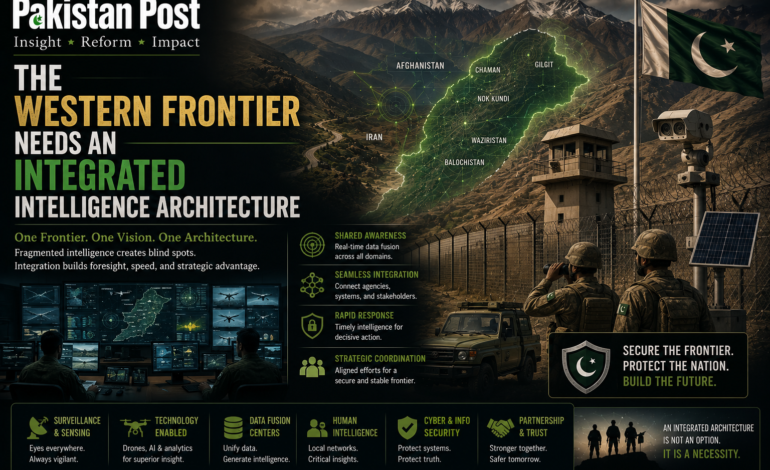
The Western Frontier Needs an Integrated Intelligence Architecture

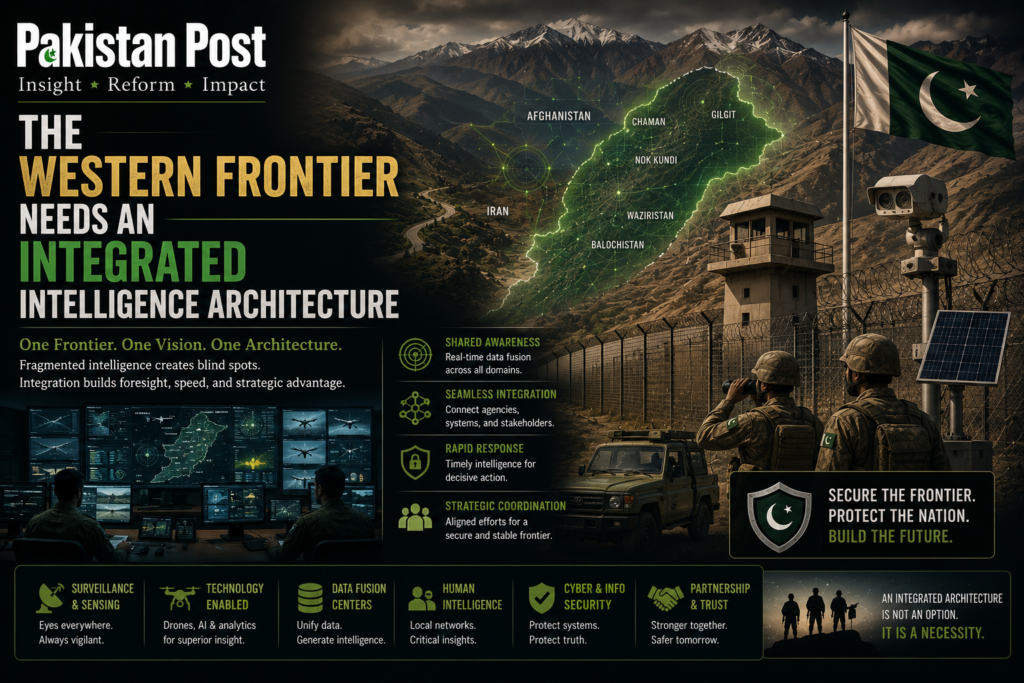
approaches Pakistan’s approach towards western frontier is not as a line on a map, but as a continuously moving security environment in which people, information, money, commodities, weapons and influence cross administrative jurisdictions with very different speeds and levels of scrutiny. The central policy question is therefore no longer whether Pakistan possesses sufficient border forces, check posts or surveillance equipment. It is whether the state can convert dispersed information into timely operational knowledge before militant networks, facilitators and illicit commercial structures exploit the interval between detection and response. A frontier can be physically fortified and remain institutionally porous. Conversely, a border can retain legitimate human and commercial mobility while becoming substantially harder for hostile actors to penetrate if intelligence, customs, immigration, financial monitoring and local administration operate as one security ecosystem.
Pakistan’s western frontier presents precisely this institutional challenge. Militancy does not ordinarily arrive as a recognisable armed column crossing a designated point. It can move through informal routes, exploit familial and commercial relationships, recruit facilitators inside settled districts, use encrypted communication, transfer funds through apparently legitimate transactions and conceal logistical activity within ordinary patterns of mobility. The operational difficulty lies in distinguishing hostile movement from legitimate movement without paralysing communities whose social and economic existence predates the modern boundary regime. This requires a transition from border control to border intelligence, in which physical surveillance becomes only one layer of a broader system of identification, correlation, assessment and intervention.
The present architecture contains considerable institutional capacity, but its effectiveness is constrained by fragmentation. Border forces observe movement. Immigration authorities document travellers. Customs authorities monitor commodities and declared transactions. Provincial administrations possess local knowledge and administrative reach. Police forces maintain information on criminal networks. Intelligence organisations collect strategic and tactical information. Financial institutions generate transaction records. Diplomatic channels provide information concerning developments across the frontier. None of these streams is inherently deficient. The vulnerability emerges when information remains institutionally compartmentalised and operational responsibility becomes ambiguous. Intelligence that reaches the wrong desk, arrives after the relevant movement has occurred, or cannot be legally transformed into an operational action is functionally equivalent to intelligence that was never collected.
This is particularly consequential in districts where security threats overlap with organised crime, smuggling, informal commerce and political grievances. A militant facilitator may not resemble a conventional security suspect. The individual may appear in customs data as a trader, in immigration records as a frequent traveller, in telecommunications records as a contact within an extended social network and in financial records through relatively modest transfers. Each data point can appear innocuous when examined independently. Their significance emerges only through lawful correlation. Pakistan therefore needs an institutional architecture capable of identifying relationships rather than merely recording events.
The strategic requirement is an interoperable border intelligence grid with clearly defined legal authorities and command protocols. Such a system should not mean the creation of another bureaucratic organisation competing with existing intelligence structures. It should instead establish a common operational framework through which existing institutions can exchange relevant information according to predetermined rules. The objective should be fusion, not institutional absorption. A national border intelligence protocol could establish minimum data standards, threat classifications, escalation thresholds, response timelines and responsibility matrices applicable across the western frontier.
The most important reform would be the creation of permanent fusion cells at strategically significant border sectors, linking border forces, immigration, customs, provincial police, intelligence representatives and relevant financial investigation personnel. Their function should be analytical rather than ceremonial. Each cell should maintain a continuously updated operational picture incorporating verified travel patterns, suspicious movement indicators, commodity anomalies, financial signals, militant activity, local intelligence and geospatial developments. Sensitive information would remain compartmentalised according to legal authority, but actionable threat indicators should move rapidly to the institution capable of responding.
A measurable system of escalation is essential. Pakistan’s security institutions often possess considerable information but lack a universally understood mechanism determining when an observation becomes an alert, when an alert becomes a threat assessment and when an assessment requires immediate intervention. A border intelligence framework should therefore establish defined response windows. A credible and imminent threat should trigger immediate inter agency notification. A developing pattern should require analytical review within a specified period. Lower level anomalies should enter a monitored intelligence queue rather than generating indiscriminate security responses. Such differentiation would reduce both bureaucratic paralysis and unnecessary disruption of legitimate movement.
Biometric verification can provide another layer of resilience, but technology should not be confused with intelligence. Biometric systems establish identity with increasing precision; they do not independently establish intent. Their value increases when identity verification is connected to lawful watch lists, travel histories, immigration records and risk indicators. Pakistan should progressively establish interoperable identity verification at designated crossing points while creating stringent safeguards against unauthorised access, data manipulation and indiscriminate profiling. The purpose should be targeted security screening, not the transformation of the frontier into a permanent zone of administrative suspicion.
Geospatial intelligence should similarly evolve beyond conventional observation. Satellite imagery, aerial surveillance, fixed cameras, ground sensors and other lawful monitoring systems can identify changes in crossing patterns, unusual concentrations of movement and activity around vulnerable routes. Yet the decisive advantage comes from analytical integration. A new route observed through geospatial imagery becomes strategically meaningful when matched against local intelligence, smuggling patterns, unusual telecommunications activity or movement associated with known facilitators. The frontier should therefore be treated as a dynamic geospatial database rather than a collection of isolated checkpoints.
The same logic applies to customs. Security planners have historically tended to treat customs enforcement and counter militancy as separate domains. That separation is increasingly difficult to sustain. Illicit economies provide transportation, concealment, financing and recruitment opportunities for violent networks. A border governance system that can identify unusual cargo patterns, repeatedly changing consignments, suspicious trade documentation and unexplained commercial movements can generate intelligence of considerable security value. Customs data should therefore feed appropriate indicators into the national border intelligence architecture while maintaining the legal distinction between commercial enforcement and intelligence operations.
Financial intelligence represents another underused dimension of frontier security. Militancy requires money, even when the amounts involved are relatively small. Financing can move through cash couriers, informal value transfer mechanisms, front businesses, commodity transactions or layered commercial relationships. The state does not need to treat every small cross border transaction as suspicious. It needs analytical capacity capable of identifying patterns that depart from legitimate economic behaviour. Cooperation among financial intelligence authorities, banks, customs, law enforcement and intelligence agencies should focus on network behaviour, unusual transaction sequences and geographically relevant risk indicators. This would shift financial monitoring from retrospective investigation towards preventive disruption.
The western frontier also requires a more sophisticated migration management doctrine. Legitimate movement cannot be treated as an inconvenience to national security. Families, traders, labourers and communities possess longstanding social connections that cannot be erased through administrative decree. Excessively restrictive systems can unintentionally encourage precisely the informal crossings that security institutions seek to reduce. A lawful mobility regime should therefore make documented movement easier while making clandestine movement progressively harder. Predictable crossing procedures, biometric verification, trader facilitation mechanisms and transparent documentation requirements can create a distinction between legitimate mobility and security relevant concealment.
This distinction is strategically important for local confidence. Border communities are not merely populations to be monitored. They can constitute an extensive human intelligence network if treated as stakeholders in lawful security governance. Local administrations should establish structured community liaison mechanisms through which residents, traders and transport operators can report suspicious activity without becoming exposed to retaliation or bureaucratic harassment. Such mechanisms require confidentiality, verification protocols and institutional credibility. Intelligence gathered from communities should be evaluated systematically rather than either dismissed as anecdotal or accepted without corroboration.
Diplomatic channels must also become integrated into the operational architecture. Border security cannot be managed exclusively from inside Pakistan because militant mobility and criminal logistics may exploit jurisdictional discontinuities. Diplomatic engagement should therefore complement, rather than substitute for, domestic intelligence. Border incidents, unusual movements, reciprocal security concerns and mechanisms for verified information exchange should be incorporated into formal bilateral channels wherever politically feasible. The purpose is not to outsource security to another state, but to reduce the intelligence vacuum created when networks operate across sovereign boundaries.
The command structure requires particular attention. An effective border system should make responsibility auditable. When intelligence is generated, there should be a recorded institutional pathway showing who received it, who assessed it, who authorised action and what response followed. This is not merely an administrative requirement. It creates institutional learning and prevents the familiar phenomenon in which warning signals are retrospectively discovered across multiple agencies after an incident. An auditable chain of responsibility would enable security leadership to identify whether failure resulted from collection, analysis, communication, legal constraints, command hesitation or operational incapacity.
Pakistan should also establish a common border threat taxonomy. Agencies frequently use different terminology to describe similar risks, creating ambiguity during periods of rapidly developing activity. A shared classification system could distinguish militant movement, facilitation, illicit finance, weapons trafficking, human smuggling, suspicious commercial activity, cyber enabled coordination and emerging local mobilisation. Each category should possess defined indicators and escalation procedures. This would allow information generated by one institution to be understood immediately by another without requiring lengthy interpretive exchanges.
Institutional interoperability should be tested through regular exercises rather than assumed through memoranda. Joint simulations could replicate scenarios involving simultaneous militant movement, suspicious financial transfers, irregular migration, an overloaded border crossing and a disinformation campaign designed to provoke local resistance. Performance should then be measured against response time, information transmission, identification accuracy, command clarity and civilian disruption. Agencies that consistently fail to transmit critical information should receive corrective directives, while successful practices should be incorporated into standard operating procedures.
There is also a technological governance question that cannot be postponed. Artificial intelligence assisted analytics, pattern recognition and automated anomaly detection could significantly increase the volume of information that border institutions can process. But algorithmic systems should remain decision support mechanisms rather than autonomous authorities. False positives can damage public confidence, disrupt legitimate commerce and overwhelm security personnel. Every automated alert should therefore be subject to human verification, documented reasoning and appropriate legal safeguards. Pakistan should invest not simply in surveillance hardware, but in analytical personnel capable of interpreting complex data without surrendering operational judgement to technology.
The financial architecture of border security also deserves recalibration. Procurement should be linked to measurable operational outcomes rather than equipment acquisition. Cameras that cannot communicate with command centres, databases that cannot exchange records and biometric systems that operate in isolation create the appearance of modernisation without generating integrated capability. Future investment should prioritise interoperability, secure communications, data standards, maintenance, training and analytical capacity. The benchmark should be whether a relevant threat detected at one point can be transformed into actionable information elsewhere within minutes rather than hours.
For strategic planners, the deeper implication is that Pakistan’s western frontier should be conceptualised as a national resilience zone. Its significance extends beyond counter militancy. Energy routes, commercial corridors, migration management, customs revenue, provincial stability, diplomatic relations and internal security converge there. A disruption in one domain can rapidly contaminate others. Treating border governance as an exclusively security sector responsibility therefore creates structural vulnerability. The state requires a whole of government architecture, but one disciplined by clearly assigned responsibilities rather than an expansion of committees.
The objective should not be a completely sealed frontier. Such an objective would be economically unrealistic, socially corrosive and operationally unnecessary. The objective should be a frontier in which legitimate movement is documented, abnormal movement is detectable, hostile networks are traceable and institutional response is faster than adversarial adaptation. That requires Pakistan to move from a checkpoint mentality towards a networked intelligence model.
Pak Post’s assessment is that the decisive reform is therefore institutional rather than merely technological. Pakistan already possesses significant security institutions, intelligence capabilities and enforcement structures. The strategic deficit lies in the seams between them. Those seams must become channels of controlled information exchange rather than spaces in which responsibility disappears. A western frontier capable of resisting contemporary militancy will depend upon intelligence fusion, interoperable databases, biometric assurance, geospatial awareness, financial tracing, customs intelligence, community engagement and accountable command structures operating within a coherent legal framework.
The test of success should be measurable. Pakistan should be able to determine how quickly a verified threat travels from detction to decision, how many agencies receive actionable intelligence, how frequently alerts produce validated interventions, how long legitimate travellers spend at controlled crossings, how effectively illicit financial networks are disrupted and whether security incidents reveal previously known indicators that failed to generate action. These metrics would transform border security from an expenditure category into an accountable national capability.
The western frontier will remain strategically difficult because geography, history, economics and security interests intersect there. Pakistan cannot eliminate that complexity. It can, however, ensure that institutional complexity does not become an advantage for adversaries. The decisive contest is increasingly between the speed at which hostile networks adapt and the speed at which the state can recognise, interpret and act upon their adaptation. If Pakistan can close the intelligence gaps between its institutions while preserving lawful mobility and community confidence, the frontier can become not merely a defended boundary but an early warning system for the state itself.
A Public Service Message