Digital finance reshapes sovereignty and taxation systems globally

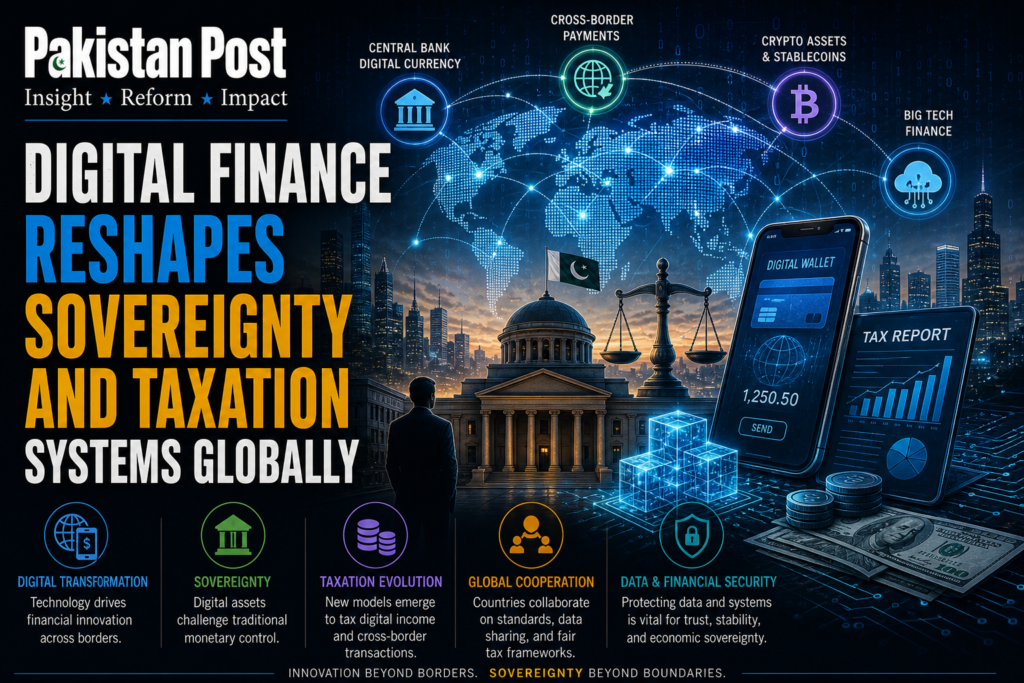
The global monetary order is entering a phase of structural experimentation where the traditional monopoly of states over currency issuance, taxation, and financial surveillance is being reconfigured by digital platforms, algorithmic finance, and decentralized payment ecosystems. For Pakistan, this transformation is not a distant technological trend but an immediate governance challenge, reshaping the boundaries of fiscal authority and monetary control in ways that are still poorly understood but rapidly accelerating.
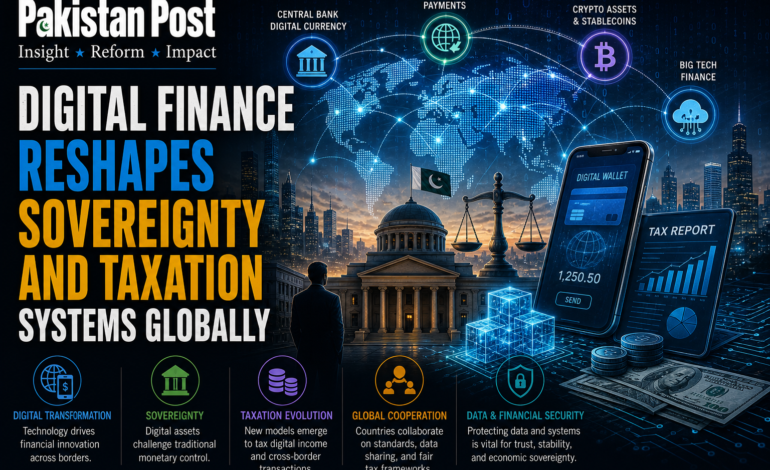
At the center of this shift is the gradual emergence of central bank digital currencies and digital payment infrastructures that are redefining what it means to control money. The State Bank of Pakistan has cautiously entered this domain, exploring frameworks for digitized currency systems that could potentially enhance financial inclusion and reduce transaction costs. Yet this experimentation unfolds within a global environment where digital finance is no longer a peripheral innovation but a core component of economic governance.
The rise of fintech ecosystems, mobile wallets, and platform based financial services has already altered the texture of everyday transactions. Services such as JazzCash and Easypaisa have expanded access to financial services for millions previously excluded from formal banking systems. This expansion is often framed as a success story of financial inclusion, yet it also signals a deeper shift in the locus of financial power from traditional banking institutions to digital intermediaries.
In this emerging ecosystem, data becomes as important as currency. Every transaction generates information, and this information becomes a resource for credit scoring, taxation, and behavioural analysis. The state’s capacity to regulate and tax economic activity is increasingly mediated through digital platforms that may be privately owned, globally distributed, or algorithmically governed. This introduces a new dimension of fiscal governance where sovereignty is exercised not only through legislation but through access to data infrastructures.
Globally, the debate around central bank digital currencies reflects divergent approaches to this transformation. Some economies view digital currencies as tools to strengthen monetary sovereignty, improve payment efficiency, and reduce reliance on cash based systems. Others see them as defensive mechanisms against the proliferation of cryptocurrencies and private digital payment systems that operate outside traditional regulatory frameworks. In both cases, the underlying concern is the erosion of state control over money creation and circulation.
The rise of cryptocurrencies and decentralized finance has intensified these concerns. Unlike traditional banking systems, these networks operate across borders, often outside the direct jurisdiction of any single state. Transactions can occur without intermediaries, and value can be transferred without conventional regulatory oversight. While their scale remains uneven and volatile, their conceptual impact on monetary sovereignty is significant. They challenge the assumption that states are the sole arbiters of financial legitimacy.
For Pakistan, this presents a dual challenge. On one hand, digital finance offers opportunities to expand the tax base, improve efficiency in public service delivery, and reduce leakages in the financial system. On the other hand, it complicates taxation enforcement, capital controls, and monetary policy transmission. The informal economy, already substantial, becomes more difficult to track as economic activity migrates into digital and semi anonymous platforms.
Taxation frameworks are particularly under strain. Traditional tax systems rely on identifiable economic transactions within regulated jurisdictions. Digital economies blur these boundaries. Cross border digital services, online freelancing, e commerce platforms, and virtual assets generate value that is often difficult to capture within existing tax regimes. This creates fiscal gaps that require new regulatory approaches.
The Federal Board of Revenue faces the challenge of adapting to this new environment. Expanding digital taxation mechanisms, improving data integration, and enhancing compliance systems are becoming essential components of fiscal policy. However, these reforms are often constrained by institutional capacity limitations, political resistance, and technological gaps. Without modernization, the risk is not only revenue loss but also increasing inequality in tax burdens between formal and informal sectors.
At the macroeconomic level, digital finance also affects monetary policy transmission. As financial activity shifts toward digital platforms, the traditional levers of interest rates and reserve requirements may become less effective. Liquidity flows can move rapidly across platforms and borders, reducing the predictability of monetary aggregates. This requires central banks to develop new analytical tools and policy instruments capable of operating in a digitized financial environment.
Globally, advanced economies are already experimenting with digital currency frameworks. The European Central Bank is exploring a digital euro, while China has advanced significantly with its digital yuan initiative. These developments are not merely technological upgrades but strategic moves to maintain monetary influence in an increasingly multipolar financial system. Currency competition is extending into the digital domain, where control over payment infrastructure can translate into geopolitical leverage.
For developing economies, the challenge is more complex. Limited technological infrastructure, weaker regulatory systems, and high levels of financial informality create constraints on rapid digital transformation. Yet delaying engagement with digital finance carries its own risks, including loss of competitiveness, reduced financial inclusion, and increased vulnerability to external digital ecosystems.
Media narratives around digital finance often oscillate between optimism and anxiety. On one hand, it is portrayed as a democratizing force that empowers individuals, reduces corruption, and enhances efficiency. On the other hand, it is seen as a potential threat to privacy, sovereignty, and financial stability. Both narratives contain elements of truth, but neither fully captures the structural nature of the transformation underway.
The deeper issue is not whether digital finance is beneficial or harmful, but how it redistributes power within the financial system. Control over data, platforms, and algorithms becomes as important as control over physical currency issuance. This shifts the balance of power from traditional institutions toward technology driven ecosystems, many of which operate across borders and outside conventional regulatory frameworks.
In Pakistan’s context, this raises important governance questions. How can the state ensure regulatory oversight without stifling innovation? How can it expand financial inclusion while maintaining fiscal discipline? How can it integrate into global digital finance networks without losing control over domestic monetary systems? These are not purely technical questions but political and institutional ones.
Cybersecurity also emerges as a critical concern. As financial systems become digitized, they become more vulnerable to cyber threats, data breaches, and system disruptions. Protecting financial infrastructure requires investment in digital security capabilities, regulatory frameworks, and international cooperation. Without this, the benefits of digital finance could be undermined by systemic risks.
Another dimension is the role of international financial institutions such as the International Monetary Fund, which are increasingly incorporating digital finance considerations into their policy frameworks. Issues such as digital taxation, cross border payment systems, and fintech regulation are becoming part of broader macroeconomic surveillance and advisory functions. This reflects the growing integration of digital finance into global economic governance.
The private sector remains a key driver of innovation in this space. Fintech companies, digital banks, and technology platforms are rapidly expanding their influence. However, this expansion raises questions about regulatory oversight, consumer protection, and systemic risk. Balancing innovation with stability is a central policy challenge.
In the longer term, digital finance may fundamentally alter the concept of sovereignty itself. If financial transactions are increasingly mediated through global platforms, the ability of states to regulate, tax, and monitor economic activity may become contingent on access to these platforms. Sovereignty thus becomes relational rather than absolute, dependent on negotiation with both domestic and international digital actors.
For Pakistan, the strategic imperative is to engage proactively with this transformation. This involves building institutional capacity, investing in digital infrastructure, and developing coherent regulatory frameworks. It also requires participation in international discussions on digital finance governance to ensure that emerging rules reflect the interests of developing economies.
Ultimately, the digital financial revolution is not a distant possibility but an ongoing reality. It is reshaping how money is created, moved, and regulated. It is redefining the relationship between states and markets, between citizens and institutions, and between domestic economies and global networks.
The challenge for Pakistan is to ensure that this transformation strengthens rather than weakens its economic sovereignty. This will require not only technological adaptation but also strategic vision. The future of fiscal control will not be determined solely by budgets or central bank policies, but by the ability to navigate a complex, digitized, and increasingly borderless financial world.
A Public Service Message