
Debt, Discipline, and the Strategic Uses of Finance: Mapping Power in the Contemporary Global Order

By Ijaz Naser
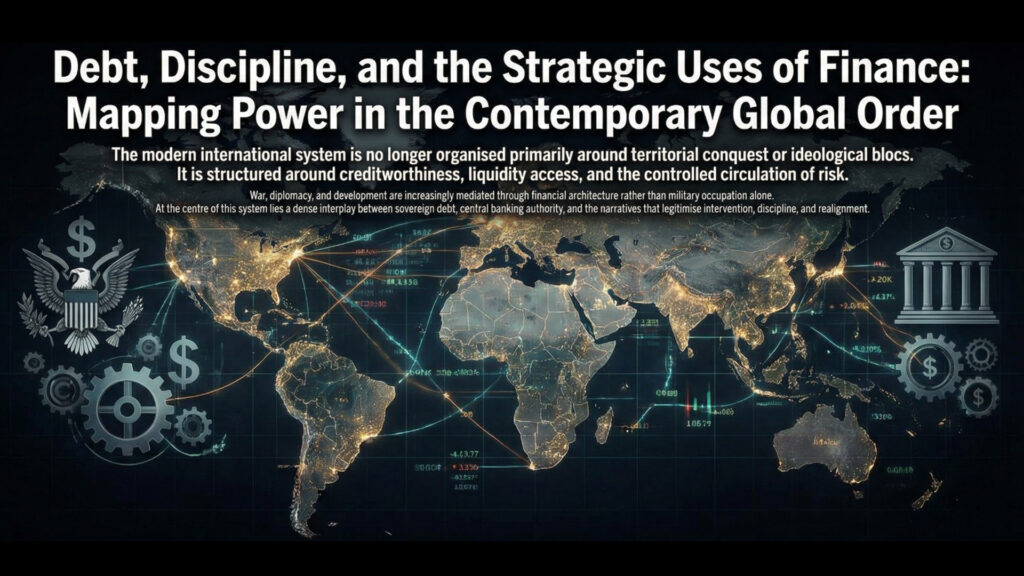
The modern international system is no longer organised primarily around territorial conquest or ideological blocs. It is structured around creditworthiness, liquidity access, and the controlled circulation of risk. War, diplomacy, and development are increasingly mediated through financial architecture rather than military occupation alone. At the centre of this system lies a dense interplay between sovereign debt, central banking authority, and the narratives that legitimise intervention, discipline, and realignment.
At the apex of the contemporary order stands the United States, not simply as a military power but as the issuer of the world’s principal reserve currency. Dollar dominance allows Washington to transform fiscal deficits into global assets, externalising domestic imbalances while internalising global savings. The Federal Reserve’s policy decisions, while formally domestic, function in practice as global allocative events. Interest rate cycles reprice risk worldwide, determining capital flows, exchange rate stability, and debt sustainability far beyond American borders. In this configuration, monetary policy becomes a strategic instrument, shaping geopolitical outcomes without the overt use of force.
Surrounding this core are a small number of stabilising but subordinate financial powers whose roles are frequently misunderstood. The Bank of England represents the institutional memory of global finance. Its importance today lies not in currency dominance but in legal authority, regulatory precedent, and market infrastructure. London remains a central node for sovereign bond issuance, dispute resolution, and financial arbitration. Through these mechanisms, the United Kingdom continues to influence how debt is structured, enforced, and interpreted, even as its imperial power has long receded.
The Bank of Japan plays a different stabilising role. By suppressing yields and absorbing vast quantities of sovereign debt internally, Japan functions as a global shock absorber. Its financial surplus is recycled into international markets, providing liquidity during periods of stress. Japan’s strategy is defensive rather than expansionist; its objective is systemic continuity. Yet this very continuity reinforces the existing hierarchy by preventing disruptive corrections that might otherwise challenge dollar primacy.
China’s People’s Bank of China occupies an ambiguous position. It is simultaneously embedded within the dollar-based system and seeking insulation from it. China’s vast foreign exchange reserves are not simply an economic buffer; they are a strategic hedge against coercion. Capital controls, managed exchange rates, and state-directed credit allow Beijing to prioritise domestic stability over market orthodoxy. However, the renminbi’s limited convertibility and China’s controlled financial transparency prevent it from serving as a true reserve currency alternative. As a result, China accumulates influence without yet reshaping the system’s foundations.
Between these central banks and the wider world operate foreign reserve holders and sovereign wealth funds, particularly from export- and energy-surplus economies. Their function is pivotal. By recycling trade surpluses into U.S. Treasuries and dollar assets, they finance American deficits while anchoring global liquidity. This arrangement appears counterintuitive—creditors underwriting the debtor—but it persists because it offers safety, scale, and predictability unavailable elsewhere. The system thus sustains itself through mutual dependence rather than coercion alone.
At the institutional core of enforcement sits the Bretton Woods framework, particularly the International Monetary Fund. The IMF does not design global financial hierarchies; it operationalises them. Its conditionalities reflect the priorities of creditors and the imperatives of system stability rather than ideological hostility toward debtor states. For countries without reserve currencies or surplus-generating economies, IMF engagement becomes unavoidable during periods of stress. Yet participation carries a reputational cost, signalling vulnerability to markets even as it averts default. In this sense, the IMF functions as a transmission belt through which global monetary discipline is applied at the national level.
It is within this structure that the debt–war–narrative nexus becomes visible. Contemporary conflicts are increasingly framed in moral or security terms—terrorism, stability, democracy—yet their material consequences are financial. Wars disrupt supply chains, justify sanctions, reprice energy, and redirect capital flows. Sanctions regimes, in particular, convert financial infrastructure into instruments of coercion. Access to payment systems, reserves, and trade settlement becomes conditional upon political alignment. Thus, conflict narratives do not merely mobilise public opinion; they reorganise financial flows and reinforce hierarchy.
Peripheral and semi-peripheral states experience this system most acutely. Pakistan exemplifies this condition. As a non-reserve currency economy with persistent current account deficits and heavy import dependence, Pakistan operates under structural constraint. Its monetary policy autonomy is limited not by legal prohibition but by market response. Any deviation from orthodoxy triggers capital flight, currency depreciation, and inflationary pressure. External shocks—whether geopolitical crises, commodity price swings, or foreign interest rate hikes—are rapidly internalised.
Pakistan’s recurrent engagement with the IMF is therefore not an aberration but a structural outcome. Bilateral financing, including from China, offers temporary relief but does not alter the underlying hierarchy. Such funding is project-specific and does not generate the foreign exchange surpluses required for systemic resilience. Nor does it substitute for market confidence. The result is a cycle of adjustment, stabilisation, and renewed vulnerability.
The persistence of conspiracy narratives surrounding global finance reflects discomfort with this reality. Personalising power—attributing systemic outcomes to families or secret cabals—obscures the institutional nature of control. Modern financial dominance is exercised through rules, infrastructures, and expectations. Central banks shape behaviour not through decree but through credibility. Debt disciplines states not through force but through anticipation of market reaction.
The United States itself is now testing the limits of this architecture. The extensive use of sanctions and financial exclusion has increased awareness of the system’s coercive capacity. In response, states are exploring hedging strategies: gold accumulation, bilateral currency settlements, and alternative payment systems. Yet these measures remain partial. Fragmentation, not replacement, characterises the emerging order.
For think tanks and policymakers, the critical insight is that global finance is not neutral terrain. It is a strategic domain in which debt, liquidity, and narrative interact continuously. Wars reshape financial flows; financial structures shape political options; narratives legitimise both. States positioned lower in the hierarchy cannot simply opt out. Their strategic challenge lies in managing exposure, enhancing predictability, and incrementally increasing resilience within the system’s constraints.
Understanding this interplay is essential not only for economic planning but for national security assessment. In the contemporary order, sovereignty is exercised as much through balance sheets as through borders. Those who grasp this architecture early gain room to manoeuvre. Those who do not remain permanently reactive.
A public service message