CEO’s Editorial Note

Geo-economic weakness is often explained as a consequence of global inequality, adverse terms of trade, or geopolitical disadvantage. These pressures are real, but they do not fully explain why economic instruments routinely undermine one another. Trade policy signals openness while regulatory behavior signals risk. Debt negotiations stabilize the present while mortgaging policy autonomy. Corridor projects promise transformation yet remain administratively disconnected from productivity and export strategy. What emerges is not failure of economics, but failure of economic statecraft—where no single authority integrates decisions into a coherent national posture.
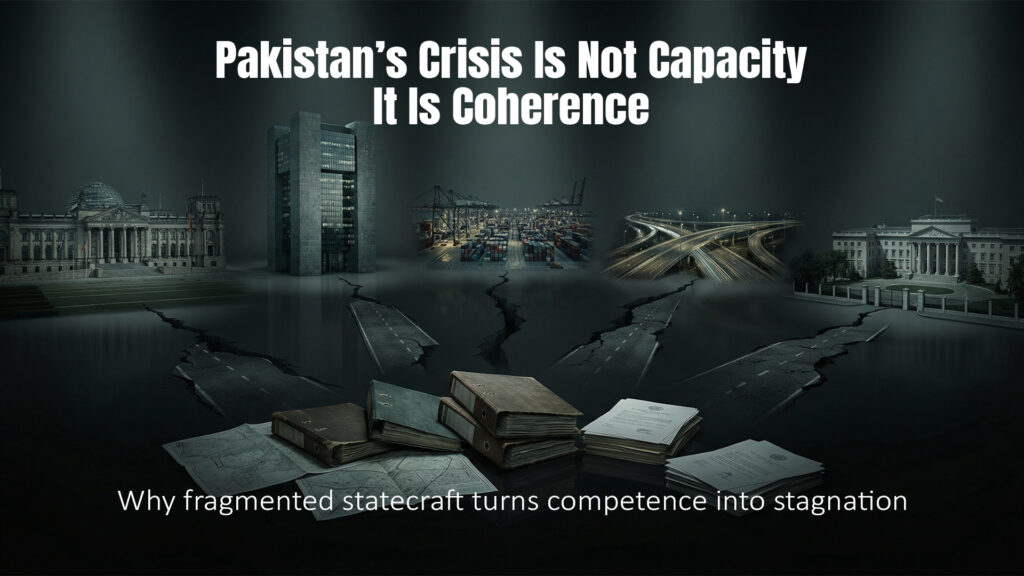
Pakistan’s central policy failure does not lie in the absence of ideas, resources, or even intent. It lies in the state’s inability to act as a single, thinking entity. Across economic management, strategic posture, legislation, reform, and accountability, institutions function with competence in isolation and incoherence in combination. The result is not collapse, but stagnation—a condition more durable and less disruptive than crisis, yet far more damaging over time.
The same fragmentation defines Pakistan’s geostrategic behavior. The state remains engaged across regions and alliances, yet struggles to translate activity into leverage. Security decisions, diplomatic messaging, and economic positioning proceed on separate tracks, often contradicting one another in timing and intent. Strategic ambiguity becomes a substitute for strategic choice, not because options are unavailable, but because prioritization is institutionally contested. Pakistan appears visible everywhere, yet decisive nowhere, not due to external hostility alone, but because strategy lacks ownership within the state itself.
Legislation reflects a similar pattern. Laws are passed with frequency and urgency, yet enforcement authority erodes. Regulatory overlap multiplies discretion rather than accountability. Federal and provincial jurisdictions diffuse responsibility instead of anchoring it. The legal system grows denser while governance grows thinner. This is not a deficit of lawmaking capacity, but a misalignment between legal output and administrative power—where the state produces rules faster than it builds the authority to sustain them.
What are labeled as Pakistan’s “critical issues” are, in practice, recurring expressions of the same disorder. Economic instability, political volatility, social distrust, and governance paralysis do not arise independently; they cycle through the system because underlying coordination failures remain untouched. Crisis management becomes a permanent mode of governance, treating symptoms efficiently while leaving the structure intact. Over time, emergency response replaces strategic planning, and the state learns to survive instability rather than resolve it.
Reforms, when introduced, follow a predictable trajectory. They are announced with urgency, validated externally, and diluted internally. Ownership disperses once political cover fades. Administrative incentives reward continuity over disruption. Institutional resistance is not ideological; it is rational, rooted in risk-avoidant systems that penalize deviation more than failure. Reforms do not fail because they are rejected, but because no institution fully absorbs responsibility for their survival.
Civil society and media fill the spaces left by weakened institutional trust. As formal authority fragments, narratives acquire power. Public discourse becomes a proxy arena for unresolved governance struggles, while regulation reacts to influence rather than shaping it. This dynamic is often misread as a binary conflict between freedom and control. In reality, it reflects an imbalance where legitimacy migrates from institutions to platforms, deepening contestation without restoring authority.
Corruption and mismanagement endure not as moral anomalies, but as structural outcomes. Systems designed with excessive discretion, opaque procedures, and selective enforcement create environments where informal practices become rational. Accountability mechanisms, when politicized, lose credibility. Integrity becomes individualized, while corruption remains systemic. In such conditions, misconduct adapts faster than reform, embedding itself deeper with each cycle.
Taken together, these patterns point to a single conclusion: Pakistan’s challenge is not the absence of capacity, but the absence of coherence. Institutions act, but rarely act together. Power exists, but it is dispersed across logics that do not converge into state strategy. Until governance shifts from managing domains to integrating them, policy outcomes will continue to underperform intent.
This second edition of Pak-Post does not argue for urgency or alarm. It argues for clarity. The question facing the state is no longer whether pressures are external or internal. It is whether Pakistan is prepared to function as a unified strategic actor—or remain a collection of capable institutions moving in different directions, indefinitely.
A public service message