Broken Academic Calendars, Learning Loss, and the Urgent Need for Systemic Reform in Punjab

By Mahrukh Ijaz
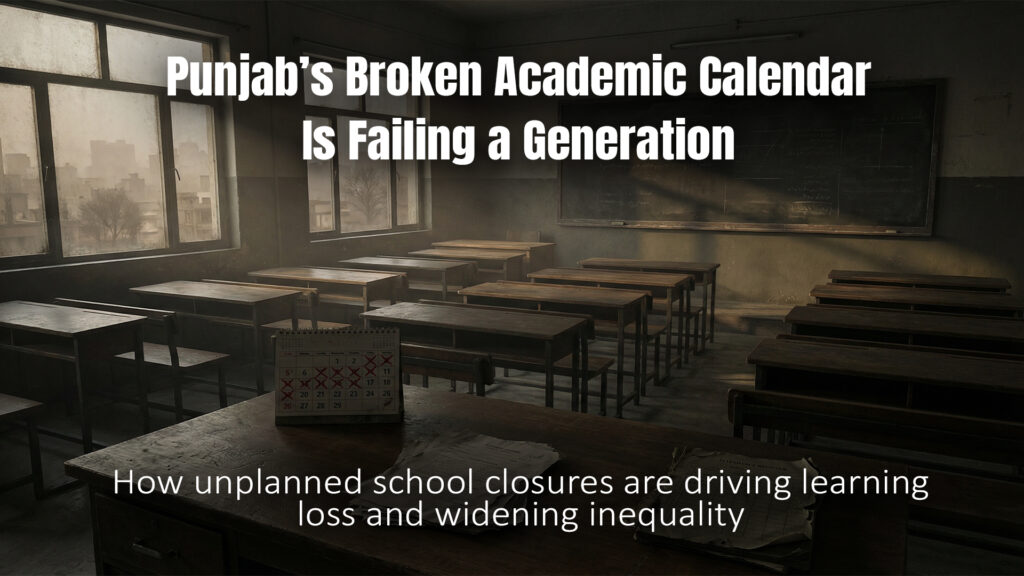
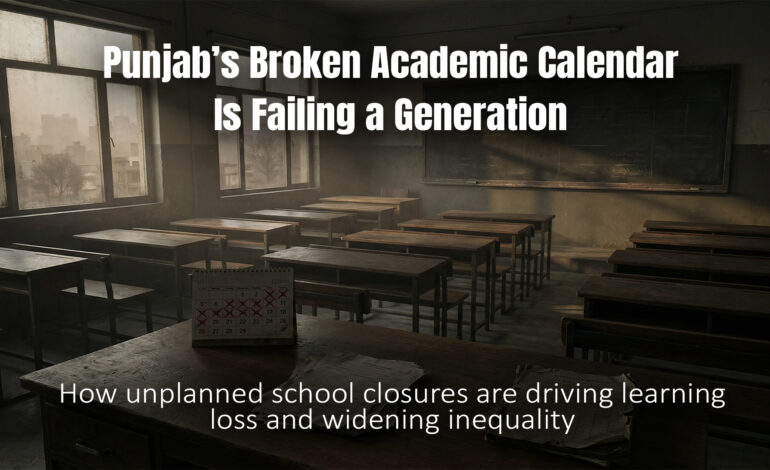
Punjab’s academic calendar has become a tool of disruption rather than learning. Well-intentioned closures to protect children from smog, heat waves, elections, or security concerns have repeatedly translated into cumulative learning loss, undermining both classroom instruction and the future potential of millions of students. Pakistan currently has 22.8 million children aged 5–16 out of school, and among those attending, nearly 75 percent of 10-year-olds cannot read or comprehend a simple sentence in their mother tongue. These numbers expose the depth of learning poverty, a crisis that is intensified whenever the academic year is broken by unplanned interruptions.
The official expectation of 200–220 teaching days per year is rarely met, with students experiencing only 150–160 days of actual instruction. The remaining days are consumed by sudden closures due to smog, heat waves, political events, elections, security incidents, and VIP movements, compounded by winter breaks, Eid holidays, public holidays, and local strikes. The result is a fragmented academic year where children’s learning is neither continuous nor cumulative, teachers are forced into reactive crisis management, and parents are left uncertain about their children’s progress.
Punjab is not alone in facing this challenge, but the scale here is exceptional due to population size and systemic governance weaknesses. While countries like India, Sri Lanka, and Bangladesh have faced environmental or political disruptions, they have increasingly introduced data-driven closure protocols and learning recovery mechanisms. In contrast, Punjab continues to operate reactively, often leaving children, especially in rural or low-fee schools, to bear the brunt of administrative indecision.
The consequences of this broken calendar are immediate and long-term. Students face curriculum compression, rushed instruction, rote memorization, and guess-based assessments. Weak learners are promoted without remediation, creating cumulative gaps that later manifest in poor performance in board exams, limited preparedness for higher education, and inadequate vocational skills. Research consistently shows that lost instructional days correlate directly with lower literacy, numeracy, and life skill outcomes, and that even short-term disruptions disproportionately affect students from disadvantaged backgrounds. Teachers operate under constant pressure to cover the syllabus, conduct assessments, manage events, and communicate with parents, leaving little room for professional development, reflective planning, or innovative pedagogy. Parents’ trust erodes as notifications about closures arrive late, contingency plans remain unclear, and the number of effective teaching days is never transparently communicated.
The problem is systemic, not incidental. While planned holidays are predictable and manageable, unplanned closures are rarely based on clear thresholds, data, or standardized operating procedures. Administrative discretion and political considerations often dictate when and where schools close, creating predictable cycles of learning loss. In districts frequently affected by environmental or security-related closures, students fall behind sharply, and socio-economic disparities in learning outcomes widen. Even well-resourced private schools struggle to compensate for lost instructional time, and low-fee or rural schools are disproportionately affected, further entrenching inequality.
Historical patterns show that Punjab has repeated this cycle for decades. Board examination results, literacy assessments, and national surveys all point to the same trend: learning gaps widen year after year, not because teachers or students fail, but because systemic structures fail to guarantee continuous, predictable instruction. While the government often cites logistical challenges—weather, smog, security—the absence of standardized policies, contingency frameworks, or enforceable minimum teaching days ensures that children are the first casualties of any disruption.
Evidence underscores the urgency. Schools are losing 40–50 days annually to unplanned closures, amounting to 20–25 percent of the official academic year. When combined with the existing crisis of out-of-school children and widespread learning poverty, these disruptions represent a structural failure that cannot be addressed through incremental or ad-hoc measures. Punjab cannot afford to continue managing education reactively; the status quo is not sustainable.
The human cost is significant. Repeated learning loss erodes student confidence, heightens drop-out risk, and creates an intergenerational cycle of limited opportunity. For teachers, the consequences are equally damaging: burnout, high turnover, reduced motivation, and a narrowed pedagogical focus to simply “cover syllabus” rather than nurture deep learning. Parents, particularly those with limited literacy themselves, face stress and uncertainty, often seeking expensive private tutoring to fill gaps caused by systemic failure. This cycle disproportionately harms rural populations and low-fee private schools, widening already significant inequalities between urban and rural, rich and poor students.
To protect children’s learning, the government must introduce enforceable minimum teaching days legislation, requiring at least 200 instructional days per academic year across all schools. Any emergency closure must trigger a mandatory recovery plan, which could involve extended school hours, Saturday sessions, or an extension of the academic year. A framework of standardized, data-driven procedures should define closure thresholds based on air quality, temperature, or security metrics, and include pre-designed learning continuity measures such as worksheets, digital content, or broadcast lessons ready for immediate deployment. These interventions would prevent learning from grinding to a halt whenever the calendar is disrupted.
Accountability mechanisms are equally critical. An independent, non-political Learning and Calendar Commission should be established, bringing together school leaders, university experts, assessment specialists, and representatives of private and low-fee schools. This body should publish an annual “Learning Loss and Teaching Days Report” with district-level data on closures, planned versus actual teaching days, and recommendations to minimize gaps. Such transparency would allow policymakers to track patterns over time, identify the most affected areas, and intervene proactively, replacing guesswork and administrative discretion with evidence-based governance.
The academic calendar should be published one year in advance, detailing term dates, assessments, planned holidays, and major events, while a three-year rolling policy should guide the handling of emergency closures and ensure learning continuity. Every closure should automatically trigger remedial interventions, including diagnostic assessments, focused tutoring, and extra support for slow learners. Failure to implement recovery mechanisms effectively converts unavoidable closures into deliberate learning loss, with long-term consequences for students’ knowledge, skills, and opportunities.
Punjab is currently at a crossroads. Political pressures, budget constraints, and environmental challenges will persist, but children cannot wait for ideal conditions. Every lost day compounds into irrecoverable learning deficits that no future budget or speech can repair. Data-driven governance, enforceable minimum teaching days, standardized closure procedures, recovery plans, and independent oversight are not optional—they are essential. A broken calendar is not inevitable; inaction is. If policymakers fail to act now, Punjab risks condemning an entire generation to educational mediocrity.
The policy vision for Punjab must be forward-looking. Beyond immediate recovery plans, schools should integrate continuous assessment mechanisms to track learning loss, with data informing remedial instruction in real-time. Teacher training programs must incorporate contingency pedagogy, equipping educators to maintain continuity of learning during unavoidable closures. Communities should be engaged through parent-school communication platforms, ensuring clarity and accountability about both planned and unplanned instructional disruptions. Leveraging technology—through low-cost digital learning, radio, or televised lessons—can bridge gaps during closures, particularly for rural and underserved populations.
Comparisons with neighboring countries underline the feasibility of these interventions. India has implemented AQI-based school closure policies coupled with digital learning content; Sri Lanka maintains centralized tracking of teaching days to ensure syllabus completion despite environmental and political challenges; Bangladesh integrates accelerated learning and remedial programs following unplanned closures. Punjab can adapt these evidence-based practices, combining legislative enforcement, monitoring, and recovery mechanisms tailored to its demographic and environmental realities.
The stakes are not only educational but societal. Students denied consistent learning today risk becoming adults unprepared for modern labor markets, civic engagement, and technological literacy. Teacher burnout and attrition will worsen without systemic reform, further compromising quality. Persistent parental distrust undermines the social contract between families and schools, eroding broader confidence in governance. Conversely, a structured, enforceable system would protect learning, reduce inequality, strengthen teacher capacity, and build trust in public institutions.
Every policy intervention should follow a simple principle: holiday without a recovery plan equals deliberate learning loss. By contrast, a closure managed through clear SOPs, pre-designed continuity measures, and structured remediation represents responsible governance. Punjab’s government has the data, expertise, and precedent from regional neighbors to design such a system—but decisive action is required now.
In conclusion, Punjab cannot continue treating children’s learning as expendable collateral in the face of administrative or environmental emergencies. Political convenience, budget limitations, or logistical challenges cannot justify a repeated cycle of broken calendars and lost teaching days. The government must adopt a systemic, accountable, and evidence-based framework to ensure continuous, high-quality education for all children, incorporating enforceable minimum teaching days, closure SOPs, recovery mechanisms, independent monitoring, community engagement, and digital or broadcast learning infrastructure. The time for action is immediate. A structured, enforceable system, not reactive convenience, will safeguard learning and protect the future of millions of children in Punjab.
A public service message