
Pakistan’s Agricultural Shockwave & Food Security

By Sadia Majeed
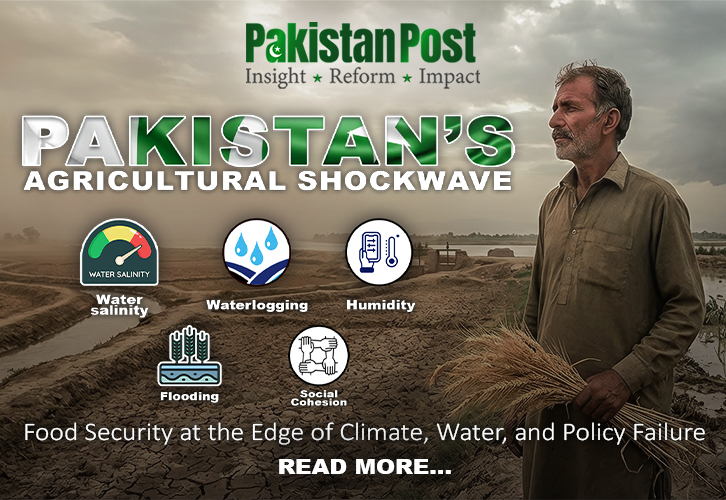
Pakistan’s agricultural sector—the economic lifeline and social stabilizer for millions—now stands within a shifting epicenter of climatic unpredictability, water scarcity, soil degradation, rural poverty, and global market volatility. For decades this country’s agrarian economy sustained its people and fed its cities, but the accumulated pressures of environmental stressors and structural policy weaknesses have now intersected to create what can only be termed an agricultural shockwave, one that threatens national food security, rural livelihoods, and social cohesion with unprecedented ferocity. The crisis unfolds not in a single catastrophe but through a mosaic of compounding threats: rising temperatures and irregular precipitation patterns disrupting crop cycles, a catastrophic imbalance between water demand and supply in the Indus Basin, rapid soil salinity and degradation undermining productive capacity, and global commodity price volatility amplifying economic distress for both farmers and consumers.
Pakistan has already warmed by about 1.1°C since the pre‑industrial era, and projections for the rest of the century indicate further warming of between 2.6°C to over 4°C under high emissions scenarios. This change exacerbates the vulnerability of staple crops such as wheat and rice—whose yields decline significantly even with modest temperature increases. Heat stress accelerates crop maturation and reduces grain fill, while erratic and intense rainfall events, instead of moderate and timely precipitation, cause waterlogging, flooding, or prolonged droughts that disrupt planting and harvesting schedules. These shifts in fundamental climatic parameters mean that traditional crop calendars and agricultural wisdom are no longer reliable; what once was prudent sowing or harvesting timing has become a gamble against the weather itself. Meanwhile, higher humidity from climatic shifts encourages pest proliferation and fungal disease spread, further reducing crop output and raising production costs for farmers who often cannot afford effective protective measures.


The soil, often described poetically as the mother of agriculture, illustrates perhaps the deepest layer of this crisis. Pakistan’s soils their organic carbon levels, texture, and microstructure have been steadily deteriorating due to salinization, waterlogging, erosion, and the overuse of chemical fertilizers. These are not abstract scientific observations but material changes felt in fields from Sindh’s rice paddies to Punjab’s wheat belts. Around one‑quarter of cultivated land is affected by salinity and waterlogging, severely depressing yields and reducing productive land area. In Sindh, for example, salinity alone has cut rice yields by between 20–30 percent, while desertification is advancing in drier regions like Balochistan, shrinking what little arable ground remains. The decline in soil health is both a symptom and a driver of the broader agricultural crisis: degraded soils store less water, offer fewer nutrients, and make crops less resilient to climatic extremes, forming a vicious cycle that deepens vulnerability with every passing season.
Water scarcity amplifies these stresses with a starkness that defies simple explanation. Pakistan’s per capita water availability has plunged from more than 5,000 cubic meters in the early 1950s to less than 900 cubic meters today—a perilous threshold that places the country below the United Nations’ definition of absolute water scarcity. Agriculture consumes upwards of 90 percent of the nation’s freshwater, yet archaic irrigation practices waste an enormous proportion of that allocation. Traditional flood irrigation loses water to seepage and evaporation; roughly only a small fraction of surface water applied at canal headworks reaches crop roots. Groundwater depletion compounds the shortage: millions of tube wells extract water far beyond the natural recharge rate, lowering water tables, especially in Punjab and Sindh, and leaving aquifers stressed to breaking point. The Indus River system, which provides over three‑quarters of the country’s irrigation water, is caught between declining glacier inputs, variable monsoon patterns, and disputes over transboundary water governance. The result is a water crisis where millions of hectares face unreliable supply, forcing farmers either to reduce irrigated acreage, shift crops, or depend increasingly on expensive and unsustainable groundwater pumping.
Indeed, that water imbalance has become an existential constraint on production. Pakistan’s irrigation infrastructure—the largest contiguous system of its kind in the world—was conceived in an era of relative hydrological stability. It cannot cope with the combined demands of climate change, demographic expansion, and inefficient allocation. In many areas, head‑end farmers receive more than their equitable share of canal water, while tail‑end farmers face intermittent flows that jeopardize crop establishment and yield potential. Waterlogging and salinity have resulted from inadequate drainage, and groundwater quality deterioration has produced saline irrigation sources that eventually degrade soil fertility—an outcome that extends beyond crop losses to long‑term socio‑economic decline for farming communities.
These environmental stresses converge with deeply entrenched policy distortions. Water pricing, for example, is heavily subsidized or absent, making farmers insensitive to the true economic scarcity of this vital resource. Subsidized canal water has historically encouraged the cultivation of highly water‑intensive crops such as rice and sugarcane, even in water‑scarce regions—choices economic rather than ecological imperatives would dissuade. These crops consume the lion’s share of irrigation water while contributing relatively little to export earnings or food security, displacing higher‑value or drought‑tolerant alternatives that might be better aligned with the realities of a water‑constrained future. Meanwhile, market structures offer little protection against price volatility. Farmers typically lack access to crop insurance or forward market contracts that could cushion against climatic losses or global price swings. The absence of robust risk management and adaptive extension services means that many rural producers react to crises rather than prepare for them, perpetuating cycles of debt and distress.
The human consequences of this rupture in the natural and economic order are profound. Crop losses have become a chronic feature in recent years, not limited to isolated incidents. The monsoon floods of 2022, among the most devastating in Pakistan’s history, submerged millions of acres of farmland, destroyed food stocks, and killed livestock that represent security and savings for rural households. In that single season, an estimated 4.4 million hectares of crops were lost, and the agricultural sector absorbed a disproportionate share of the overall economic damage—on the order of tens of billions of dollars. Beyond the immediate devastation, such extreme events leave lingering impacts: delayed planting, soil nutrient depletion, and loss of farmers’ adaptive capacity. These microeconomic disruptions cascade into macroeconomic stress as food prices rise, inflation accelerates, and households across the income spectrum feel the squeeze.
The crisis also deepens rural poverty and fuels distress migration. As yields falter and production costs rise, farming incomes stagnate or decline. Smallholder farmers—many operating with limited land and no safety nets—find themselves trapped in cycles of indebtedness. With agriculture’s income‑generating capacity compromised, rural residents increasingly migrate to urban centers in search of alternative livelihoods, swelling informal settlements and creating new pressures on infrastructure and public services far from the fields where their families once cultivated wheat, cotton, and rice. In some water‑stressed districts, rural poverty rates have climbed above 45 percent, reflecting the cumulative economic and environmental burdens borne by these populations.
Pakistan’s food security challenge is not unique, but its confluence of risk factors situates it dangerously close to a breaking point. Globally, countries such as Bangladesh have framed climate‑smart agriculture as a central strategy for increasing productivity and resilience in the face of rising temperatures, erratic rainfall, and sea‑level rise that affect coastal farming systems. In Bangladesh, studies show that adoption of climate‑smart agricultural practices—such as early planting, diversified cropping, and improved irrigation—can measurably increase household food security, especially when supported by extension services and policy incentives. Such comparative cases illustrate the potential for adaptation, but also the persistent barriers in technology adoption when institutional support is weak.
In India, the National Innovations in Climate Resilient Agriculture program and other initiatives have aimed to combine strategic research with on‑ground technology demonstrations to improve soil health, water management, and crop resilience across multiple agro‑climatic zones. These efforts, backed by capacity building and crop diversification, illustrate a path toward structural reform that Pakistan has yet to realize at scale. Moreover, water‑saving irrigation innovations promoted in neighboring regions—such as precision irrigation systems that reduce water use by substantial percentages while maintaining yields—demonstrate the kinds of integrated policies and practices that Pakistan could adapt if supported by coordinated investment and governance.
Nevertheless, the gap between policy frameworks and implementation remains stark. Climate‑smart agriculture (CSA), encompassing practices designed to enhance productivity, build resilience to climate change, and reduce greenhouse gas emissions, is well established in international development discourse, yet its adoption in Pakistan is hindered by limited extension services, financial constraints, and fragmented institutional coordination. A national pivot toward CSA would require not just pilot projects but a comprehensive overhaul of advisory systems, credit mechanisms for smallholder farmers, and public investment in water‑efficient infrastructure at the landscape level.
The structural reforms needed are both technical and political. On the technical side, policy must incentivize water‑efficient crops, rehabilitate irrigation infrastructure, accelerate drainage projects to combat salinity and waterlogging, and expand research into heat‑tolerant and drought‑resistant crop varieties adapted to emerging climatic regimes. On the governance side, equitable water distribution mechanisms, transparent allocation systems, and real market pricing for water and agricultural inputs are critical to shifting incentives toward sustainability. Without such reforms, Pakistan’s highly water‑intensive agricultural practices will continue to erode the very resource base on which they depend. The unchecked proliferation of solar‑powered irrigation, while reducing energy costs, is accelerating groundwater depletion because it removes economic barriers to excessive extraction—a cautionary example of technological adoption without regulatory oversight.
Finally, the global context cannot be ignored. Climate change increases the likelihood of simultaneous agricultural disruptions across multiple major food‑producing regions—what some researchers call a “multiple breadbasket failure”—which can ripple through global markets and intensify food price volatility. For countries like Pakistan that are both climate vulnerable and import dependent for certain food staples, such global shocks could compound local production shortfalls with external supply constraints, driving prices beyond the reach of the poorest households. Mitigating such risks requires not only domestic adaptation but integration into global food security frameworks that promote diversification, early warning systems, and cooperative research.
Pakistan’s agricultural crisis is not a distant theoretical forecast; it is unfolding in real time, reshaping landscapes, economies, and lives. The water that once sustained ancient civilizations now slips away through leaks in canals, evaporates under intense heat, or seeps into saline aquifers. The soils that once fed generations have lost their vitality under the twin pressures of salinity and erosion. Rural communities that once drew dignity and sustenance from the land now confront diminishing yields, rising debt, and the indignity of hunger or forced migration.
Yet, the country’s agricultural sector can still be stabilized—but only through decisive action that combines scientific understanding, policy innovation, and political will. Reforming water governance, adopting climate‑smart agricultural practices, investing in resilient infrastructure, and aligning incentives toward sustainability are not optional; they are prerequisites for averting a descent into deeper food insecurity and social instability. If these steps are delayed, the fault lines beneath Pakistan’s fields will widen into fissures that threaten the nation’s economic viability and social fabric. In a world of rising climatic uncertainty, Pakistan’s agriculture cannot merely endure—it must transform.
A Public Service Message.