
Unprecedented Surge in Sugar Prices

By Hafeez
The unprecedented surge in sugar prices in Pakistan last year exposed the profound and systemic rot that afflicts economic governance in the country. What was presented as a regulatory decision grounded in objective data to allocate export quotas to the All Pakistan Sugar Mills Association (APSMA) based on data supplied by the Federal Board of Revenue (FBR) and Sugar Cane Commissioners was in fact a misinformed, if not deliberately engineered, policy misstep with catastrophic consequences for the economy and for the welfare of ordinary citizens. At its core, this episode reflects a deeper pathology in Pakistan’s political economy: the capture of state power by narrow commercial interests, the instrumentalization of regulatory agencies for private gain, and the resultant transfer of wealth from the most vulnerable segments of society to a small cadre of politically connected industrialists and traders.
In the months leading up to the price surge, government agencies were presented with data purporting to show a domestic surplus of sugar sufficient to justify aggressive export quotas. On the basis of this information, the federal government granted export permissions to APSMA members, enabling mills to ship large quantities of sugar abroad. What was not publicly disclosed—indeed what appears to have been systematically obscured was that much of the sugar being exported was not held in reserve stocks but was being diverted directly from ongoing crushing operations. In other words, the supply base from which exports were sourced overlapped with the supply base needed to satisfy domestic consumption.
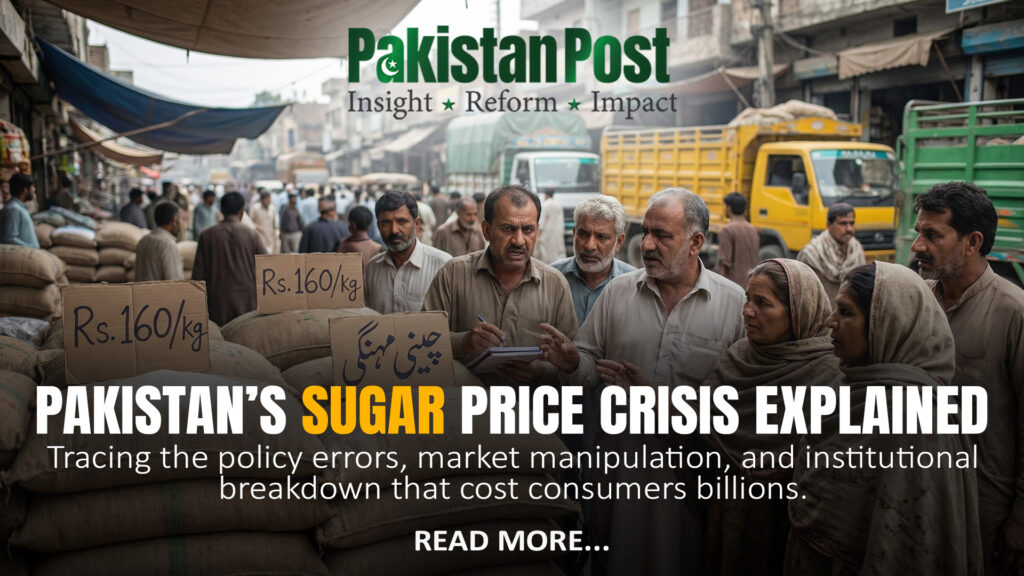
This misrepresentation of stock and supply data proved calamitous. As exports accelerated, domestic availability of sugar tightened sharply. Wholesale and retail inventories depleted; immediate shortages emerged in Punjab, Sindh, Khyber Pakhtunkhwa, and Balochistan. Market participants quickly recognized the emerging scarcity, triggering speculative hoarding and price escalation. Within weeks, sugar prices soared to levels previously unseen, exceeding PKR 190 to PKR 200 per kilogram in many urban centers. For millions of Pakistani households, already strained by inflation and stagnant incomes, this price surge was not merely an economic inconvenience it was a pronounced assault on subsistence.
The economic cost of this episode is staggering. Conservative estimates place the excess cost borne by consumers over and above what prices would have been absent the export spree at approximately PKR 300 billion. This sum represents a transfer of wealth from the populace at large, particularly low‑income households, to a restricted group of industrialists and intermediaries who benefited from elevated domestic prices and export profits. Contrary to the public interest, the sugar sector became a conduit for extreme rent‑seeking, wherein marginal increases in global sugar prices were amplified domestically, to the enrichment of a few and the impoverishment of many.
This outcome was not accidental. The failure of governance occurred at multiple junctures. First, the data provided by the FBR and the Commissioners of Sugar Cane, which underpinned export approvals, was demonstrably flawed. Whether through negligence, incompetence, or malevolent collusion, the agencies entrusted with objective assessment failed to verify the veracity of stock reports. Sugar mills and their associations, aware of the lax oversight, appear to have furnished inflated stock figures to justify export allocations that far exceeded real domestic availability. The absence of an independent audit mechanism or real‑time tracking of stocks and crushing outputs created a regulatory environment susceptible to manipulation.
Second, the government’s response to emergent market pressure was lamentably tardy and ineffectual. As prices escalated and the public registered grievances, the relevant ministries and enforcement bodies did not act with the alacrity and decisiveness required to stabilize the market. Investigations were delayed, export consignments already end route were not recalled, and punitive measures against manipulators were conspicuously absent or insufficient. The state’s inertia emboldened the very actors contributing to the crisis, signaling that regulatory capture had effectively neutered accountability.
Third, enforcement agencies, including the Federal Investigation Agency (FIA), displayed a conspicuous absence of proactive oversight. Even as reports emerged of illicit export practices, stock misreporting, and collusion among mill owners and traders, there was no immediate activation of enforcement mechanisms to investigate or remediate these violations. Instead of rigorous inquiry and prosecution, the narrative forwarded to the public was mired in obfuscation and bureaucratic equivocation. In a healthy governance system, regulatory and investigatory bodies serve as bulwarks against market abuse; in this case, they displayed either incapacity or complicity.
Equally troubling was the pattern of insider trading and speculative conduct that accompanied this episode. Persons with access to privileged information regarding export approvals and anticipated supply contractions were enabled to engage in front‑running behaviors. Traders located in economic hubs such as Lahore, Kasur, Faisalabad, Multan, and Karachi capitalized on anticipatory price movements, purchasing and controlling stocks ahead of price peaks. These speculative rings interconnected through informal networks, political connections, and shared commercial interests effectively orchestrated market dynamics to inflate prices artificially.
Compounding the domestic damage was the illegal smuggling of sugar to neighboring countries, notably to Afghanistan and other destinations where export controls are less stringent and prices higher. While official export channels were monitored with some oversight, smuggling operations thrived in transit routes that escaped regulatory scrutiny. These movements not only deprived domestic markets of further essential supplies but also funneled profits into informal and unregulated economies, further insulating beneficiaries from taxation and accountability.
The societal impact of this crisis cannot be overstated. For Pakistan’s working poor and middle class already grappling with multifaceted economic pressures the leap in sugar prices constituted a direct loss of disposable income and a tangible deterioration in living standards. Sugar, as a staple commodity, has pervasive use in households across socioeconomic strata. Its price affects not only direct consumption but also the cost structures of small businesses, food service providers, and informal economic actors. The asymmetry of impact where the affluent could absorb price increases while the poor bore the brunt illuminates the inequity inherent in the nexus between state policy and commercial interests.
This episode also reveals a broader failure of public administration and institutional integrity. Effective economic governance requires both accurate data and transparent decision‑making processes. The reliance on unverified industry data, without independent audits or cross‑checks, represents a dereliction of duty. Furthermore, when regulatory agencies are staffed by personnel susceptible to influence from the entities they are meant to regulate, the foundational principles of impartial oversight collapse. The sugar crisis in Pakistan exemplifies this collapse.
Stock misreporting was not subject to real‑time verification. There were no mandated GPS‑linked inventories, no requirement for third‑party auditors, and no electronic traceability mechanisms in place to ensure that reported stocks corresponded with physical reality. Given the magnitude of sugar production and its significance to food security, this regulatory vacuum was stark. The absence of meaningful penalties for misrepresentation further exacerbated the problem; the expectation of impunity emboldened market manipulators.
At the political level, the episode underscores how state power can be deployed to benefit a narrow set of stakeholders. Export quotas ostensibly a tool to enable market access and foreign exchange earnings were instead leveraged to facilitate profit extraction at the expense of national welfare. The optics of “export promotion” masked the underlying reality: exports were authorized without safeguarding domestic supply, without calibrated release mechanisms, and without contingency planning. Political patronage, rather than economic rationale, appears to have guided these choices.
The cumulative effect of these failures is the erosion of public trust. When ordinary citizens observe that regulatory capture can lead to painful price shocks, that investigatory agencies are unable or unwilling to act, and that political influence can shield powerful actors from accountability, it deepens cynicism about the state’s role as an arbiter of fairness. This erosion of trust has long‑term consequences, diminishing civic engagement and reinforcing perceptions of inequality before the law.
Remedial actions, both immediate and structural, are imperative to restore market integrity and to shield the public from future abuses. At a minimum, there must be an independent forensic audit of stock and export data for the period in question, with findings made public. Those found to have supplied falsified information should face legal consequences commensurate with the economic harm inflicted. Regulatory frameworks must be strengthened to require real‑time inventory tracking, third‑party validation of stock reports, and mandatory disclosure of export allocations and compliance.
Moreover, regulatory and enforcement agencies like the FBR and FIA must be insulated from industry influence through merit‑based appointments, transparent oversight structures, and accountability mechanisms. These agencies should not be conduits for industry self‑representation but guardians of public interest. Their mandate must prioritize verification, detection of misrepresentation, and proactive intervention where market distortions emerge.
Beyond technical reforms, the episode demands political accountability. Policy decisions with wide‑ranging economic implications cannot be insulated from scrutiny; they must be subject to legislative oversight and public review. When regulatory capture leads to concentrated enrichment and widespread suffering, the locus of accountability extends beyond administrative errors it implicates the political architecture that enabled such errors to persist unchecked.
In conclusion, the sugar price surge in Pakistan was not merely a transient market phenomenon; it was a manifestation of deep‑seated governance failures and an embodiment of how state power can be subverted to serve private interests at the expense of public welfare. The tragic transfer of wealth from the nation’s most vulnerable to a select elite underscores the urgency of systemic reform. Only through transparent governance, robust regulatory frameworks, and unwavering enforcement can Pakistan hope to prevent the recurrence of such episodes and to ensure that its economic policy serves the many rather than the few.
A Public Service Message.