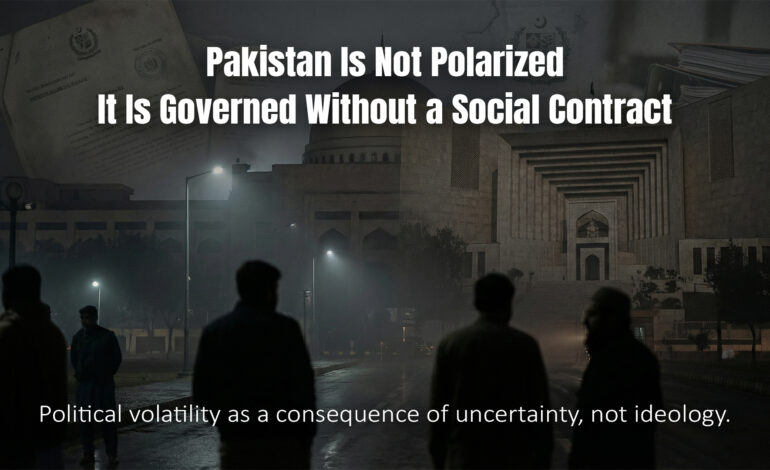
Pakistan Is Not Polarized—It Is Governed Without a Social Contract

By Yahya Sultan Ijaz
Pakistan’s recurring political volatility is frequently interpreted as evidence of deep ideological polarization, an entrenched division between competing political camps, or an increasingly emotional electorate. Such readings, while convenient, obscure a more structural explanation. The persistence of protest cycles, voter volatility, and institutional distrust reflects not ideological fragmentation but the gradual erosion of an implicit social contract between the state and its citizens. The core issue is not disagreement over national direction but uncertainty over how power is exercised, rules are enforced, and obligations are reciprocated. Political instability, in this sense, emerges less from polarization than from governance practices that weaken predictability, consistency, and mutual expectations.
A social contract, even when unwritten, relies on shared assumptions about fairness, accountability, and procedural reliability. In Pakistan, these assumptions have been steadily diluted by inconsistent rule enforcement and selective accountability. Laws are applied unevenly across actors and over time, creating uncertainty about consequences and protections. Citizens observe that compliance does not guarantee security, while influence often substitutes for rule adherence. This pattern does not produce ideological radicalization so much as strategic disengagement. When outcomes appear detached from behavior, public participation becomes episodic, transactional, and conditional, oriented toward moments of leverage rather than sustained institutional engagement.
Political management has increasingly prioritized short-term stability and narrative control over legitimacy-building. Governments across cycles have focused on containing dissent, shaping public messaging, and maintaining administrative continuity, often at the expense of repairing trust. Stability is treated as an operational objective rather than a derivative of consent. This approach can suppress immediate disruption but does not address underlying uncertainty about governance norms. Over time, the gap between formal authority and perceived legitimacy widens, creating a political environment where calm is temporary and confrontation recurrent, not because citizens are polarized, but because expectations remain unmet and unclarified.
Protest behavior in Pakistan reflects this dynamic. Demonstrations are often framed as emotional outbursts or politically engineered mobilizations, yet their recurrence suggests a more rational logic. Protests become tools for signaling exclusion from routine channels of influence. When institutional processes are perceived as unpredictable or inaccessible, public pressure shifts to the street, not as an ideological statement but as a practical response to uncertainty. The objective is often procedural recognition rather than ideological transformation. Protest cycles thus function as corrective mechanisms in a system where routine accountability is perceived as unreliable.
Voter volatility follows a similar pattern. Electoral shifts are frequently interpreted as swings in public ideology or loyalty. In reality, they often represent adaptive behavior in response to governance performance and credibility. Voters recalibrate support based on perceived delivery, fairness, and responsiveness rather than doctrinal alignment. When political commitments appear reversible or selectively enforced, electoral loyalty weakens. This does not indicate polarization but conditional engagement. Citizens participate when they believe outcomes matter and disengage or shift allegiance when institutional signals suggest otherwise.
Institutional skepticism has become a defining feature of Pakistan’s political landscape. Courts, regulatory bodies, and administrative institutions are engaged with selectively, depending on perceived impartiality at a given moment. This skepticism is not inherently antagonistic; it is pragmatic. Citizens and political actors assess institutions based on recent behavior rather than formal mandates. Trust becomes episodic, earned temporarily through performance rather than assumed through position. Such conditional trust undermines the stabilizing function institutions are meant to serve, reinforcing cycles of challenge and recalibration.
The governance environment that produces these outcomes is characterized by policy unpredictability. Sudden shifts in economic measures, regulatory enforcement, or administrative priorities are often justified as necessary adjustments. However, their cumulative effect is to weaken expectations. When policies change without clear process or explanation, compliance becomes provisional. Actors adjust by hedging, delaying commitment, or seeking informal assurances. Over time, this behavior erodes the normative authority of policy itself, making governance increasingly reliant on enforcement rather than consent.
Selective accountability further compounds this erosion. When accountability mechanisms are activated inconsistently, they lose their signaling function. Accountability becomes associated with political timing rather than rule-based consequence. This perception discourages institutional engagement and encourages risk calculation. Actors assess not whether an action is permissible, but whether it is likely to be sanctioned. Such an environment does not polarize society; it incentivizes strategic behavior and short-term alignment, weakening the foundations of collective trust.
Political leadership operates within this framework, often focusing on managing immediate pressures rather than recalibrating expectations. Dissent is managed efficiently through administrative controls, legal measures, or negotiated accommodations. These tools are effective in reducing visible disruption but do not address why dissent recurs. The underlying question of legitimacy remains underexamined. Leadership attention gravitates toward containment rather than reconstruction of trust, reinforcing a cycle where stability is repeatedly restored but rarely consolidated.
Narrative control plays a central role in this approach. Political communication emphasizes order, continuity, and external threats while downplaying governance inconsistencies. This strategy can align public discourse temporarily but does not substitute for predictable rule application. Over time, divergence between narrative and experience deepens skepticism. Citizens become adept at separating official messaging from operational reality, further weakening the integrative function of political narratives.
The absence of a coherent social contract manifests in everyday governance interactions. Citizens encounter varying standards across institutions, jurisdictions, and time periods. Administrative discretion substitutes for procedural clarity. Appeals processes are opaque, and grievance redress is uneven. These experiences accumulate into a generalized expectation of uncertainty. Political engagement then becomes episodic, activated during moments of acute grievance rather than sustained through institutional channels.
This environment also shapes elite behavior. Political actors operate within a system where rules are negotiable and enforcement contingent. Coalition-building, alliance shifts, and rhetorical recalibration become survival strategies rather than ideological expressions. The political class adapts to governance uncertainty by prioritizing flexibility over programmatic consistency. This behavior is often misread as opportunism or polarization, but it reflects adaptation to an environment where long-term commitments carry elevated risk.
The resulting political landscape is one of managed instability. Institutions function, elections occur, and administrations rotate, yet underlying trust remains fragile. Stability is achieved through continuous adjustment rather than durable settlement. Each cycle resets expectations without resolving foundational ambiguities. This pattern imposes costs on governance capacity, policy continuity, and social cohesion, even as it avoids systemic breakdown.
Understanding Pakistan’s political condition through the lens of social contract erosion offers a different diagnostic pathway. It shifts attention from ideological divides to governance design and practice. The central issue becomes not what citizens believe, but what they expect from the state and whether those expectations are met consistently. Where expectations are unclear or unmet, disengagement and confrontation follow logically.
For political leadership, recalibration begins with recognizing that efficiency in dissent management does not equate to legitimacy. Short-term stability achieved through control mechanisms must be complemented by efforts to restore predictability. This does not require sweeping ideological repositioning but incremental institutional clarity. Consistent rule enforcement, transparent policy sequencing, and reliable accountability mechanisms can gradually rebuild expectations.
Leadership recalibration also involves rebalancing narrative emphasis. Messaging that acknowledges uncertainty and explains decision pathways can reduce skepticism more effectively than assertive declarations of control. Predictability in communication reinforces predictability in governance. When citizens understand not only what decisions are made but how and why, institutional engagement becomes more rational and less confrontational.
Policy consistency is another critical dimension. While flexibility is necessary, it must operate within articulated frameworks. Sudden reversals without explanation undermine compliance. Establishing clearer policy horizons and signaling adjustment criteria can stabilize expectations even amid change. This approach treats citizens as stakeholders capable of adaptation rather than audiences to be managed.
Accountability mechanisms require similar recalibration. Predictable, rule-based accountability restores signaling value. When consequences are clearly linked to actions, trust in institutions increases incrementally. This does not imply uniform outcomes but uniform processes. Procedural consistency matters more for legitimacy than substantive agreement.
Recalibration also extends to managing protest and dissent. Viewing protests as rational responses to governance uncertainty rather than disruptions allows for more constructive engagement. Institutional channels for grievance articulation can reduce reliance on episodic confrontation. This requires strengthening administrative responsiveness rather than expanding control.
Electoral processes benefit from this approach as well. When governance practices stabilize expectations, voter behavior becomes less volatile. Electoral competition shifts toward performance evaluation rather than risk hedging. Over time, this can deepen programmatic politics without imposing ideological uniformity.
The role of institutions is central to this recalibration. Courts, regulators, and administrative bodies must function as predictable reference points rather than variable actors. Institutional autonomy is less about insulation from politics and more about consistency in application. When institutions behave predictably, political conflict is more likely to remain within procedural bounds.
This recalibration does not promise immediate transformation. Social contracts are rebuilt gradually through repeated, credible interactions. Small gains in predictability accumulate into broader trust. Conversely, inconsistency erodes gains quickly. Leadership commitment must therefore be sustained rather than episodic.
Importantly, this analysis does not attribute failure to individual actors or parties. The erosion of the social contract is systemic, produced through cumulative practices over time. Responsibility is distributed across institutions and cycles. Recalibration similarly requires collective adjustment rather than singular intervention.
Pakistan’s political volatility, viewed through this lens, is neither irrational nor exceptional. It reflects adaptive behavior within an uncertain governance environment. Citizens, parties, and institutions respond logically to incentives and signals they receive. Polarization is an insufficient explanation because it assumes fixed identities rather than conditional engagement.
The absence of emotive extremes in much public behavior supports this reading. Despite frequent protests and sharp rhetoric, large segments of society remain pragmatically engaged, seeking stability and predictability rather than ideological victory. This pragmatic orientation suggests latent capacity for trust repair if governance signals adjust.
International comparisons reinforce this perspective. States with similar diversity but stronger procedural consistency experience lower volatility despite intense political competition. The differentiating factor is not consensus but credible rules. Pakistan’s challenge is therefore institutional rather than ideological.
For senior administrators and policymakers, the implication is analytical rather than prescriptive. Repetition of instability should be read as feedback, not anomaly. Each protest cycle, electoral swing, or institutional challenge signals unresolved expectation gaps. Managing these signals requires reflection as much as response.
The strategic question becomes how to shift from managing outcomes to shaping expectations. This shift does not demand radical reform agendas or populist mobilization. It requires aligning governance practice with institutional commitments consistently over time. Incremental recalibration can gradually reduce the need for episodic confrontation.
Ultimately, Pakistan is not polarized in the conventional sense. Its political system operates under conditions of weakened mutual expectation between state and citizen. Restoring that expectation requires predictability, consistency, and procedural clarity. Until these elements are reinforced, political volatility is likely to persist as a rational, adaptive feature of governance rather than an ideological pathology.
A public service message