Why Winter Energy Stress Repeats in Pakistan—Every Year

By Sadia Majeed

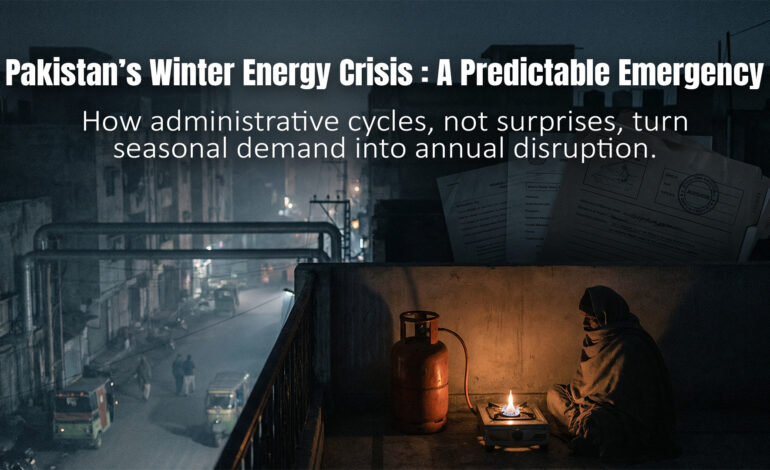
Pakistan’s recurring winter gas shortages and LPG price volatility are commonly described as crises, often framed as sudden supply disruptions or unavoidable external shocks. Yet the persistence, timing, and internal consistency of these episodes suggest a different diagnosis. Winter energy stress is not an unanticipated event but a calendrically predictable condition embedded within the country’s administrative cycle. Demand rises each year within a narrow and well-documented temperature band, consumption patterns repeat with minor variation, and institutional actors are aware of the timeline months in advance. Despite this, winter demand continues to be operationally treated as an exception rather than a routine governance function, converting predictability into emergency through design rather than surprise.
At the policy level, winter energy demand is formally acknowledged. Forecasts are prepared, briefings circulated, and summaries approved across federal and provincial layers. Gas utilities submit projections, regulators review balance statements, and inter-ministerial coordination meetings note seasonal pressure points. However, acknowledgement does not translate into binding operational sequencing. Procurement decisions, storage planning, and distribution controls remain temporally misaligned with demand peaks. The result is a system that recognizes winter as a concept but approaches it administratively as a contingency, triggering reactive measures once shortages are already socially visible.
Responsibility for winter preparedness is distributed across multiple authorities without consolidation at a single point of decision. Federal regulators approve frameworks and pricing structures, line ministries oversee imports and allocations, provincial departments manage enforcement and consumer interface, and local administrations respond to ground-level disruptions. Each layer performs a defined function, yet no institution holds end-to-end accountability for winter energy continuity. This diffusion allows procedural compliance without outcome ownership. When shortages emerge, corrective action is fragmented, incremental, and often retrospective, reinforcing a cycle in which responsibility is shared but accountability remains elusive.
Regulatory design plays a central role in this pattern. Price notifications, allocation rules, and licensing frameworks are often structured around average annual conditions rather than peak seasonal stress. Procurement timelines for LNG and LPG are frequently calibrated to fiscal or contractual cycles rather than demand curves. Storage policy, where it exists, prioritizes cost minimization over resilience, resulting in limited buffers precisely when volatility is highest. Distribution oversight focuses on compliance at the point of sale rather than continuity across the season, leaving gaps that become consequential during periods of constrained supply.
Within these gaps, intermediaries and informal networks operate predictably. The emergence of hoarding, selective distribution, and price escalation during winter months is not an aberration but an adaptive response to structural lag. Where oversight weakens and enforcement becomes episodic, actors with storage capacity, transport access, or local influence can arbitrage scarcity. These behaviors are often labeled as cartelization or mafia activity, yet they are better understood as rational adaptations to an environment where rules are inconsistently applied and incentives are misaligned. The system rewards anticipation and penalizes compliance during peak stress periods.
Households and small businesses bear the cumulative cost of this architecture. Urban consumers face abrupt supply interruptions, while rural areas experience prolonged scarcity. LPG price spikes disproportionately affect lower-income populations who rely on cylinders for heating and cooking. Informal rationing becomes normalized, with consumers adjusting consumption patterns, seeking alternative fuels, or paying premiums to secure supply. These adjustments are not captured in formal assessments of energy performance, yet they represent real economic and social costs absorbed outside the administrative ledger.
The distinction between institutional roles becomes particularly visible during winter. Some institutions approve frameworks and issue notifications, fulfilling their procedural mandates. Others manage implementation under constrained conditions, improvising enforcement and distribution controls. A third set of actors benefits from opacity and delay, leveraging informational asymmetries and logistical bottlenecks. Citizens, meanwhile, absorb uncertainty through adaptive behavior, adjusting daily routines, business operations, and household budgets. This distribution of roles is stable year to year, indicating not failure of awareness but normalization of a particular governance equilibrium.
Climate stress amplifies these dynamics without originating them. Colder spells, extended winters, or erratic weather patterns increase demand volatility, narrowing margins for error. However, climate variability exposes rather than creates institutional fragility. The absence of integrated winterization planning across energy, environment, and local governance systems becomes more visible under stress. Climate units produce projections, energy departments manage supply, and local administrations respond to immediate effects, yet coordination remains ad hoc. The system responds sequentially rather than synchronously, reinforcing reactive governance.
The language of emergency plays a functional role in sustaining this cycle. Declaring winter shortages as crises legitimizes stop-gap interventions, discretionary allocations, and temporary enforcement drives. These measures provide short-term relief and public signaling without altering underlying structures. Emergency framing also diffuses responsibility, as crises are, by definition, exceptional. When emergencies recur annually, their repetition becomes normalized, reducing institutional pressure to redesign processes that convert predictable demand into predictable stress.
Procurement timing illustrates this pattern clearly. Decisions on imports are often finalized close to the onset of winter, influenced by price considerations, fiscal constraints, and approval cycles. While economically rational in isolation, this timing reduces flexibility when demand spikes or supply chains tighten. Storage levels remain thin, leaving little room to absorb shocks. Distribution controls are then intensified post hoc, focusing on visible outlets rather than upstream flows. Each step is defensible within its mandate, yet collectively they produce systemic vulnerability.
Enforcement continuity is another structural issue. Monitoring intensifies during peak shortages and relaxes once temperatures rise. This episodic enforcement signals to market actors that compliance is seasonally variable. Predictably, behaviors adjust accordingly. Long-term deterrence is weakened, and short-term gains from non-compliance increase. The system oscillates between tolerance and crackdown, rather than maintaining consistent oversight calibrated to seasonal risk.
For policymakers, the recurrence of winter energy stress often registers as operational fatigue rather than structural signal. Briefings summarize familiar constraints, approvals authorize familiar interventions, and public management focuses on mitigation rather than diagnosis. Yet repetition itself is diagnostic. When the same pattern unfolds annually with minor variation, it indicates a governance design that converts predictability into disruption. The issue is not absence of knowledge but the absence of institutional mechanisms that bind foresight to execution.
Pakistan’s winter energy shortages thus reflect a seasonal governance failure embedded in administrative cycles, regulatory timing, and accountability diffusion. Climate stress, market behavior, and consumer adaptation interact within this framework, amplifying visible effects without altering core dynamics. Understanding this pattern does not require attributing blame or prescribing reform agendas. It requires recognizing that what is treated as an annual emergency is, in fact, a routine function performed through emergency instruments. Until winter demand is governed as a standing operational reality rather than a recurring contingency, the cycle is likely to persist, absorbing costs quietly through households, markets, and administrative credibility.
A public service message