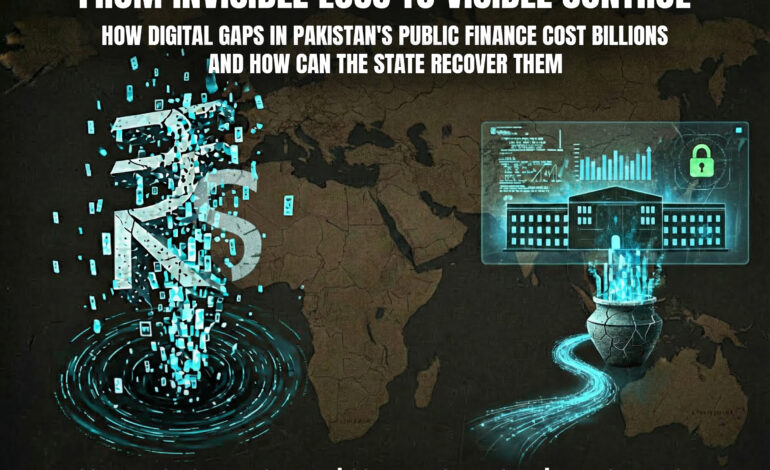
From Invisible Losses to Visible Control: How Digital Gaps in Public Financial Management Cost Pakistan Billions—and How the State Can Recover Them(Corruption & Management | Governance Reform | Public Finance)

By Dr. M. Ahsan Sardar
Pakistan’s fiscal debate is most often framed around taxation shortfalls, debt sustainability, and external financing pressures. These issues are visible, measurable, and frequently debated. Less visible, but no less consequential, is a structurally embedded challenge that quietly erodes public resources over time: systemic financial leakage arising from weak management systems rather than overt corruption. Inefficiencies across procurement, expenditure tracking, project execution, and audit cycles have accumulated year after year, gradually draining public funds at a scale that increasingly rivals headline fiscal deficits. This erosion does not occur through dramatic scandals or singular institutional failures, but through routine processes where money moves faster than oversight and authority extend further than real-time visibility.
Multiple official audits, Planning Commission reviews, and multilateral public financial management assessments converge on a sobering conclusion: when cost overruns, abandoned or delayed projects, procurement inefficiencies, reconciliation lags, and weak expenditure controls are aggregated over extended budget cycles, cumulative fiscal losses plausibly exceed PKR 1 trillion. This figure is not attributable to any single sector, province, or institution. Rather, it reflects the compound effect of thousands of small, individually unremarkable leakages that occur in spaces where digital integration is weak and information flows are fragmented. The challenge, therefore, is not one of institutional collapse or widespread malfeasance. It is a management problem amplified by digital blind spots situations where rules exist, responsibilities are defined, and funds are authorized, but system-wide visibility remains incomplete.
Public procurement illustrates this dynamic with particular clarity. According to the World Bank’s Country Procurement Assessment Report and repeated observations by the Auditor General of Pakistan, procurement accounts for approximately 25 to 30 percent of total government expenditure. Even marginal inefficiencies in this domain therefore translate into substantial absolute losses. Documented weaknesses include non-standardized tender documentation, fragmented publication of procurement notices that limits competition, weak price benchmarking across departments, and insufficient digital tracking of post-award contract variations. International benchmarks indicate that inefficient procurement processes inflate costs by 10 to 20 percent even in the absence of fraud. Applied conservatively to Pakistan’s procurement volumes, this suggests avoidable losses running into hundreds of billions of rupees over multiple years. Significantly, these inefficiencies persist despite the presence of procurement laws and regulatory authorities, underscoring that the deficit lies in systems and integration rather than in formal rules.
A similar pattern emerges in development spending. Reviews conducted by the Planning Commission consistently show that a substantial proportion of Public Sector Development Programe projects miss original completion timelines, exceed approved cost ceilings, and ultimately deliver lower economic returns than anticipated. A review covering the 2018–2022 period found that over 30 percent of PSDP projects experienced cost overruns, with average delays ranging from two to five years. Escalations absorbed funds originally earmarked for new initiatives, narrowing fiscal space for future development. These outcomes are seldom the result of headline corruption cases. More often, they stem from weak project monitoring systems, delayed feedback between implementing agencies and central planners, and misalignment between physical progress and financial disbursement. When deviations are detected months or years later, corrective action becomes costly, and inefficiency hardens into a systemic feature rather than a temporary deviation.
Fragmentation across financial information systems further deepens these vulnerabilities. Pakistan’s public finance architecture spans federal and provincial budget platforms, line ministry accounts, provincial and district treasuries, project management units, and banking interfaces. Many of these operate on non-interoperable systems, with reconciliations occurring weeks or even months after funds have been released. International Monetary Fund public financial management assessments have repeatedly noted that such delays undermine real-time expenditure control, weaken cash management, and shift oversight from prevention to post-facto explanation. The issue is not uncontrolled spending, but late detection—by the time anomalies surface, fiscal and administrative costs of correction have already escalated.
Comparative experience highlights that Pakistan’s challenges are not unique, nor are they inevitable. A management comparison drawn from World Bank, IMF, and OECD public financial management indicators illustrates how peer economies have addressed similar constraints through digital integration rather than expanded punitive oversight:
| Indicator | Pakistan | Malaysia | Turkey | Indonesia |
| Integrated e-procurement coverage | Partial, fragmented | Nationwide | Nationwide | Nationwide |
| Real-time treasury dashboards | Limited | Advanced | Advanced | Moderate |
| Project cost overrun rate | High (≈30%) | Low (≤10%) | Moderate | Moderate |
| AI-assisted audit analytics | Pilot level | Operational | Operational | Emerging |
| Time lag in expenditure reconciliation | Weeks–Months | Real-time–Days | Days | Days |
The key insight from these comparisons is that countries which successfully reduced leakage did so by digitally integrating procurement, treasury, and audit functions, not by expanding discretionary authority or politicizing accountability mechanisms. Evidence from within Pakistan supports this conclusion. Punjab’s phased adoption of e-procurement through the Punjab Procurement Regulatory Authority led to increased bidder participation, shorter tender processing times, and improved audit traceability. Auditor General reports indicate fewer procurement-related audit observations in departments using digitized systems compared to those relying on manual processes. Internationally, Indonesia’s introduction of a Treasury Single Account linked with real-time dashboards reduced idle cash balances, improved budget predictability, and recovered substantial dormant funds, all under a reform narrative framed around financial discipline rather than anti-corruption campaigns. Turkey’s Supreme Audit Institution integrated data analytics across procurement and payments, enabling risk-based audits and faster identification of systemic inefficiencies, while shifting emphasis from transaction policing to performance assessment without expanding audit authority.
It is essential to situate this analysis correctly within Pakistan’s institutional context. Civil administration, development agencies, and oversight bodies operate under high transaction volumes, capacity constraints, and legacy systems designed for a far smaller fiscal footprint. The Armed Forces and security institutions, often referenced in public discourse, operate largely outside civilian procurement and PSDP frameworks. The fiscal leakages discussed here arise primarily within civilian public financial management systems and reflect complexity, scale, and outdated tools rather than institutional intent. Framing the issue as governance modernization rather than blame preserves institutional trust while enabling reform grounded in evidence.
Reducing these losses requires aligning policy design, operational execution, and oversight within a shared digital environment. Fully integrated e-procurement ecosystems can standardize workflows from tender publication to contract execution, embed uniform classification codes, and digitally track contract variations. Real-time treasury and expenditure dashboards can link budget authorizations, commitments, and payments, allowing early detection of anomalies and improving cash management. AI-enabled audit risk engines can analyze entire transaction universes to identify patterns and outliers, enabling auditors to focus on high-risk areas while expanding coverage. Interoperable data frameworks built on shared standards and secure access protocols can connect planning bodies, finance authorities, and oversight institutions without centralizing control. Parliamentary oversight can be strengthened within this architecture by shifting attention from individual transactions to systemic trends through dashboard-based briefings, anchoring accountability in outcomes rather than attribution.
The idea of an “invisible trillion” should therefore be understood not as an accusation, but as a management diagnosis. Pakistan’s fiscal system manages vast resources in a complex and demanding environment. When digital visibility lags behind authority, inefficiency becomes embedded even in well-intentioned structures. The path forward lies not in harsher rules or louder accountability, but in smarter systems that transform governance from reactive to anticipatory. When public spending becomes visible, comparable, and analyzable in real time, leakage narrows naturally—without confrontation, politicization, or institutional erosion. By embedding digital reform at the core of fiscal discipline, Pakistan can recover lost value, strengthen service delivery, and enhance public confidence quietly, professionally, and sustainably.
A public service message