
Ramzan Under Pressure: Policy Gaps, Urban Strain and the Case for Vigilant Governance

Ramzan in Pakistan is more than a month of fasting; it is a period that tests the resilience of urban systems, social cohesion, and governance structures. While citizens engage in spiritual reflection and communal solidarity, the practical realities of city life, including traffic
Financial Integrity and Public Dignity: Rethinking the Mass Blocking of Bank Accounts in Pakistan

Financial regulation is not an abstract exercise conducted in air-conditioned boardrooms. It travels through neighborhoods, pension lines, village branches, biometric machines, and worn hands that have worked for decades. When thousands of bank accounts are temporarily blocked across the country in the name
The Currency of Words: Media, Power, and Geo Economic Rivalry

The vocabulary of media freedom is undergoing a structural transformation. For decades, the dominant paradigm revolved around a binary. Free speech was equated with democratic vitality. Restriction was equated with authoritarian decline. That binary now appears inadequate to describe the realities of a

Calibrated Silence: Strategic Media Governance in the Era of Information Warfare

Across the world, the struggle over media is no longer framed simply as freedom versus censorship. It has evolved into a contest over narrative sovereignty, institutional legitimacy, and strategic stability. States are not merely suppressing speech. They are redesigning the architecture through which

Pakistan’s War Embedded Grand Strategy: Navigating a Dual‑Front Security Dilemma in an Era of Persistent Conflict
In the realm of strategic studies, the concept of a “war embedded grand strategy” describes a state whose external security environment is not episodically hostile but constitutively warfare‑like. Pakistan exemplifies this condition as a medium power state locked within a persistent, dual‑front security
Pakistan at the Indo-Pacific Eurasian Seam: Strategic Autonomy and the Hybrid Order Frontier
In the evolving architecture of twenty-first century geopolitics, power is neither purely maritime nor exclusively continental. It is increasingly hybrid, layered, and contested across land, sea, cyber, and cognitive domains. At the fulcrum of this emerging Indo-Pacific Eurasian seam, Pakistan occupies a strategic
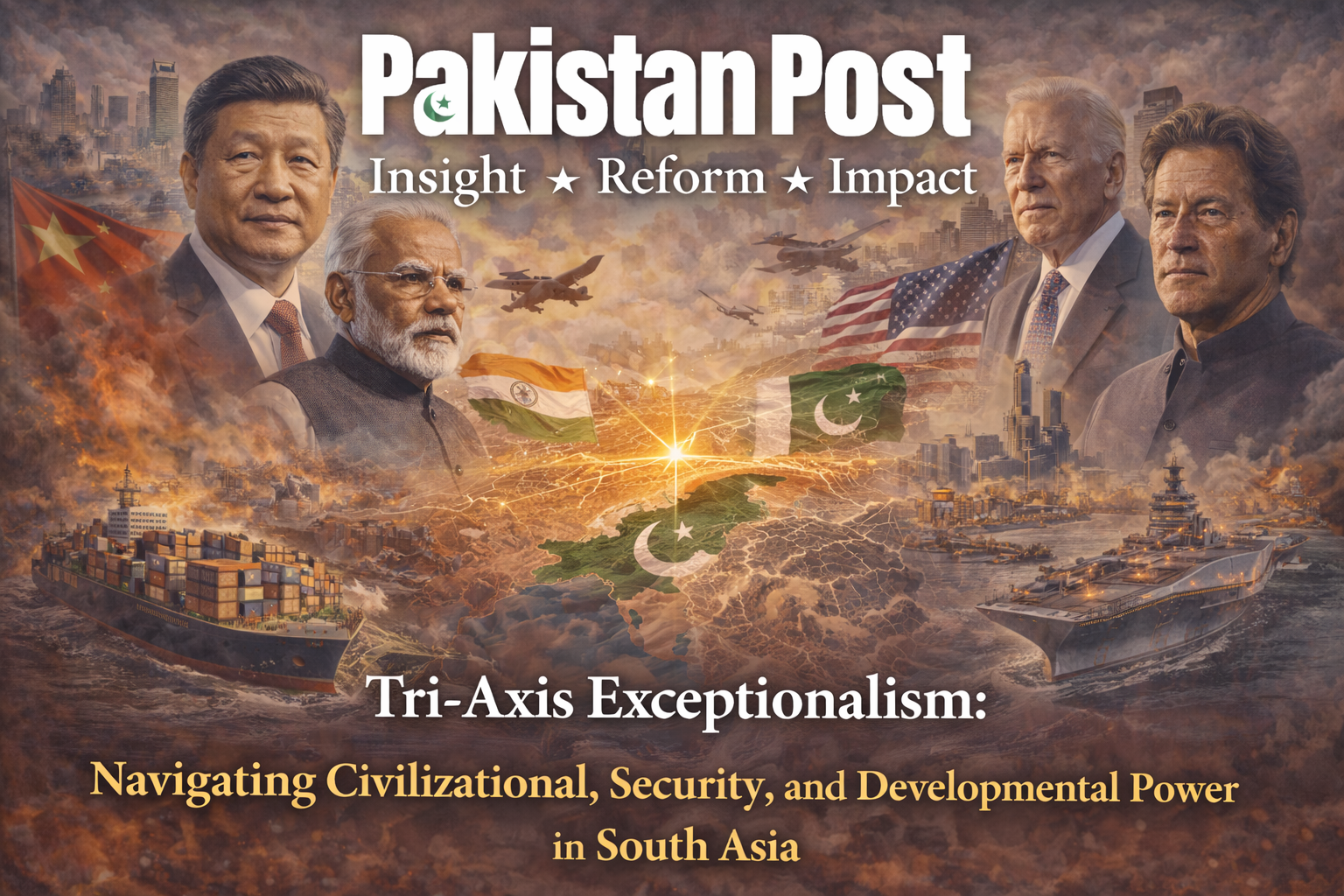
Tri-Axis Exceptionalism: Navigating Civilizational, Security, and Developmental Power in South Asia
Competing narratives of exceptionalism have long shaped the geopolitical landscape of South Asia, defining the contours of regional influence and strategic alignments. India, asserting its role as the largest democracy in the world, projects a vision of civilizational leadership and moral authority, framing

Driving Pakistan’s Growth:Rodrik, BRI, and Pakistan’s Manufacturing Future
Dani Rodrik’s work on economic development and structural transformation rests on two interlinked propositions: first, that sustained growth, rapid poverty reduction, and structural transformation are fundamentally driven by industrialization and competitive manufacturing; and second, that well‑designed industrial policyselective, pragmatic, and learning‑oriented support for

Pakistan’s Product Space Trap: Pathways to Export Upgrades and Geoeconomic Resilience

Pakistan’s position in the global product space reveals deep structural vulnerabilities that erode its export competitiveness and macroeconomic stability. At its core, this analysis, grounded in Ricardo Hausmann’s pioneering framework, illuminates not just economic diagnostics but a geoeconomic philosophy. Nations thrive not by

The Broken Social Contract: Why Pakistani Cities Feel Unlivable

Pakistan is urbanizing at a pace faster than its governance capacity. Over the past two decades, millions have migrated from rural districts to metropolitan centers in search of employment, education, and opportunity. Cities such as Karachi, Lahore, Islamabad, Peshawar, and Quetta have expanded