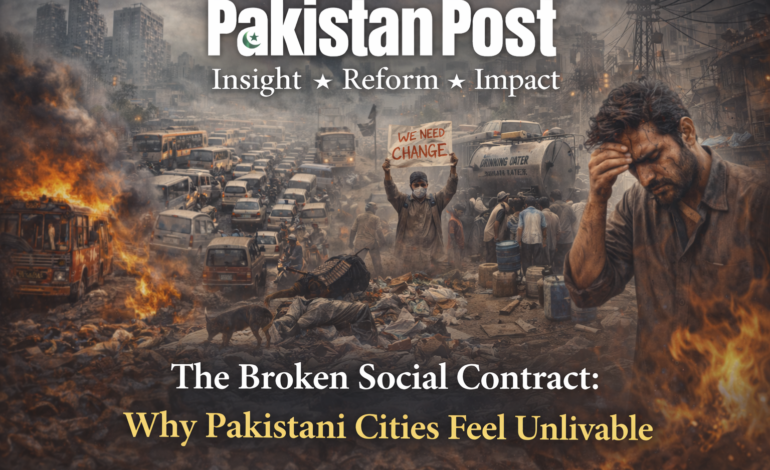
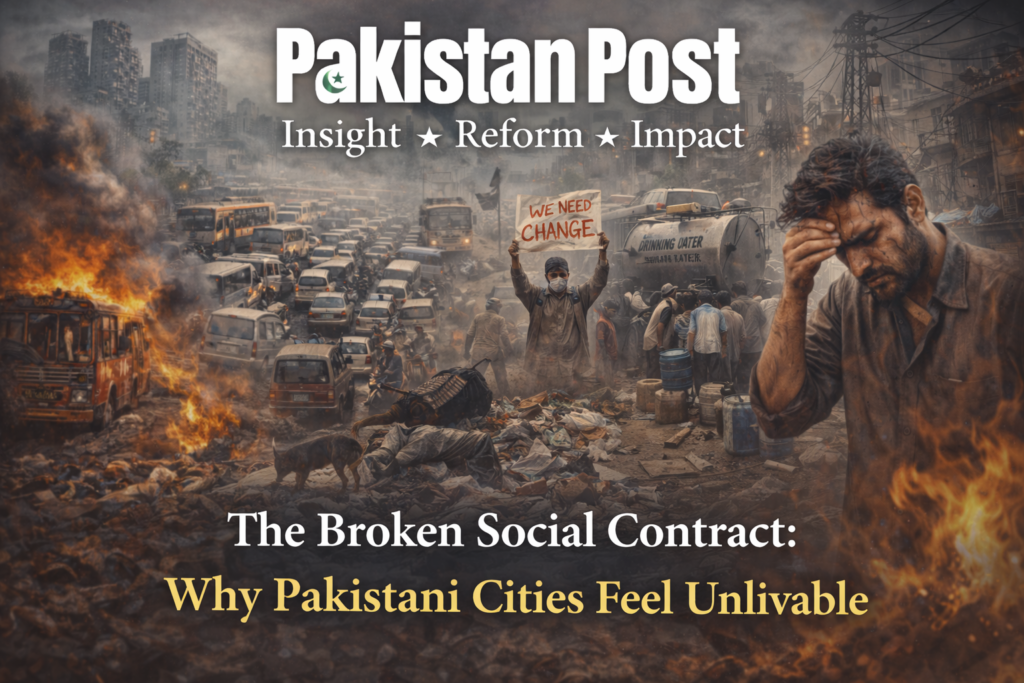
The Broken Social Contract: Why Pakistani Cities Feel Unlivable

Pakistan is urbanizing at a pace faster than its governance capacity. Over the past two decades, millions have migrated from rural districts to metropolitan centers in search of employment, education, and opportunity. Cities such as Karachi, Lahore, Islamabad, Peshawar, and Quetta have expanded outward and upward. Yet while the skyline has changed, the underlying civic structure has not kept pace.The result is not merely inconvenience. It is the gradual erosion of the social contract.Urban citizens pay fuel taxes embedded in every liter purchased. They pay electricity bills layered with surcharges. Salaried individuals contribute withholding tax at source. Property owners pay annual levies. Consumers absorb indirect taxes through daily purchases. In return, they expect functional roads, regulated markets, reliable public transport, sanitation, and predictable civic order.
Instead, they navigate congestion, inflationary spillovers, decaying infrastructure, and inconsistent service delivery.This is not a partisan accusation. It is a structural concern.Pakistan’s urban population now constitutes a substantial proportion of the national total, and demographic projections indicate continued expansion. Yet municipal governance remains administratively fragmented. Overlapping jurisdictions between provincial authorities, development agencies, municipal corporations, and special boards dilute accountability. Revenue collection mechanisms exist, but expenditure efficiency and transparency remain uneven.
Consider traffic management. During peak seasons, particularly in Ramzan, major arteries in large cities experience near paralysis before iftar. Commuters spend extended hours in gridlock. Emergency vehicles struggle to pass. Productivity declines as fuel burns idly in congested corridors. This is not simply a matter of impatient drivers. It reflects insufficient urban planning, weak enforcement of parking regulations, limited investment in mass transit integration, and lack of coordinated traffic engineering.Fuel consumed in traffic is already taxed. Citizens effectively pay twice, once through direct expenditure and again through lost time.
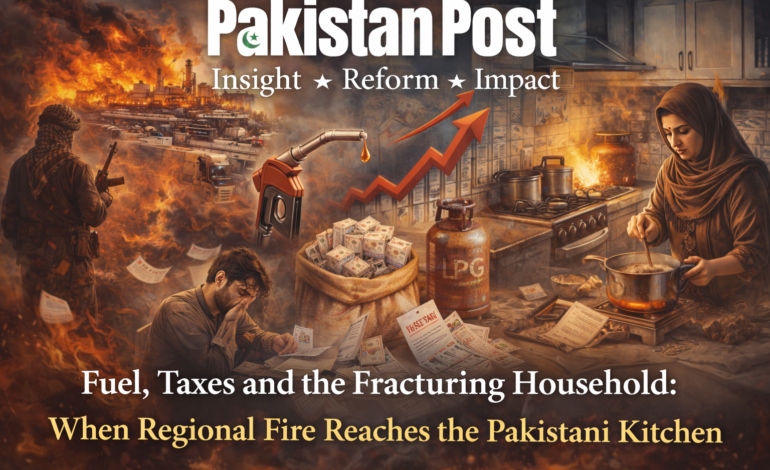
Public transport remains inadequate relative to population density. While certain corridors in metropolitan areas have benefited from bus rapid transit systems, integration with feeder routes is limited. Informal transport operators fill the gap, often without standardized fare regulation or safety compliance. For lower income workers dependent on daily travel, rising fuel prices translate quickly into fare hikes. When global oil volatility, influenced by geopolitical shifts involving actors such as Iran or policy decisions in energy markets shaped by the Organization of the Petroleum Exporting Countries, drives domestic fuel adjustments, urban commuters bear immediate consequences.
Thus, regional instability, though geographically distant, enters the domestic sphere through the fare charged by a rickshaw driver.Encroachments represent another chronic urban failure. Markets spill onto sidewalks and road shoulders, narrowing passageways and compounding congestion. Enforcement campaigns periodically clear areas, only for encroachments to reappear due to inconsistent follow through and complex socioeconomic dependencies. Vendors rely on high footfall zones for survival. Municipal authorities struggle to balance regulation with livelihood protection. The absence of structured, affordable vending spaces transforms regulation into a cycle of eviction and return rather than sustainable planning.
Sewerage and drainage failures pose more serious risks. Seasonal rains expose the fragility of outdated infrastructure. Overflowing drains contaminate water supplies and elevate the risk of waterborne diseases. In lower income neighborhoods, open sewage channels remain a persistent hazard. Yet residents in these areas contribute indirectly through utility payments and consumption taxes. The mismatch between taxation and sanitation fuels resentment that is less vocal but deeply felt.
Price control mechanisms illustrate another layer of institutional weakness. Committees are formed to monitor essential commodity prices, especially during high demand periods. Official rate lists are displayed. However, enforcement varies widely. Retail prices frequently exceed notified rates due to supply chain inefficiencies, transport cost increases, and weak inspection regimes. When fuel prices rise, freight costs increase. When freight costs increase, wholesale prices adjust. When wholesale prices adjust, retail margins stretch. Without real time monitoring capacity, committees operate reactively rather than proactively.Inflation therefore becomes spatial. It differs from one neighborhood to another, reflecting local enforcement capacity.
Municipal taxation exists in multiple forms, property tax, water charges, commercial fees, parking fees, and development charges. The aggregate burden on formal property holders and registered businesses is significant. Yet visible reinvestment in neighborhood infrastructure often lags. Roads remain uneven. Streetlights malfunction. Waste collection schedules are inconsistent. When residents perceive that taxation is not translating into tangible improvement, civic trust weakens.
This erosion of trust has broader implications. Urban centers are engines of economic growth. Small and medium enterprises rely on predictable logistics, stable electricity, and accessible customers. When congestion inflates delivery times and inconsistent utilities raise operating costs, competitiveness declines. Investors factor infrastructure reliability into location decisions. Governance inefficiency thus carries macroeconomic consequences.
At the same time, urban hardship intersects with regional dynamics. Pakistan’s exposure to global energy markets means that fluctuations in crude oil prices, often triggered by geopolitical tensions or production decisions, directly influence domestic inflation. Higher fuel prices increase municipal operating costs for waste collection fleets and public transport buses. Electricity generation costs rise where thermal sources dominate. Provincial budgets, already stretched, must allocate more to recurrent expenditures, leaving less for infrastructure upgrades.
In this way, external volatility magnifies internal structural weaknesses. The core question returns to the social contract. Citizens accept taxation because it underwrites collective goods that individuals cannot efficiently provide alone. Roads, drainage systems, traffic signaling networks, regulated markets, and public transport require coordinated planning and pooled resources. When those pooled resources are collected but not effectively translated into service, the moral basis of taxation is strained.
Defending public interest requires acknowledging complexity. Urban governance is resource constrained. Rapid population growth outpaces planning cycles. Informal settlements expand faster than formal zoning processes. Fiscal decentralization debates complicate budget flows between federal, provincial, and local tiers. Nonetheless, structural challenges do not absolve structural responsibility. Data driven reform begins with transparency. Municipal budgets should be publicly accessible, with clear breakdowns of revenue sources and expenditure categories. Digital dashboards can track project progress and maintenance schedules. Citizen reporting platforms can integrate complaints into measurable service delivery metrics. When performance is quantified and visible, accountability shifts from rhetoric to evidence.
Urban transport planning must move beyond isolated corridors toward integrated networks. Feeder services, regulated fare structures, and digital ticketing can enhance efficiency. Investment in non-motorized transport infrastructure, pedestrian walkways and cycling lanes, reduces congestion and fuel dependence. Such measures are not cosmetic. They directly lower household transport expenditure and urban pollution levels.Encroachment management requires designated commercial zones for small vendors supported by micro leasing frameworks. Formalization increases revenue collection while preserving livelihoods. Clear zoning and consistent enforcement prevent the recurrent cycle of eviction and return that undermines both authority and commerce.
Drainage and sewerage modernization demands long term capital planning rather than seasonal emergency responses. Mapping vulnerable flood zones and prioritizing upgrades reduces health risks that disproportionately affect lower income communities. Public health expenditure linked to waterborne disease treatment often exceeds preventive infrastructure costs over time. Price monitoring mechanisms must incorporate digital supply chain data. Wholesale markets can report daily arrival volumes and price ranges electronically, allowing authorities to detect anomalies early. Consumer awareness campaigns combined with enforcement create a deterrent environment more effective than sporadic raids.
Importantly, reform should not be framed as punitive toward any group. It is not about targeting traders, motorists, or municipal workers. It is about aligning fiscal extraction with service provision.Regional instability will remain a variable in Pakistan’s policy environment. Energy markets are global. Diplomatic tensions in distant theaters influence shipping routes and insurance premiums. Yet the resilience of Pakistani cities depends on domestic governance quality. If municipalities operate efficiently, external shocks are absorbed with less disruption. If infrastructure is fragile and oversight inconsistent, even moderate price fluctuations amplify hardship.
Urban livability is not a luxury aspiration. It is a stability imperative. Cities concentrate youth populations, employment hubs, media networks, and political discourse. Frustration that accumulates in daily commutes and market transactions can quietly alter national mood. Conversely, visible improvements in cleanliness, traffic flow, and fair pricing reinforce confidence that taxation serves a purpose.The broken social contract narrative emerges when citizens feel they are financing a system that does not reciprocate in services. Repairing that contract requires measurable commitments, published targets, and institutional continuity beyond electoral cycles. Governance must be predictable, not episodic.National strength is often measured in strategic terms. Yet the durability of any state rests equally on whether its citizens can move through their cities without undue hardship, access markets without exploitation, and trust that their contributions are reinvested in collective welfare.
Pakistani cities do not feel unlivable because of one policy or one administration. They feel strained because structural pressures have accumulated without proportional institutional adaptation. Addressing this imbalance is not ideological. It is administrative and moral.Citizens are not demanding perfection. They are demanding proportionality. If they pay fuel taxes, utility bills, withholding taxes, and property levies, they expect roads that function, markets that are regulated, drainage that works, and transport that is reliable. When this exchange is balanced, social cohesion strengthens. When it is not, frustration festers.
The task before policymakers is therefore clear. Restore alignment between revenue and results. Integrate urban planning with fiscal realism. Communicate transparently. Enforce consistently. Invest strategically.National stability is defended not only at frontiers but in neighborhoods. The durability of the republic will ultimately depend on whether its cities are places of opportunity and order or congestion and neglect. The answer will define not just urban comfort but the strength of the social contract itself.
A Public Service Message