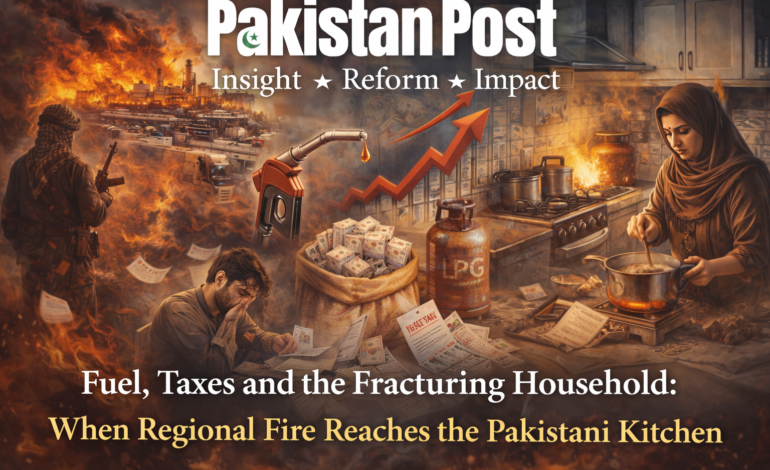
Fuel, Taxes and the Fracturing Household: When Regional Fire Reaches the Pakistani Kitchen


National stability is not secured only at borders. It is secured in kitchens, classrooms, and fuel stations.Pakistan today stands at a structural crossroads. The debate over economic reform, fiscal discipline, and revenue generation is often framed in the language of macroeconomics, deficits, reserves, conditionalities, and stabilization. Yet beneath these technical expressions lies a deeper and more consequential reality. The burden of state financing is increasingly being carried through indirect taxation, particularly petroleum levies and consumption-based taxes. This is no longer a narrow fiscal discussion. It is a question of social stability.
Pakistan’s revenue architecture relies heavily on indirect taxes, including General Sales Tax, petroleum development levy, customs duties, and utility surcharges. These instruments are efficient from a collection standpoint. They are also regressive in impact. When fuel prices rise, the effect is not limited to motorists. It cascades through transport networks, supply chains, electricity generation, agricultural inputs, and ultimately household consumption. Every increase at the pump reverberates in the price of flour, vegetables, school transport, and daily essentials.
In a country where a large proportion of households operate with little to no savings cushion, such increases are not statistical adjustments. They are existential shifts.
Indirect taxation, by design, applies uniformly across income classes. A daily wage laborer and a high net worth individual pay the same General Sales Tax on goods and the same embedded petroleum levy in fuel prices. The ratio of income consumed by these taxes, however, differs dramatically. For low income and lower middle income households, consumption constitutes the bulk of earnings. That means a larger proportion of their income flows back to the state through indirect channels.
The Federal Board of Revenue’s collections over recent years demonstrate a consistent pattern. Petroleum levy and fuel related taxes remain substantial contributors to federal revenues. This revenue stream becomes particularly attractive during periods of fiscal pressure and commitments under stabilization programs. It is predictable, broad based, and administratively simpler than expanding direct income taxation.
Yet predictability for the state does not equal sustainability for society.
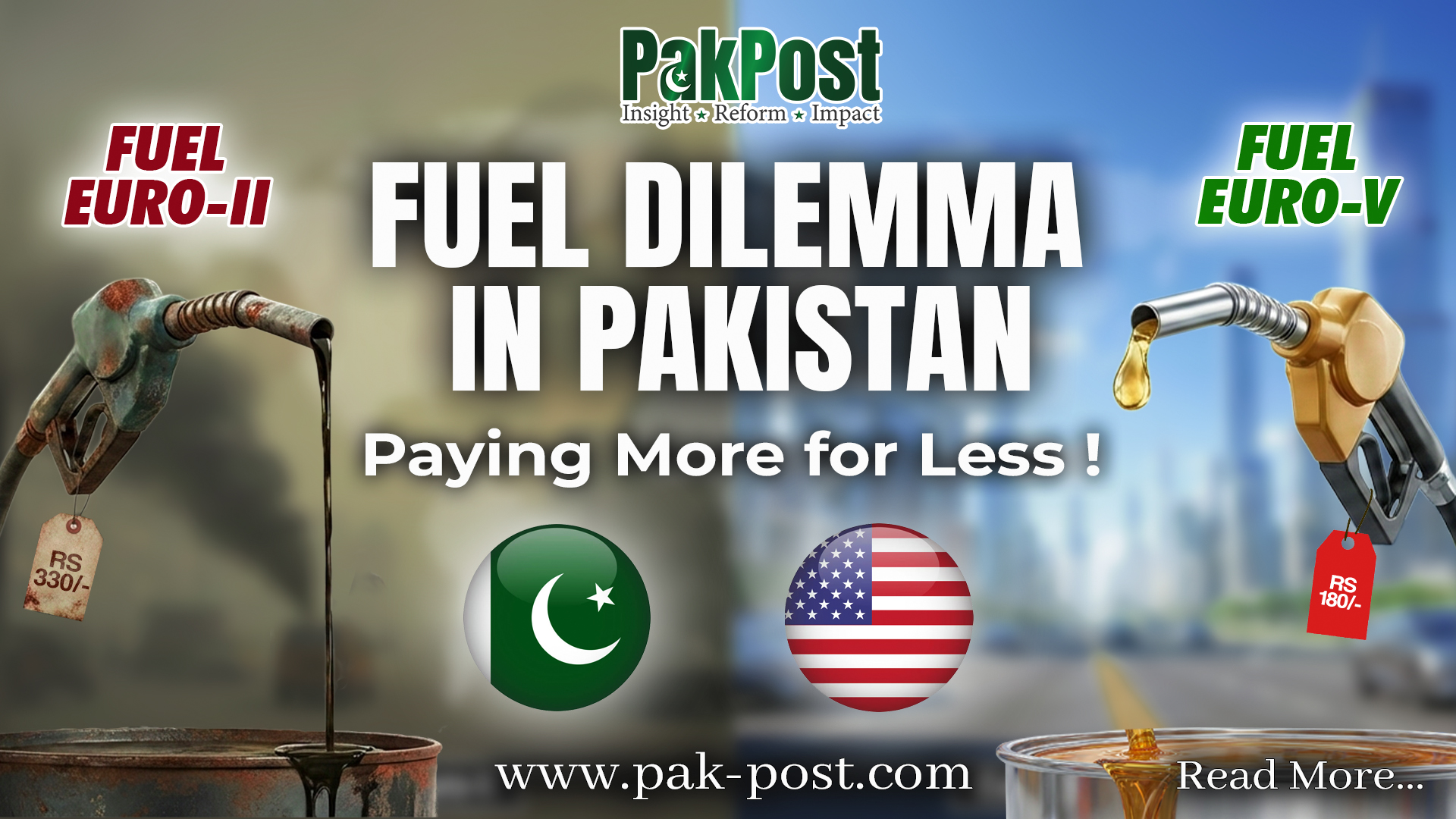
Pakistan is an energy importing country. It remains exposed to fluctuations in global oil prices shaped by production decisions of the Organization of the Petroleum Exporting Countries and geopolitical developments involving major actors such as Iran and the United States. Regional tensions in the Gulf, sanctions regimes, shipping route disruptions, or production cuts translate almost immediately into higher landed costs for imported crude.
When international prices rise, the domestic price setting mechanism faces dual pressure, increased import cost and the fiscal imperative to maintain or increase petroleum levy targets. For households, the distinction between global price adjustment and domestic levy decisions is blurred. What remains visible is the number displayed at fuel stations.
Oil, unlike many other commodities, functions as a social multiplier. A rise in petrol prices increases transport fares for buses and rickshaws, freight costs for goods moving from farms to urban markets, operational costs for small businesses reliant on generators, agricultural input costs particularly diesel powered machinery, and electricity generation costs in thermal plants. The second order effects are often more severe than the initial shock. Transporters revise fares. Wholesale markets adjust rates. Retailers preemptively increase prices to hedge against further volatility. Schools revise van fees. Households recalibrate monthly budgets.
Inflation thus becomes not only an economic metric but a behavioral phenomenon.
The Pakistani middle class, traditionally a stabilizing force, is experiencing measurable compression. Salaried individuals face withholding taxes at source, rising utility tariffs, and consumption taxes embedded in nearly every transaction. Unlike segments of the informal economy, salaried groups have limited scope to adjust declared incomes.
For lower income households, the impact is even more immediate. Food expenditure constitutes a high percentage of total income. Even a modest increase in transport or fuel cost indirectly elevates prices of perishables. Nutritional compromises become common. Protein consumption reduces. Cheaper substitutes replace higher quality items. Meal frequency adjustments occur quietly within homes.
These adjustments rarely make headlines. They accumulate silently.
At the macro level, policymakers may observe stabilization indicators such as improved reserves, narrowed current account deficit, and stronger revenue collection. At the micro level, households observe shrinking purchasing power and declining predictability. The dissonance between macro stabilization and micro strain can widen social frustration if not carefully managed.
Taxation is not merely a fiscal instrument. It is a foundation of the social contract. Citizens accept taxation in exchange for public goods, infrastructure, security, education, health services, and regulatory stability. When citizens perceive taxation as disproportionate or inadequately matched by service delivery, trust erodes.
In urban centers, traffic congestion persists despite fuel taxes embedded in every liter purchased. Public transport networks remain underdeveloped relative to population growth. Municipal services struggle with waste management and drainage systems. Rural regions face periodic energy shortages affecting irrigation and small industry. When a household pays more at the fuel station yet continues to navigate broken roads and inconsistent services, taxation begins to feel extractive rather than developmental.
Engagement with international financial institutions has often emphasized revenue mobilization and subsidy rationalization. Such reforms are designed to ensure fiscal sustainability and reduce deficits. These objectives are legitimate and necessary for a developing economy with external obligations. However, the sequencing and composition of reforms determine their social impact.
If revenue mobilization relies predominantly on indirect taxation without simultaneous broadening of the direct tax base, the distributional effect becomes uneven. If energy pricing reforms are implemented without targeted social protection buffers, the shock to vulnerable households intensifies. Policymaking requires granular analysis of which income segments bear the heaviest burden of petroleum levy increases and how household expenditure patterns shift after fuel price adjustments.
Fuel pricing also intersects with access to education. In many urban and peri urban areas, students depend on private vans or rickshaws. When fuel prices rise, transport operators revise fees. For middle income families with multiple school going children, the cumulative monthly increase is substantial. Private schools adjust tuition citing generator expenses or supply chain cost hikes. Even public institutions face higher operational costs linked to energy tariffs.
Thus an oil price shock originating in global markets ultimately influences classroom affordability. The pump and the school gate are connected realities.Economic stress carries psychological consequences. Persistent financial uncertainty increases household anxiety, reduces long term planning, and elevates intra family tension. Small business owners dependent on steady footfall and predictable overhead costs find planning increasingly difficult amid volatile input prices. Informal borrowing rises. Savings decline. Risk appetite contracts. When a society becomes more risk averse and less confident about future purchasing power, consumption slows, affecting small retailers and local markets and creating a feedback loop.
Addressing this issue does not require dramatic slogans. It requires calibrated structural reform. The direct tax base must expand meaningfully. Documentation of retail, real estate, and under taxed sectors should proceed with technological integration and simplified compliance mechanisms. When more income streams are formally taxed, pressure on consumption taxes can gradually reduce.
Transparency in petroleum levy structure can build public trust. Clear communication regarding what proportion of the fuel price reflects international cost versus domestic levy clarifies accountability. Predictable levy ceilings rather than frequent ad hoc adjustments may improve planning certainty. Targeted social protection must accompany energy price adjustments, with data linked cash transfers to lower income households mitigating regressive effects.
Investment in public transport infrastructure reduces dependency on private fuel consumption. Efficient transit systems and improved logistics networks can lower aggregate fuel demand and shield households from volatility. Agricultural supply chain modernization can reduce the fuel to food price transmission effect by improving efficiency and storage capacity.
Pakistan’s security discourse has traditionally centered on territorial integrity and regional geopolitics. These remain critical dimensions of sovereignty. Yet internal stability is equally anchored in economic fairness and household resilience. A state that secures its borders but allows disproportionate economic pressure on its most productive citizens risks subtle erosion of cohesion. Conversely, a taxation model perceived as equitable reinforces national solidarity during external challenges.Regional tensions will continue. Oil markets will fluctuate. International financial conditions will tighten and loosen cyclically. The question is not whether external shocks will occur. The question is how domestically prepared we are to absorb them. Resilience is not built only through foreign reserves and defense capacity. It is built through fair taxation, efficient service delivery, and predictable economic governance.
Pakistan does not face a choice between fiscal responsibility and social justice. It faces the challenge of aligning them. Indirect taxation and petroleum levies have provided short term fiscal relief and administrative efficiency. Yet over reliance on these tools transfers volatility from global markets directly into household budgets. The result is not immediate unrest but gradual social fracture, the quiet compression of the middle class, the silent nutritional compromise of lower income families, and the shrinking optimism of small entrepreneurs.
National stability is not secured only at borders. It is secured in kitchens, classrooms, and fuel stations. If taxation policy recognizes this truth and reform balances revenue needs with social equity, Pakistan can transform fiscal consolidation from a source of strain into a foundation of shared resilience. That transformation will define the strength of the republic far more than any quarterly indicator ever could.
A Public Service Message