
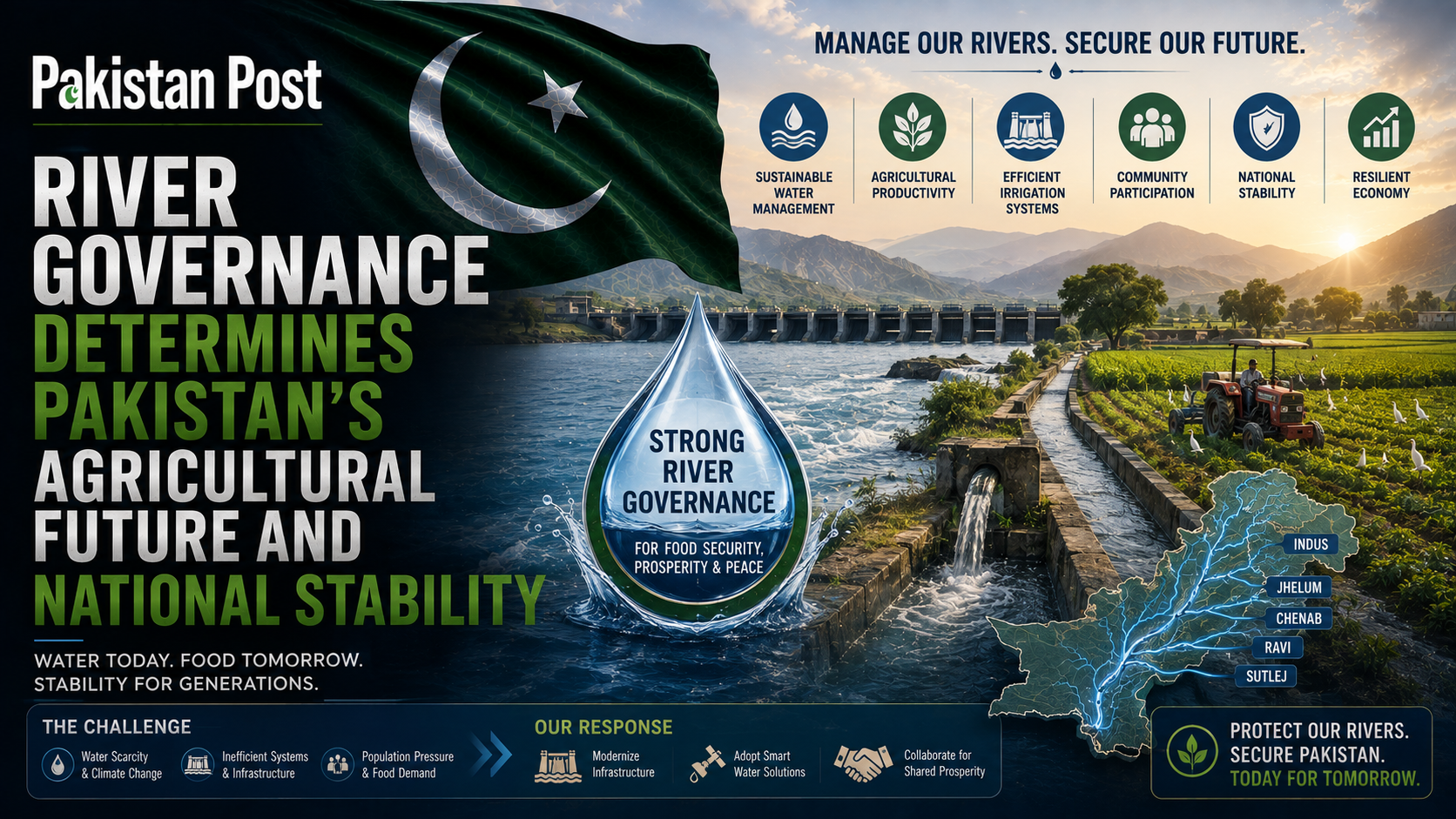
River Governance Determines Pakistan’s Agricultural Future and National Stability

Every monsoon season Pakistan confronts a familiar national dilemma that extends far beyond the immediate spectacle of inundated villages, submerged highways and emergency evacuations. Floods are frequently described as natural disasters, yet the scale of recurring agricultural destruction increasingly reflects institutional choices rather
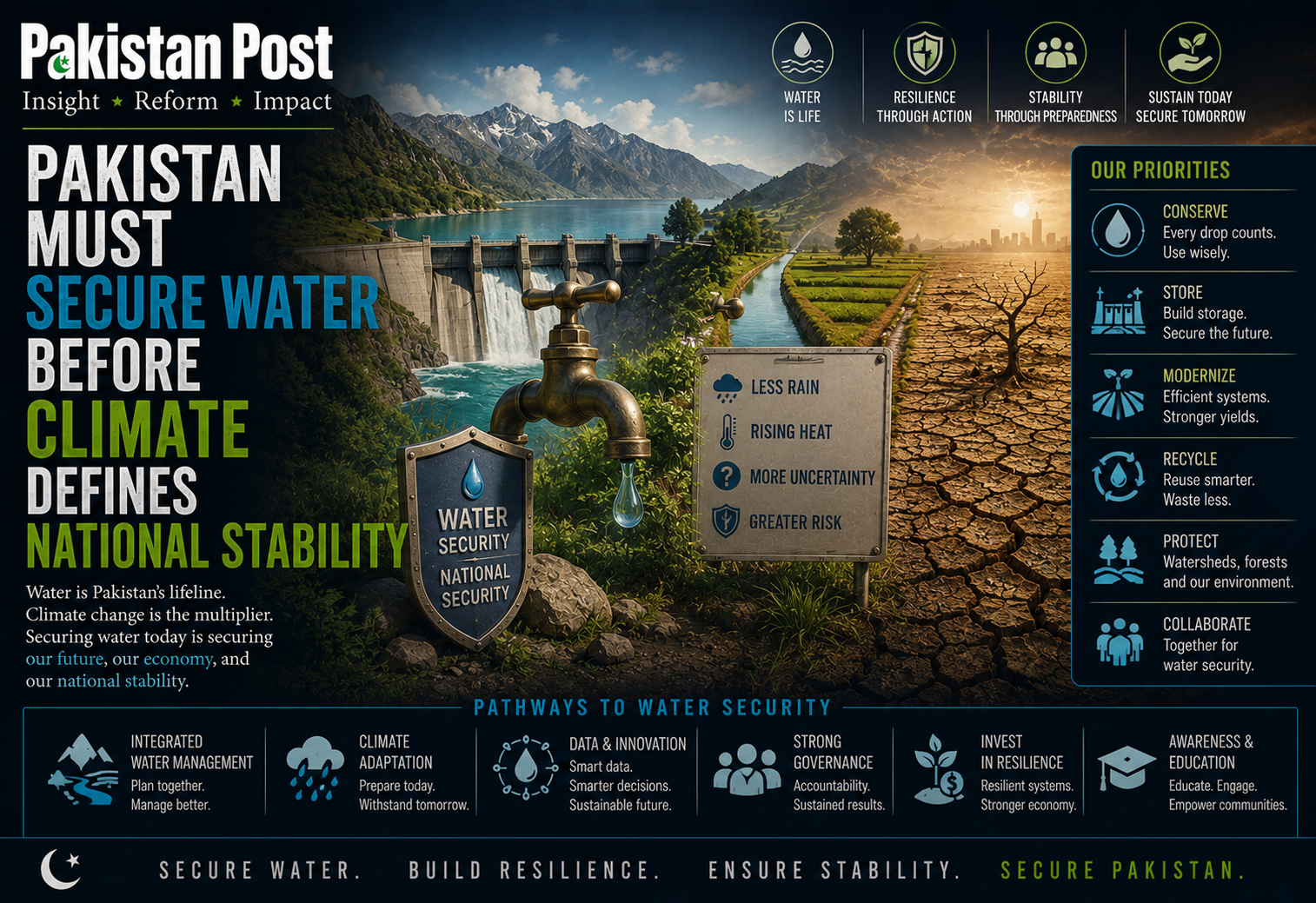
Pakistan Must Secure Water Before Climate Defines National Stability
Water has always shaped the geography, economy and strategic identity of Pakistan, yet the country now faces a transformation in which water is no longer merely a developmental concern but an increasingly decisive element of national security. Climate variability, demographic expansion, urbanisation, industrial
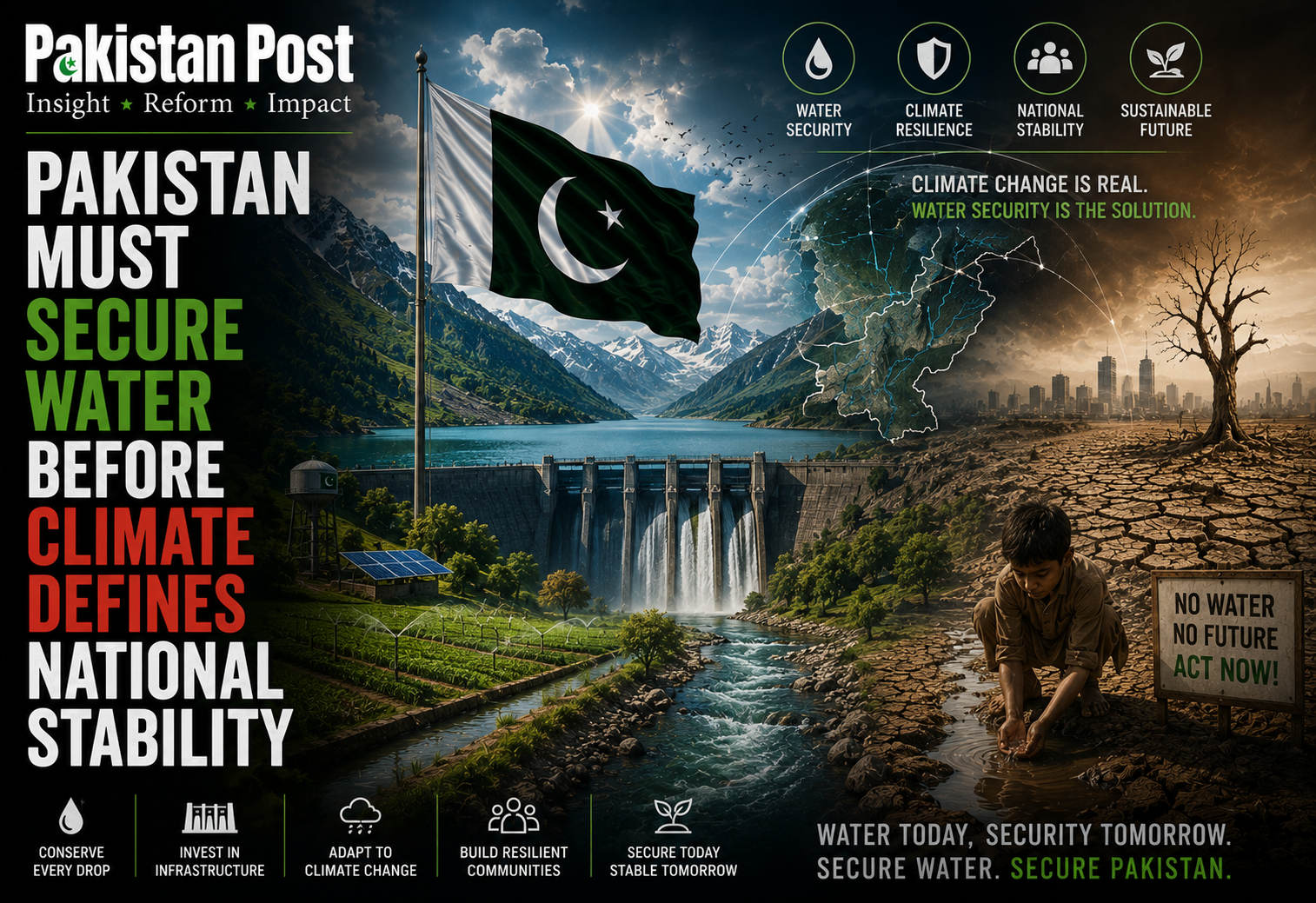
Pakistan Must Secure Water Before Climate Defines National Stability
Water has always shaped the geography, economy and strategic identity of Pakistan, yet the country now faces a transformation in which water is no longer merely a developmental concern but an increasingly decisive element of national security. Climate variability, demographic expansion, urbanisation, industrial

Water Security Will Define Pakistan’s Governance Future Today
Pakistan’s water crisis is often narrated as an environmental warning, a climate vulnerability, or a hydrological stress point on the Indus basin system. That framing is no longer sufficient because it underestimates what is fundamentally a governance failure that is now accumulating into

Debt Entrapment and Sovereign Compression in Pakistan Economy
Pakistan stands at an inflection point where macroeconomic stabilization has ceased to function as a policy objective and has instead evolved into a permanent operating condition. The recurrent reliance on external financial lifelines, particularly through multilateral adjustment frameworks, has produced a structural dependency

Climate Displacement and Pakistan Emerging Security and State Fragility Imperative.
Climate displacement in Pakistan is no longer a humanitarian footnote in development reporting, nor a seasonal consequence of monsoon variability. It has become an increasingly central axis through which questions of state capacity, governance legitimacy, and national security are being reframed both domestically

Institutional Fragmentation and the Shifting Civil–Military Equilibrium in Pakistan
Pakistan’s governance system has long been described as a layered state, where formal constitutional arrangements coexist with informal centres of authority that shape policy direction, crisis response, and strategic decision-making. Over time, this coexistence has not matured into stable power-sharing but has instead

Merit Buried in Silence
There is a quiet crisis unfolding within Pakistan’s higher education system, one that does not erupt in headlines every day yet steadily corrodes the very foundation of intellectual life in the country. It is not a crisis of infrastructure, nor solely of funding,

When Fields Run Dry and Factories Stall: Pakistan Faces a Structural Water Crisis
Water is the pulse that drives Pakistan’s economy, nourishing its fields, powering its industries, and sustaining the livelihoods of millions. Yet this pulse is weakening, signaling a crisis that is deeper and more structural than conventional droughts. The United Nations University Institute for

The Broken Social Contract: Why Pakistani Cities Feel Unlivable
Pakistan is urbanizing at a pace faster than its governance capacity. Over the past two decades, millions have migrated from rural districts to metropolitan centers in search of employment, education, and opportunity. Cities such as Karachi, Lahore, Islamabad, Peshawar, and Quetta have expanded