Water Security Will Define Pakistan’s Governance Future Today

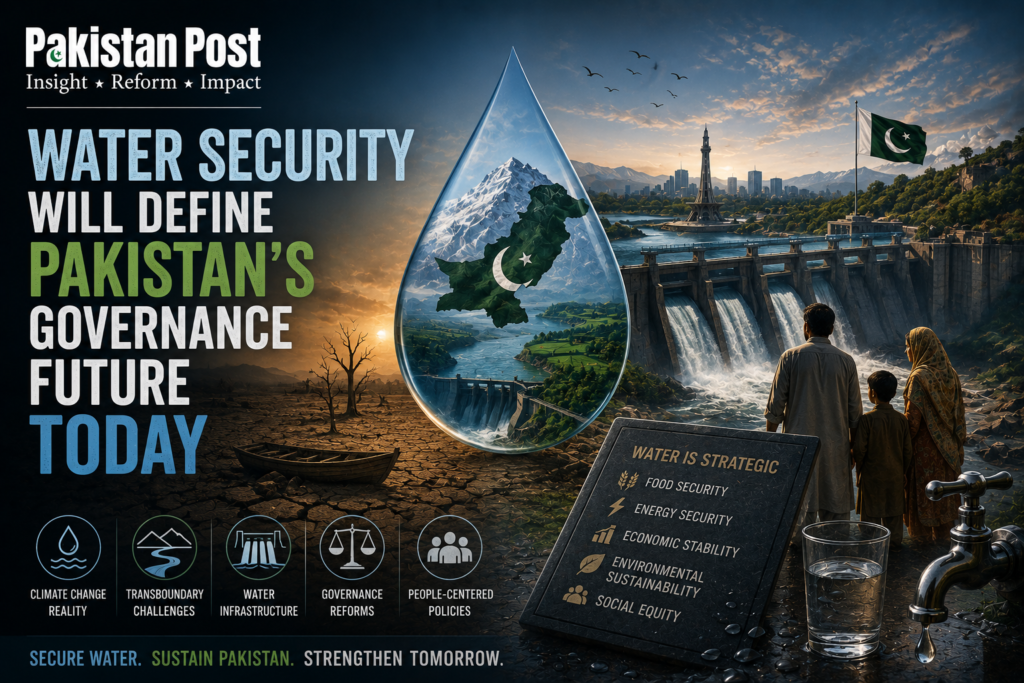
Pakistan’s water crisis is often narrated as an environmental warning, a climate vulnerability, or a hydrological stress point on the Indus basin system. That framing is no longer sufficient because it underestimates what is fundamentally a governance failure that is now accumulating into a national security condition. The distinction matters. Climate variability is real, glacier melt patterns are shifting, monsoon irregularity is increasing, and transboundary pressures are intensifying. Yet countries do not collapse from climate signals alone. They collapse when institutions fail to convert stress into management, and when policy delay compounds natural scarcity into structural breakdown. Pakistan is now approaching that threshold where water is no longer just a resource question but a state capacity question.
The first structural fault line is pricing incoherence. Water in Pakistan is effectively unpriced for agriculture, lightly priced for urban consumption, and entirely absent as an economic signal for conservation. Canal irrigation charges have remained politically frozen for decades, creating a distorted incentive system in which the largest water consumer sector behaves as if supply is infinite. This is not merely inefficiency; it is institutionalized overuse. A reform pathway exists but has been politically avoided. A graduated volumetric pricing mechanism for canal water, beginning with large landholdings above a defined acreage threshold, is technically feasible. It would require digital water measurement at distributary and watercourse levels, combined with satellite verification of crop water intensity. Without this shift, any infrastructure expansion simply increases inefficiency at scale.
The second fault line is storage deficit. Pakistan’s per capita water storage capacity is among the lowest in comparable river basin economies. This is not a technical unknown; it is a planning inertia problem compounded by interprovincial mistrust. Large dam projects have been trapped in political contestation, litigation cycles, and narrative polarization. Yet the operational truth remains that without additional seasonal storage capacity, Pakistan will continue to release surplus monsoon flows into the sea while simultaneously facing winter shortages. The solution is not only mega dams but a tiered storage architecture. That includes small and medium reservoirs at catchment level, revival of historical natural storage zones, and rehabilitation of existing sediment-choked reservoirs. Each of these requires an implementation authority insulated from provincial veto cycles, with legally binding completion timelines and audit mechanisms tied to federal fiscal transfers.
The third fault line is groundwater collapse. Pakistan has effectively moved from a surface water economy to an unregulated groundwater extraction economy without building governance systems for aquifer management. Tube wells have multiplied beyond regulatory visibility, particularly in Punjab and parts of Sindh, creating a silent depletion crisis. Unlike surface canals, groundwater does not trigger immediate political alarm. It fails quietly until wells run dry, pumping costs rise, and water tables fall irreversibly. A national aquifer mapping initiative is urgently required, using remote sensing combined with mandatory registration of all extraction points. Beyond mapping, abstraction caps must be introduced at district level with enforceable penalties. Without this, Pakistan will experience irreversible aquifer fatigue that no dam can reverse.
The fourth fault line is agricultural inefficiency. The largest share of water is consumed by low-efficiency crop patterns, particularly water intensive staples that do not align with comparative advantage or export optimization. The issue is not farmer behavior alone but policy signaling. Procurement pricing structures and subsidy regimes encourage water heavy crops while ignoring drought resilient alternatives. A reconfiguration is needed in which procurement support is gradually shifted toward crops with lower water footprints and higher value per drop. This requires aligning Ministry of National Food Security policy with water availability models, not just market demand. Extension services must be redesigned to function as climate adaptation advisors rather than traditional yield maximization agents.
The fifth fault line is urban leakage and infrastructure decay. Urban water systems in major Pakistani cities lose a significant proportion of treated supply due to leakage, illegal connections, and outdated distribution networks. This is not only a technical issue but a governance discipline failure. Urban water utilities require corporatization with independent boards, transparent loss reporting, and performance based funding. Smart metering in industrial and high consumption residential zones can immediately reduce non revenue water losses. Without urban reform, rural water stress will be compounded by internal migration into already failing city systems.
The sixth fault line is interprovincial mistrust. Water governance in Pakistan is heavily politicized through provincial identity frameworks. The Indus River system, instead of functioning as a shared national asset, has become a contested distributive arena. The absence of transparent real time data sharing among provinces intensifies suspicion and reduces cooperation. A national water data grid is essential, where flow, storage, and allocation data is publicly accessible and independently audited. This reduces narrative manipulation and allows disputes to shift from political rhetoric to technical adjudication. Strengthening the role of the Indus River System Authority with enforcement capacity rather than advisory status is central to this transition.
The seventh fault line is climate finance underutilization. Pakistan has access to multiple international climate financing mechanisms, yet absorption capacity remains weak due to fragmented project design and weak institutional coordination. Climate adaptation funds often remain unspent or are directed toward isolated pilot projects without scaling pathways. What is required is a unified national water resilience portfolio that aggregates projects under a single financing framework, allowing multilateral donors to fund systemic transformation rather than scattered interventions. This includes floodplain restoration, irrigation modernization, urban water renewal, and watershed management integrated into a single investment logic.
The eighth fault line is communication failure. Water scarcity is still communicated as an abstract future threat rather than a present operational constraint. This delays behavioral change across sectors. Public communication must move toward measurable indicators such as household consumption benchmarks, crop water footprints, and regional scarcity indices. Without behavioral signaling, policy reform remains confined to bureaucratic circles.
Taken together, these fault lines indicate that Pakistan’s water challenge is not primarily about absolute scarcity but about governability of scarcity. The question is not whether water is available but whether the state has built the institutional architecture to allocate it efficiently, equitably, and sustainably under conditions of stress. That architecture is currently incomplete.
A shift in doctrine is required from supply expansion to demand management. For decades, water policy has focused on increasing supply through dams and canals. That model is now reaching diminishing returns. The next phase must prioritize demand compression through efficiency, pricing reform, crop diversification, and leakage reduction. This is politically more difficult because it directly alters entrenched interests, but technically more impactful because it addresses the core drivers of depletion.
Institutional reform is the central axis of transformation. A National Water Commission with constitutional backing could consolidate fragmented authorities and operate with cross provincial legitimacy. Its mandate would include data integration, project approval, enforcement oversight, and crisis response coordination. Without institutional consolidation, policy fragmentation will continue to produce implementation paralysis.
Legal reform is equally important. Water rights in Pakistan remain ambiguously defined, creating uncertainty in allocation and enforcement. A codified water rights framework that distinguishes between agricultural, industrial, and domestic entitlements is necessary. This does not mean privatization of water but clarification of usage rights within a public trust model.
Technological integration offers immediate leverage. Remote sensing for crop monitoring, AI based irrigation scheduling, satellite driven flood prediction, and smart metering systems can transform efficiency without requiring immediate large scale infrastructure expansion. However, technology without institutional adoption will remain underutilized.
The national security dimension emerges when water stress begins to interact with food inflation, energy shortages, and internal migration. Hydropower variability affects energy stability, irrigation shortages affect food supply chains, and rural water collapse drives migration toward urban centers. These secondary effects convert water from a sectoral issue into a systemic risk multiplier.
The critical question is whether Pakistan still has time to treat water as a planning problem. The answer is conditionally yes, but the window is narrowing. Planning capacity must be converted into execution capacity. This requires political consensus on depoliticizing water governance, administrative reform that prioritizes technical authority, and financial restructuring that aligns incentives with conservation outcomes.
What is ultimately at stake is not only water availability but state legitimacy in managing common resources. When citizens perceive resource allocation as unfair, inefficient, or corrupt, institutional trust erodes. Water is therefore not only a physical resource but a governance legitimacy test.
Pakistan’s future stability will depend on whether it can transition from reactive crisis management to anticipatory resource governance. If it fails, water scarcity will not appear as a single catastrophic event but as a slow accumulation of pressures across agriculture, cities, energy, and social cohesion. If it succeeds, water reform could become one of the few domains where state capacity visibly improves, creating a template for broader governance renewal.
The choice is not between scarcity and abundance but between managed scarcity and ungoverned decline.
A Public Service Message