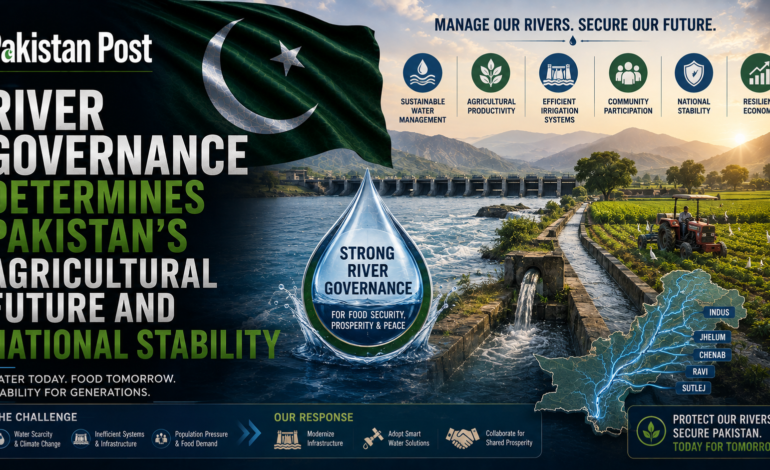
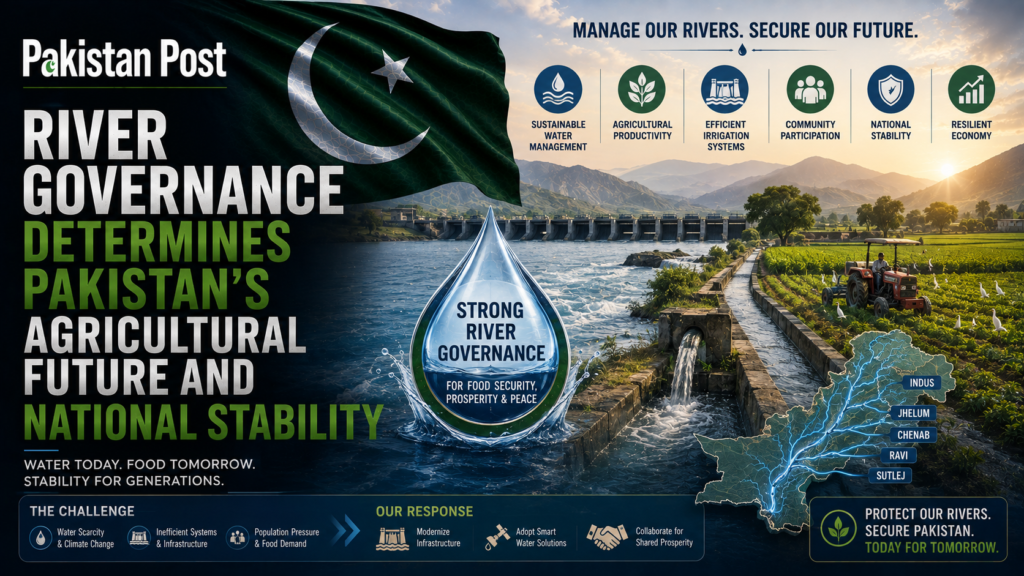
River Governance Determines Pakistan’s Agricultural Future and National Stability

Every monsoon season Pakistan confronts a familiar national dilemma that extends far beyond the immediate spectacle of inundated villages, submerged highways and emergency evacuations. Floods are frequently described as natural disasters, yet the scale of recurring agricultural destruction increasingly reflects institutional choices rather than purely climatic events. Rivers inevitably flood. Agricultural economies need not collapse. The distinction lies in governance. Across successive decades Pakistan has invested enormous fiscal resources in post disaster relief, reconstruction packages and emergency compensation, while comparatively neglecting the systematic maintenance of river systems, watershed protection, drainage infrastructure and sediment management capable of preventing much of the recurring damage.
The cumulative consequence has become one of the country’s most expensive but least acknowledged structural liabilities. Productive farmland repeatedly disappears beneath prolonged floodwaters. Irrigation infrastructure deteriorates faster than it is rehabilitated. Agricultural investors postpone mechanisation because capital cannot remain profitable within chronically uncertain production environments. Rural credit markets become increasingly fragile as repeated crop failures undermine repayment capacity. Insurance penetration remains negligible because actuarial risk becomes commercially unattractive. Consequently, preventable river mismanagement gradually transforms into a persistent constraint upon national food security, macroeconomic stability and long term strategic resilience.
Pakistan possesses one of the world’s largest integrated irrigation systems, constructed upon the Indus Basin and supported by an extensive network of barrages, canals and distributaries. Yet hydraulic engineering alone cannot compensate for deteriorating river governance. Rivers are dynamic ecological systems requiring continuous sediment regulation, floodplain management, environmental restoration and institutional coordination. Infrastructure without governance gradually becomes infrastructure without resilience.
Sedimentation represents perhaps the most underestimated challenge confronting Pakistan’s river systems. Himalayan rivers naturally transport enormous sediment loads generated through erosion, glacier movement and mountainous runoff. Without regular desilting, river channels gradually lose carrying capacity. Their beds become progressively elevated while adjacent floodplains become increasingly vulnerable. Water that historically remained within defined channels increasingly spills across cultivated land, settlements and transport corridors.
Sediment accumulation also reduces the operational efficiency of reservoirs, barrages and irrigation canals. Storage capacity declines incrementally each year. Irrigation scheduling becomes increasingly unpredictable. Hydraulic pressure fluctuates. Canal maintenance costs accelerate. Farmers experience irregular water deliveries during critical cultivation periods, reducing productivity even in years without catastrophic flooding.
Despite the predictable nature of sediment accumulation, maintenance frequently becomes reactive rather than preventive. Budget allocations often prioritise emergency repairs following disasters instead of continuous river system management throughout the year. Deferred maintenance appears fiscally convenient within annual budget cycles but produces substantially higher cumulative liabilities over longer planning horizons.
Drainage infrastructure presents an equally significant institutional weakness. Flood management depends not only upon controlling incoming water but also upon rapidly removing excess water after inundation. Across numerous agricultural districts drainage canals remain obstructed by sediment, vegetation, illegal construction and inadequate maintenance. Urban expansion has further complicated natural drainage patterns as roads, housing developments and industrial estates interrupt historical water pathways without corresponding hydraulic redesign.
When intense rainfall coincides with reduced drainage capacity, agricultural land remains submerged for extended periods. Crop losses increase exponentially with each additional day under water. Soil fertility deteriorates through prolonged waterlogging. Seed reserves disappear. Livestock diseases expand rapidly. Rural transportation networks become inaccessible precisely when harvesting equipment and emergency assistance are most urgently required.
Institutional fragmentation magnifies these engineering deficiencies. Responsibility for rivers, irrigation, drainage, agriculture, forestry, environmental regulation, disaster management and local government remains dispersed across multiple federal and provincial organisations operating under differing legal mandates, budgetary priorities and administrative cultures. Effective river basin governance requires integrated decision making across these sectors. Pakistan instead frequently operates through compartmentalised administrative structures where each institution optimises its own responsibilities without sufficient consideration of cumulative system performance.
River authorities may focus upon embankment integrity while environmental departments concentrate upon conservation regulations. Agricultural ministries pursue productivity targets independent of watershed degradation. Disaster management agencies prepare emergency response plans after institutional failures have already accumulated upstream. Local governments confront encroachment issues without adequate authority over broader river basin planning. The absence of permanent inter institutional coordination transforms manageable technical problems into national economic crises.
Floodplain encroachment further illustrates governance deficiencies rather than engineering limitations. Across many regions agricultural cultivation, housing developments, commercial construction and transport infrastructure have gradually expanded into natural floodplains historically designed by nature to absorb seasonal water surges. These areas temporarily store excess river discharge during periods of exceptional flow. Once occupied by permanent infrastructure, rivers lose natural expansion capacity while economic exposure increases dramatically.
Encroachment often occurs incrementally through weak land administration, inconsistent regulatory enforcement and political accommodation. Individual developments may appear economically rational in isolation. Collectively they narrow river corridors, increase hydraulic pressure and redirect floodwaters towards previously protected agricultural zones. The resulting damage reflects accumulated planning failures rather than extraordinary meteorological events.
Deforestation across upper watersheds compounds downstream flooding through altered hydrological behaviour. Forests regulate runoff by increasing water infiltration, stabilising soil and reducing erosion. Their removal accelerates surface runoff while simultaneously increasing sediment transport into rivers. Consequently, upstream environmental degradation directly influences downstream agricultural vulnerability.
Climate variability intensifies these existing institutional weaknesses rather than replacing them. More variable precipitation, accelerated glacier melt and increasingly intense rainfall events create additional pressure upon already stressed river systems. Climate change therefore magnifies governance failures instead of serving as their primary cause. Countries with effective watershed management generally experience lower disaster losses despite facing comparable climatic variability.
Agriculture remains particularly vulnerable because production cycles depend upon seasonal predictability. Modern farming increasingly requires substantial capital investment in precision irrigation, advanced machinery, certified seeds, digital monitoring systems and improved storage facilities. Investors require confidence that these assets will remain operational across multiple production seasons. Chronic flood uncertainty discourages precisely the technological transformation necessary for improving national productivity.
Farmers confronted by repeated flood losses understandably prioritise liquidity over innovation. Investment decisions become defensive rather than developmental. Instead of purchasing modern machinery, producers maintain ageing equipment requiring lower immediate expenditure despite inferior productivity. Fertiliser application declines where expected returns become uncertain. High value crops requiring greater capital investment become less attractive than lower productivity alternatives. Agricultural modernisation therefore slows not because technology is unavailable but because governance uncertainty undermines investment confidence.
Financial institutions encounter similar constraints. Agricultural lending depends upon reasonably predictable production outcomes. Repeated flood related defaults increase perceived credit risk, encouraging banks either to reduce agricultural lending or impose higher financing costs. Smaller farmers consequently become increasingly dependent upon informal credit networks carrying substantially higher borrowing costs.
This cycle gradually erodes rural capital formation. Equipment replacement slows. Farm infrastructure deteriorates. Household savings disappear following repeated reconstruction expenses. Educational investment declines as families prioritise immediate recovery over long term human capital development. Rural economies consequently experience structural stagnation extending well beyond individual flood seasons.
Macroeconomic consequences become equally significant. Agricultural losses reduce export earnings, increase food imports and generate inflationary pressure through reduced domestic supply. Government budgets absorb expanding reconstruction costs while simultaneously experiencing declining tax revenues from affected regions. Foreign exchange reserves encounter additional pressure through increased imports of food, fertilisers and reconstruction materials.
Repeated disasters also influence sovereign investment perceptions. Infrastructure investors increasingly evaluate climate resilience and governance quality when allocating capital. Regions characterised by recurring flood related disruption encounter higher financing costs because physical assets appear less secure. Industrial investment consequently concentrates within comparatively protected regions, widening regional economic disparities.
Pakistan’s strategic food security similarly depends upon resilient river governance. Population growth, urbanisation and changing dietary patterns require steadily increasing agricultural productivity. Expanding cultivated acreage remains constrained by water availability and environmental limitations. Productivity improvements therefore become indispensable. Flood induced capital destruction directly undermines this imperative by reducing farmers’ capacity to adopt advanced technologies capable of increasing yields.
International experience demonstrates that river governance succeeds through integrated institutional architecture rather than isolated engineering projects. The Dutch approach combines hydraulic infrastructure with continuous spatial planning, environmental restoration and sophisticated risk modelling. Rivers are provided controlled expansion space through designated overflow areas rather than permanently confined by progressively higher embankments. Flood management consequently becomes an exercise in adaptive coexistence rather than perpetual confrontation.
Japan integrates watershed forestry, sediment control, river engineering and community preparedness within unified planning frameworks. Continuous monitoring, predictive modelling and preventive maintenance reduce emergency intervention while strengthening infrastructure reliability. Local participation complements central coordination through clearly defined institutional responsibilities.
France employs river basin agencies responsible for integrated water resource management across administrative boundaries. Financing mechanisms encourage preventive investment while scientific monitoring informs long term planning. Agricultural policies increasingly incorporate watershed protection rather than treating environmental management as an independent policy sector.
Australia’s Murray Darling Basin demonstrates both the complexity and necessity of integrated governance across multiple jurisdictions. Although politically contentious, basin wide planning has progressively linked environmental sustainability, agricultural productivity and water allocation through institutional mechanisms capable of balancing competing interests under changing climatic conditions.
China has substantially expanded river chief systems assigning identifiable administrative responsibility for river management across different governmental levels. Accountability mechanisms connect environmental quality, maintenance standards and administrative performance evaluation. While institutional contexts differ considerably, the underlying principle of clearly assigned responsibility remains broadly applicable.
Pakistan need not replicate any single international model. Its hydrological conditions, constitutional framework and administrative traditions differ substantially. Nevertheless, successful experiences consistently demonstrate several common characteristics. River governance functions most effectively when scientific monitoring informs political decision making, institutional responsibilities remain clearly defined, preventive maintenance receives stable financing and environmental management becomes inseparable from agricultural planning.
Future reforms should therefore begin with institutional integration rather than additional bureaucratic expansion. Permanent Indus Basin governance mechanisms incorporating federal and provincial stakeholders should coordinate sediment management, watershed restoration, irrigation planning, environmental regulation and disaster preparedness through unified operational frameworks. Shared data platforms, common performance indicators and synchronised budgeting would substantially reduce administrative fragmentation.
Annual desilting should transition from discretionary expenditure towards mandatory infrastructure preservation supported through protected multi year financing. Preventive maintenance consistently generates higher economic returns than post disaster reconstruction. Independent engineering audits should evaluate maintenance quality using measurable hydraulic performance indicators rather than administrative expenditure alone.
Floodplain zoning requires comprehensive revision supported by digital cadastral mapping, satellite monitoring and transparent enforcement mechanisms. High risk encroachments should gradually transition through compensation and relocation policies balancing humanitarian considerations with long term national resilience. Future infrastructure approvals must incorporate hydrological risk assessments as mandatory regulatory requirements.
Watershed restoration deserves recognition as strategic economic infrastructure rather than exclusively environmental expenditure. Large scale reforestation, soil conservation, slope stabilisation and erosion control reduce sediment transport while improving water regulation. Environmental investment therefore simultaneously strengthens agriculture, energy production and disaster resilience.
Agricultural finance similarly requires redesign around climate resilience. Credit facilities should encourage flood resistant infrastructure, precision irrigation, elevated storage systems and resilient mechanisation. Crop insurance supported through advanced satellite monitoring and digital verification can gradually expand private sector participation by reducing information asymmetry and administrative costs.
Modern hydrological forecasting should integrate meteorological observation, satellite imagery, artificial intelligence and real time river monitoring into comprehensive national early warning systems. Information alone cannot prevent floods. Timely information integrated with operational decision making substantially reduces economic losses and improves emergency coordination.
Institutional accountability remains indispensable. Maintenance failures should become measurable administrative indicators subject to independent evaluation. River governance cannot remain diffused across overlapping jurisdictions where responsibility becomes impossible to identify after disasters occur. Administrative clarity encourages preventive management by connecting performance directly with institutional outcomes.
Pakistan’s establishment also possesses legitimate strategic interests in strengthening river governance beyond conventional disaster management. Agricultural stability underpins national resilience, food security, social cohesion and internal economic security. Large scale rural disruption influences migration patterns, fiscal stability and broader national preparedness. Consequently, resilient river governance increasingly constitutes strategic infrastructure alongside transport corridors, energy systems and telecommunications networks.
The central lesson emerging from Pakistan’s recurring flood experience is neither technological nor financial. Engineering knowledge exists. Hydrological science remains well established. International best practices are widely documented. The persistent constraint lies within institutional continuity, governance integration and preventive administrative culture. Rivers continuously reshape landscapes according to natural laws. Whether those processes generate national prosperity or recurring agricultural decline depends primarily upon governance systems capable of anticipating rather than merely reacting to environmental reality.
For Pakistan, transforming river governance into a coherent national strategic priority would represent far more than improved flood management. It would strengthen agricultural competitiveness, encourage private investment, protect fiscal stability, reinforce food security and enhance institutional credibility simultaneously. The annual cost of preventable flood mismanagement has already become too substantial to regard as an unavoidable consequence of geography. It increasingly reflects a governance choice whose cumulative economic burden extends far beyond flooded fields into the broader architecture of national development, strategic resilience and state capacity itself.
A Public Service Message