
Debt Entrapment and Sovereign Compression in Pakistan Economy

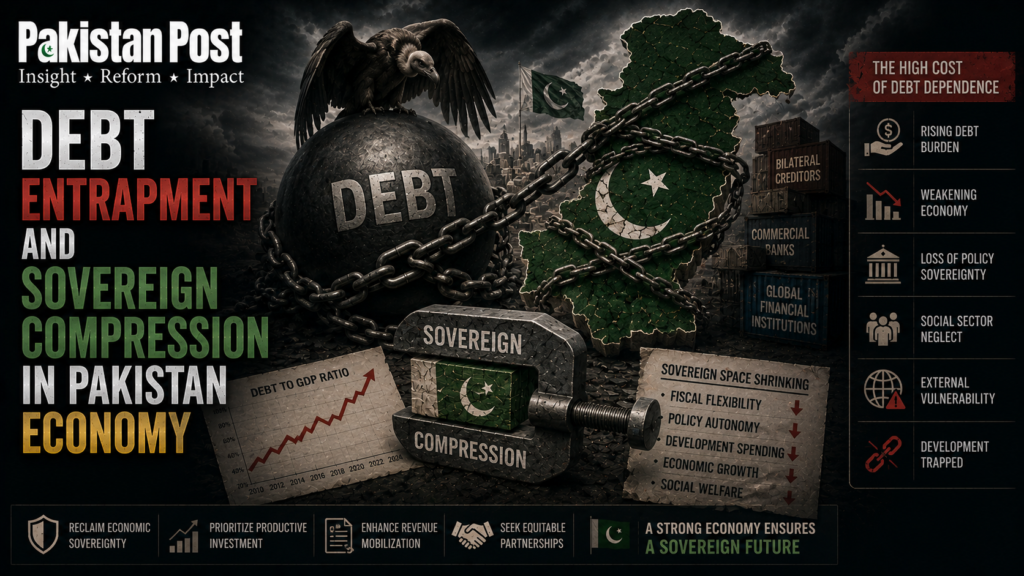
Pakistan stands at an inflection point where macroeconomic stabilization has ceased to function as a policy objective and has instead evolved into a permanent operating condition. The recurrent reliance on external financial lifelines, particularly through multilateral adjustment frameworks, has produced a structural dependency loop that increasingly defines the limits of sovereign fiscal agency. From a strategic policy vantage point, the situation is not merely one of liquidity shortage but of systemic fiscal compression, where the state’s economic decision space is progressively narrowed by the cumulative weight of external obligations, internal inefficiencies, and entrenched political economy structures.
Over the past decades, successive stabilization cycles have followed a predictable arc: external financing is secured, immediate default risk is deferred, nominal indicators improve marginally, and structural reforms remain partially implemented or diluted over time. This cyclical pattern has embedded a form of economic temporality in which crisis management replaces development planning. The consequence is an economy that appears periodically stabilized yet remains structurally unbalanced, heavily import dependent, and persistently exposed to external shocks.
At the core of this configuration lies a persistent divergence between resource inflows and productive transformation. External borrowing has not translated into sustained export expansion or industrial deepening. Instead, a significant proportion of financial inflows has been absorbed into consumption smoothing, debt servicing obligations, and foreign exchange gap financing. This creates a paradoxical condition in which increased borrowing does not reduce vulnerability but rather defers it, accumulating future fiscal pressure in exchange for present stability.
A critical dimension of this dynamic is the internal allocation structure of financial resources. The distribution of economic rents across select segments of the economy has generated a persistent distortion in capital deployment. Infrastructure procurement, energy contracts, real estate channels, and subsidy regimes have, in multiple instances, functioned as conduits for concentrated benefit extraction rather than broad based productivity enhancement. This has produced an asymmetry where the fiscal burden is socialized while the gains remain selectively privatized.
From a strategic governance perspective, this rent mediated fiscal circulation constitutes one of the least visible yet most consequential leakages in the system. While external narratives often emphasize sovereign debt exposure as the primary vulnerability, internal fiscal inefficiencies and allocation distortions represent an equally significant constraint on economic sovereignty. In effect, the state is simultaneously externally constrained and internally fragmented.
The export base, which should function as the principal anchor of external stability, remains narrowly structured and technologically stagnant. A high dependence on low value added production, limited diversification into complex manufacturing, and weak integration into global value chains have collectively restricted foreign exchange generation capacity. As a result, the economy remains structurally reliant on imports for energy, machinery, and intermediate goods, reinforcing chronic balance of payments pressures.
This structural imbalance produces a recurring external financing gap, which is then bridged through successive rounds of borrowing. However, without a parallel expansion in export productivity, each cycle of borrowing increases the absolute scale of future repayment obligations without proportionally enhancing repayment capacity. The result is a compounding fiscal burden that gradually reduces sovereign flexibility.
Within policy and strategic circles, there is growing recognition that the prevailing model of stabilization is approaching diminishing returns. The marginal gains from each successive adjustment program are declining, while the structural costs are accumulating. This reflects a deeper exhaustion of the existing economic paradigm, which is oriented toward short term liquidity management rather than long term productive transformation.
A central hidden risk in this trajectory is the gradual erosion of policy autonomy. As external financing becomes increasingly conditional, fiscal decision making is progressively aligned with externally defined parameters. While such conditionality may enforce macroeconomic discipline in the short term, it can also constrain domestic policy innovation if not calibrated toward structural transformation outcomes. The risk is not external engagement itself, but the asymmetry between stabilization requirements and developmental imperatives.
Another less visible but strategically significant risk lies in the compression of fiscal space for social and human capital investment. As debt servicing consumes a growing share of public expenditure, the discretionary capacity of the state to invest in education, health, and technological upgrading diminishes. This creates a long horizon developmental deficit, where current stabilization efforts inadvertently weaken future growth potential.
The establishment level concern, viewed through a national security and macroeconomic stability lens, is therefore not solely default risk but systemic resilience degradation. A fiscally constrained state with limited export capacity, rising external liabilities, and fragmented internal governance structures becomes increasingly vulnerable to external volatility, commodity shocks, and geopolitical financial pressures.
Addressing this condition requires a fundamental reorientation of debt logic. External borrowing must be decoupled from consumption stabilization and re-anchored to measurable productivity enhancement. This implies a shift toward a sovereign productivity linked financing framework, where debt inflows are explicitly tied to export expansion metrics, industrial diversification benchmarks, and foreign exchange generation targets. Without such reconfiguration, debt will continue to function as a liquidity bridge rather than a transformation instrument.
Equally important is the need to address internal fiscal leakage mechanisms. A systematic audit of public expenditure flows, particularly within energy procurement systems, procurement contracting frameworks, and quasi fiscal operations, is essential to identify structural inefficiencies. These inefficiencies often represent a parallel fiscal burden comparable in magnitude to external debt servicing pressures, yet remain under addressed in conventional policy discourse.
In addition, the tax structure requires recalibration toward widening the effective base rather than increasing marginal burden on existing compliant segments. Informal sector integration, property valuation reform, and digital taxation frameworks represent critical areas where revenue potential remains underutilized. Without broadening the fiscal base, debt dependence will persist regardless of external financing conditions.
From an institutional standpoint, the absence of a coherent long term economic planning architecture further exacerbates vulnerability. Policy discontinuity across political cycles, fragmented implementation capacity, and weak inter ministerial coordination reduce the effectiveness of reform initiatives. The result is a structural gap between policy design and execution, which undermines reform credibility and investor confidence.
Strategically, this institutional fragmentation has broader implications for economic sovereignty. A state that cannot consistently implement its own policy frameworks becomes increasingly reliant on externally designed reform pathways. This gradually shifts the locus of economic decision making away from domestic institutions toward external stakeholders, further narrowing sovereign policy space.
A forward looking stabilization framework must therefore integrate three parallel tracks: external debt restructuring aligned with productivity outcomes, internal fiscal leakage correction, and institutional execution strengthening. These cannot be treated as sequential reforms but must operate as interconnected pillars of a unified economic strategy.
On the external front, debt restructuring should move beyond maturity extension toward conditional productivity alignment. This would involve linking future disbursements and refinancing arrangements to verifiable export performance indicators. Such a mechanism would reorient incentives toward structural transformation rather than short term stabilization.
On the internal front, fiscal reform must prioritize efficiency over expansion. Reducing non productive expenditures, rationalizing subsidy regimes, and improving procurement transparency would collectively enhance fiscal space without increasing nominal tax pressure. This is particularly critical in an environment where political constraints limit aggressive revenue extraction.
On the institutional front, performance based civil service reform represents a necessary but politically sensitive dimension. Embedding outcome based evaluation systems within administrative structures, introducing digital monitoring frameworks for project execution, and strengthening audit independence would collectively enhance governance efficiency.
The broader strategic implication is that Pakistan’s economic challenge is no longer cyclical but structural. It is not defined by temporary liquidity shortages but by a persistent misalignment between fiscal architecture, productive capacity, and institutional execution. Without addressing this triad, stabilization efforts will continue to yield diminishing returns.
In conclusion, the prevailing debt driven stabilization model has reached a critical threshold where its continuation in its current form risks entrenching long term vulnerability rather than resolving it. The transition required is not incremental but paradigmatic, shifting from stabilization-oriented policy design to transformation oriented economic engineering. Only through such a reorientation can sovereign fiscal space be restored, external dependency reduced, and long-term economic resilience established.
A Public Service Message