Water Stress Climate Collapse and Internal Migration Shockwaves

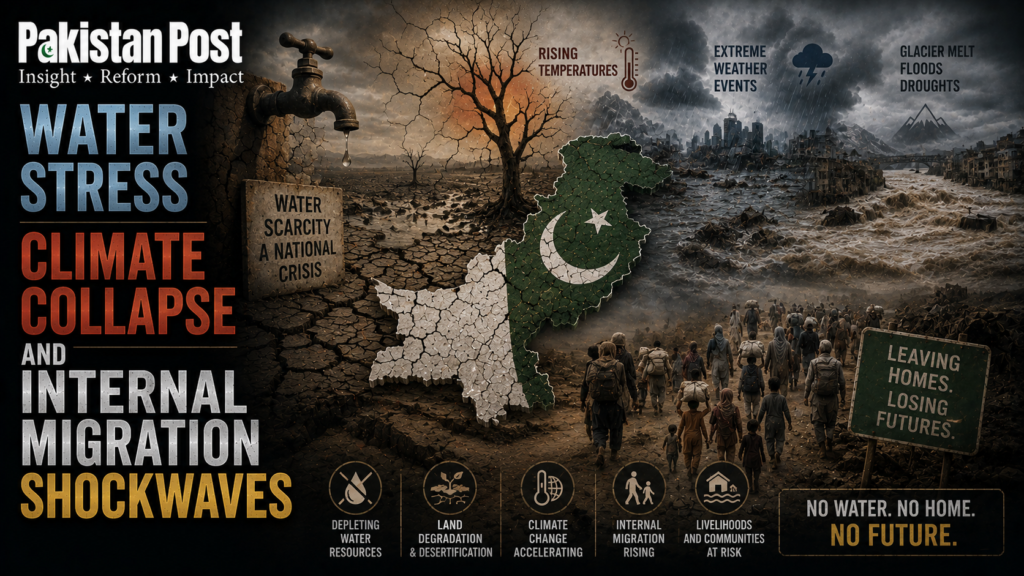
Pakistan is entering a phase of hydrological volatility that can no longer be interpreted through the lens of cyclical droughts or seasonal variability. The emerging reality is one of structural water stress, where climatic, institutional, and demographic pressures converge to produce a sustained erosion of water security. From a strategic policy perspective, this is not merely an environmental concern but a multi vector national stability challenge with direct implications for food systems, internal migration patterns, and urban governance capacity.
At the upstream level, accelerated glacial retreat in the Himalayan and Karakoram ranges is altering the temporal distribution of water flows. The initial phase of increased meltwater has created a misleading impression of abundance, yet hydrological modelling indicates a long term decline in glacier mass balance. This creates a front loaded surplus followed by a chronic deficit, destabilizing historical irrigation cycles that have underpinned agricultural planning for decades. The result is a structural break in predictability, which is more damaging to agricultural systems than absolute scarcity alone.
The Indus basin irrigation network, historically one of the largest contiguous irrigation systems in the world, is increasingly constrained by inefficiencies in water distribution, sedimentation in canal systems, and governance fragmentation. Allocation mechanisms remain heavily politicized and administratively rigid, preventing adaptive redistribution during periods of scarcity. This institutional rigidity amplifies physical scarcity, converting a resource management issue into a systemic governance vulnerability.
Agriculture, which still absorbs a significant proportion of national water consumption, is experiencing diminishing marginal returns on water input. Traditional flood irrigation methods persist across large segments of cultivable land, resulting in substantial wastage. Meanwhile, groundwater extraction has intensified without adequate recharge mechanisms, leading to aquifer depletion in key agrarian zones. This dual pressure on surface and subsurface water reserves is creating a silent but accelerating depletion cycle.
The strategic implication is clear: water is no longer simply an agricultural input but a security determinant. Declining water availability directly translates into reduced crop yields, heightened price volatility in staple commodities, and increased dependence on food imports. This externalizes domestic ecological stress into macroeconomic vulnerability, particularly in an import constrained fiscal environment.
A less visible but increasingly significant dimension of this crisis is the migration shockwave it is generating. Rural populations, particularly in climate exposed regions of southern Punjab and interior Sindh, are beginning to exhibit climate induced displacement patterns. These movements are not episodic but cumulative, reflecting gradual livelihood erosion rather than sudden disaster events. The migration is predominantly directed toward secondary urban centers and peri urban peripheries, where infrastructure and services are already under strain.
This internal demographic reconfiguration carries profound implications for urban governance. Cities are absorbing population inflows without corresponding expansion in housing, sanitation, water supply, or employment capacity. The result is the proliferation of informal settlements, expansion of unregulated labor markets, and increasing pressure on municipal systems. Over time, this generates a structural urban fragility that intersects with socio economic inequality and governance deficits.
Food security is emerging as a critical transmission channel between climate stress and macroeconomic instability. As agricultural productivity becomes increasingly volatile, domestic supply fluctuations are translating into price instability in essential commodities. This disproportionately affects lower income households, intensifying socio economic stress and increasing the risk of political sensitivity around food inflation cycles. In this context, climate stress is no longer an environmental variable but a macro social stabilizer.
Institutionally, the governance response remains fragmented across multiple administrative domains. Water management, agriculture, climate policy, and urban planning operate in largely disconnected silos. This fragmentation prevents the formation of a coherent climate security doctrine. The absence of integrated hydrological governance results in reactive rather than anticipatory policy responses, further amplifying systemic vulnerability.
From a strategic establishment perspective, the convergence of water scarcity, agricultural stress, and migration pressure constitutes a multi dimensional security risk. Unlike traditional security threats, this configuration is slow moving, cumulative, and structurally embedded, making it more difficult to detect through conventional policy indicators. However, its long term impact on state stability is potentially more profound than episodic crises.
A critical hidden risk lies in the temporal mismatch between ecological change and policy response cycles. Climate systems operate on long duration trajectories, while governance systems remain locked in short electoral and budgetary cycles. This misalignment produces a structural delay in policy adaptation, allowing risks to accumulate beyond manageable thresholds before intervention occurs.
Addressing this requires a redefinition of water as a strategic national asset rather than a sectoral resource. A unified hydrological governance framework is essential, integrating upstream monitoring, agricultural allocation, groundwater management, and urban consumption forecasting into a single coordinated architecture. Without such integration, policy fragmentation will continue to undermine resource efficiency.
Technological modernization of irrigation systems is also critical. Transitioning from flood irrigation to precision based water delivery systems, supported by digital monitoring and sensor based allocation, can significantly reduce wastage. However, technological intervention alone is insufficient without institutional enforcement mechanisms to ensure adoption at scale.
Urban planning must incorporate climate induced migration projections into infrastructure development models. Housing demand, transport systems, water supply networks, and labor market absorption capacity must be recalibrated based on projected demographic shifts rather than historical population trends. Failure to do so risks converting climate migration into chronic urban instability.
At a macro policy level, food security strategy must be decoupled from reactive import dependence and reoriented toward climate resilient agricultural planning. This includes crop diversification, drought resistant seed development, and strategic food reserves calibrated against hydrological risk models.
The broader strategic conclusion is that water stress is no longer an isolated environmental issue but a central axis of national resilience. It intersects simultaneously with economic stability, urban governance, social cohesion, and internal security dynamics. In this sense, climate change is functioning as a systemic stress test for the state apparatus.
Without integrated reform, Pakistan faces a trajectory in which ecological stress translates into economic volatility, which in turn amplifies social fragmentation and governance strain. Conversely, a coordinated climate security framework could transform water scarcity from a destabilizing force into a catalyst for institutional modernization and resource efficiency reform.
The decisive variable is not the presence of climate risk, but the capacity of the state to convert environmental pressure into adaptive governance innovation.
A Public Service Message