
Pakistan Must Secure Water Before Climate Defines National Stability


Water has always shaped the geography, economy and strategic identity of Pakistan, yet the country now faces a transformation in which water is no longer merely a developmental concern but an increasingly decisive element of national security. Climate variability, demographic expansion, urbanisation, industrial demand and environmental degradation are converging at a pace that is reshaping the country’s strategic landscape. The cumulative impact of glacier retreat, irregular monsoon systems, declining river predictability, groundwater exhaustion, deteriorating irrigation efficiency and growing competition over freshwater resources is creating systemic vulnerabilities that extend well beyond agriculture. These pressures increasingly influence energy generation, food security, industrial competitiveness, fiscal sustainability, internal migration, public health, provincial relations and national resilience. The emerging challenge is therefore not simply one of managing water scarcity but of governing uncertainty across interconnected sectors whose stability depends upon reliable water availability.
Pakistan’s historical water management framework was designed around assumptions of relatively stable hydrological cycles. Those assumptions are rapidly becoming obsolete. Scientific observations increasingly indicate that climatic variability is accelerating fluctuations in river flows, altering seasonal precipitation patterns and increasing the frequency of both floods and prolonged droughts. Himalayan, Karakoram and Hindu Kush glaciers continue to experience changing melt dynamics, creating short term increases in runoff while simultaneously threatening long term reductions in sustained river discharge. The strategic implication is profound. Water availability is becoming less predictable precisely when demand continues to expand across agriculture, cities, industry and energy production.
This uncertainty introduces a new category of national risk. Traditional planning models based upon historical averages become progressively less reliable when climatic extremes replace predictable seasonal behaviour. Infrastructure designed for twentieth century hydrological conditions may prove inadequate for twenty first century climate realities. Reservoir operations, irrigation scheduling, hydroelectric generation, municipal water distribution and disaster response systems all require recalibration under conditions of greater volatility rather than historical stability.
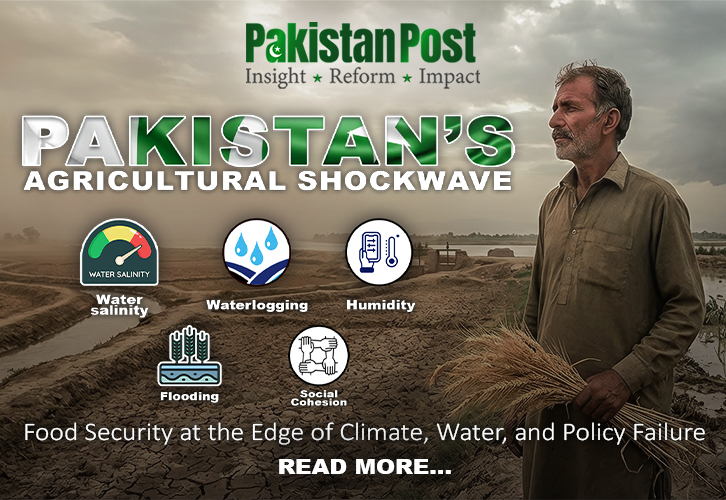
Agriculture remains the first sector exposed to these structural changes. As one of the largest contributors to employment, exports and rural livelihoods, agricultural productivity depends heavily upon consistent irrigation. Yet Pakistan simultaneously operates one of the world’s largest irrigation systems while experiencing significant transmission losses, inefficient water allocation and cultivation patterns that often fail to reflect regional water availability. Climate variability amplifies these existing inefficiencies by reducing the margin for operational error. Crop failures increasingly become consequences not only of insufficient rainfall but also of inadequate institutional adaptation.
Food security therefore becomes inseparable from water governance. Rising temperatures accelerate evapotranspiration, increasing irrigation requirements precisely when freshwater availability becomes more uncertain. Extended heatwaves reduce crop yields, while sudden floods destroy cultivated land, disrupt logistics and damage rural infrastructure. Water intensive crops cultivated in environmentally stressed regions further intensify pressure upon groundwater reserves. Unless agricultural policy evolves toward climate resilient production systems supported by precision irrigation, improved seed technologies and data driven resource allocation, future food security will remain increasingly vulnerable to climatic shocks.
Energy security faces comparable exposure. Hydropower continues to represent an important component of Pakistan’s electricity generation portfolio, yet hydroelectric output depends directly upon river flow stability and reservoir management. Climate induced fluctuations in water availability complicate generation forecasting while increasing pressure upon thermal alternatives that carry higher fiscal and environmental costs. Simultaneously, declining reservoir storage due to sedimentation reduces operational flexibility during both droughts and flood events.
The energy transition therefore cannot be considered independently from national water strategy. Future electricity planning requires integrated assessment of water availability, renewable diversification, grid resilience and reservoir optimisation. Investments in solar and wind generation provide opportunities to reduce dependence upon hydrological variability while supporting broader climate adaptation objectives. Strategic diversification enhances national resilience by reducing systemic dependence upon any single climate sensitive energy source.
Industrial competitiveness similarly depends upon reliable water access. Manufacturing sectors ranging from textiles to food processing require predictable water supplies for production continuity. Urban industrial clusters increasingly compete with residential consumers for limited freshwater resources, particularly during periods of seasonal scarcity. Water stress therefore influences investment attractiveness, export competitiveness and employment generation. Investors increasingly evaluate environmental sustainability alongside traditional economic indicators, making effective water governance an important determinant of long term industrial confidence.
Urbanisation further intensifies these pressures. Pakistan’s rapidly expanding metropolitan regions face mounting challenges associated with ageing distribution infrastructure, groundwater depletion, contamination, leakage and unequal access. Informal settlements often experience chronic shortages while wealthier districts rely upon private extraction and tanker markets. Such disparities create both economic inefficiencies and social tensions.
Groundwater depletion represents one of the country’s least visible yet most serious strategic challenges. Decades of uncontrolled extraction have transformed groundwater into an unregulated buffer against surface water shortages. The absence of comprehensive licensing systems, monitoring technologies and sustainable abstraction policies has accelerated aquifer depletion across major agricultural and urban regions. Falling water tables increase pumping costs, reduce agricultural profitability and create long term environmental degradation that may require decades to reverse.
Groundwater governance must therefore become a national priority rather than a local administrative concern. Digital monitoring systems, licensing frameworks, metering technologies and satellite based observation can substantially improve regulatory oversight. Pricing mechanisms should encourage efficient consumption while protecting vulnerable populations through carefully targeted social support. Effective groundwater management requires both scientific monitoring and institutional enforcement supported by modern legislation.
Flood management illustrates another dimension of increasing climate uncertainty. Pakistan has repeatedly experienced catastrophic floods whose economic costs extend across infrastructure, agriculture, housing, health services and public finances. Climate projections suggest that extreme rainfall events may become more frequent even as drought periods intensify elsewhere. This paradox requires a fundamental shift from reactive disaster response toward anticipatory resilience planning.
Flood resilience depends upon integrated watershed management rather than isolated engineering interventions. River basin planning, upstream catchment restoration, urban drainage modernisation, floodplain zoning, resilient infrastructure standards and community preparedness programmes collectively reduce disaster exposure. Early warning systems supported by satellite monitoring, artificial intelligence forecasting and real time hydrological data significantly improve evacuation planning and emergency coordination.
Equally important is drought preparedness. Historically, drought has often received less political attention than flooding because its impacts accumulate gradually rather than dramatically. Yet prolonged drought imposes equally severe consequences through declining agricultural output, livestock losses, groundwater depletion, food inflation and rural migration. National resilience therefore requires permanent drought management institutions capable of monitoring climatic indicators, coordinating emergency responses and supporting adaptive agricultural practices before crises escalate.
Migration increasingly emerges as an indirect consequence of environmental stress. Rural populations experiencing declining agricultural productivity frequently relocate toward urban centres already facing infrastructure deficits. Climate induced migration compounds pressures upon housing, employment, sanitation, education and healthcare. Environmental stress therefore interacts with socioeconomic inequalities, potentially generating instability that extends beyond traditional resource management.
Public health consequences further illustrate the multidimensional nature of water security. Contaminated water supplies contribute to communicable diseases, while flooding increases exposure to waterborne illnesses and vector borne infections. Heatwaves associated with climate change place additional strain upon healthcare systems while reducing labour productivity. Water quality management must therefore become integral to national health security planning rather than remaining solely within environmental regulation.
Provincial resource allocation introduces another strategic dimension requiring careful governance. Water distribution carries significant political sensitivity within Pakistan’s federal structure. Climate variability may intensify existing disagreements as provinces seek to protect agricultural interests, industrial development and urban expansion. Transparent data sharing, scientifically informed allocation mechanisms and trusted institutional processes become essential for maintaining national cohesion.
Integrated water governance consequently demands stronger coordination across federal and provincial institutions. Fragmented administrative responsibilities frequently produce overlapping mandates, inconsistent policies and delayed implementation. Effective governance requires unified strategic planning supported by interoperable information systems, common performance indicators and clearly defined institutional responsibilities. National water security cannot be achieved through isolated departmental initiatives operating independently.
The legal framework governing water management similarly requires comprehensive modernisation. Existing legislation often reflects historical priorities rather than contemporary climate realities. Emerging challenges including groundwater licensing, water quality regulation, environmental flows, digital monitoring, climate adaptation financing and ecosystem protection require updated legal instruments capable of supporting effective enforcement. Legislative reform should clarify institutional mandates while strengthening accountability across all levels of government.
Technology offers substantial opportunities for improving resilience. Remote sensing, satellite observation, artificial intelligence, predictive modelling, geographic information systems, digital water accounting and automated monitoring networks enable more accurate forecasting and efficient resource allocation. Precision agriculture reduces irrigation demand while improving productivity. Smart urban water systems minimise leakage and optimise distribution. Digital governance enhances transparency, reduces operational inefficiencies and supports evidence based policymaking.
Reservoir capacity remains another strategic consideration. Population growth and climatic variability increase the importance of seasonal storage capable of moderating both floods and droughts. Existing storage infrastructure provides limited carryover capacity relative to national requirements. Future investments should balance large reservoirs with medium sized storage facilities, groundwater recharge systems and watershed restoration programmes. Infrastructure planning must incorporate environmental sustainability, community consultation and long term climatic projections rather than relying exclusively upon historical hydrological assumptions.
Climate finance will increasingly determine the pace of adaptation. International financial institutions and climate funds offer significant opportunities to support resilient infrastructure, renewable energy, disaster preparedness and ecosystem restoration. Pakistan should strengthen institutional capacity to develop investment ready projects supported by rigorous feasibility studies, transparent governance and measurable outcomes. Effective utilisation of climate finance requires coordinated planning across ministries responsible for finance, planning, environment, energy and water resources.
Public private partnerships can accelerate innovation while expanding implementation capacity. Private investment in wastewater recycling, desalination technologies where appropriate, smart irrigation systems, digital monitoring platforms and resilient urban infrastructure can complement public expenditure. However, such partnerships require predictable regulatory environments, transparent procurement processes and carefully designed risk sharing arrangements that protect public interests while encouraging long term investment.
Regional hydro diplomacy constitutes an equally significant strategic priority. Shared river systems increasingly require sophisticated diplomatic engagement supported by scientific cooperation, technical dialogue and confidence building measures. Climate variability affects all riparian states, creating opportunities for collaborative data exchange, flood forecasting and watershed management. Constructive engagement strengthens regional stability while reducing uncertainty surrounding shared water resources.
National security institutions should increasingly integrate climate risk assessment into broader strategic planning. Environmental stress acts as a threat multiplier, intensifying existing socioeconomic and political vulnerabilities rather than replacing traditional security concerns. Defence planning, infrastructure protection, disaster logistics and critical asset resilience all benefit from comprehensive climate intelligence integrated into national risk assessment frameworks.
Whole of government coordination therefore becomes indispensable. Water security intersects with agriculture, finance, energy, health, industry, environment, defence, foreign affairs, planning and provincial governance. Fragmented policymaking inevitably generates inefficiencies because decisions in one sector frequently create unintended consequences elsewhere. Cabinet level coordination mechanisms supported by permanent technical secretariats can improve strategic coherence while accelerating implementation across institutional boundaries.
Strategic infrastructure investment should prioritise resilience over short term expansion. Every major transport corridor, industrial zone, energy project and urban development initiative should undergo climate risk assessment before approval. Resilient infrastructure may require higher initial expenditure but substantially reduces long term fiscal liabilities associated with disaster recovery and operational disruption. Investment decisions must therefore incorporate lifecycle resilience rather than immediate construction costs alone.
Education and public awareness also influence long term adaptation capacity. Water conservation, efficient agricultural practices, disaster preparedness and environmental stewardship require sustained behavioural change supported by schools, universities, civil society and media institutions. Community participation strengthens policy implementation by creating local ownership and improving compliance with regulatory measures.
Institutional reform ultimately represents the decisive factor determining whether Pakistan successfully adapts to increasing environmental uncertainty. Financial resources alone cannot compensate for fragmented governance, outdated legislation or weak implementation capacity. Effective adaptation requires professional institutions equipped with technical expertise, digital capabilities, transparent accountability mechanisms and stable policy continuity extending beyond electoral cycles.
The establishment, civilian leadership, provincial administrations, scientific institutions and private sector must increasingly recognise that water security is not a single ministry’s responsibility but a foundational pillar of national resilience. Future strategic competition may be defined less by territorial disputes than by institutional capacity to manage environmental volatility while sustaining economic growth and social cohesion.
Pakistan retains significant advantages. Its scientific community possesses growing expertise in climate research. Its engineering institutions have extensive experience managing complex irrigation infrastructure. Its young population demonstrates increasing technological capability. International partners remain willing to support credible adaptation initiatives. These strengths provide a foundation upon which comprehensive reform can be constructed if supported by consistent political commitment and disciplined institutional execution.
The defining policy question is therefore no longer whether climate change will influence Pakistan’s future but whether governance reforms will advance rapidly enough to remain ahead of accelerating environmental risk. Water security has become the central organising principle linking food production, energy stability, industrial growth, fiscal resilience, disaster preparedness, diplomatic engagement and national security. Countries that successfully integrate these dimensions into coherent long term strategy will strengthen both prosperity and sovereignty. Those that continue managing water through fragmented administrative approaches will increasingly confront economic instability, social tension and strategic vulnerability. For Pakistan, securing water has become synonymous with securing the nation itself.
A Public Service Message