
Tri-Axis Exceptionalism: Navigating Civilizational, Security, and Developmental Power in South Asia

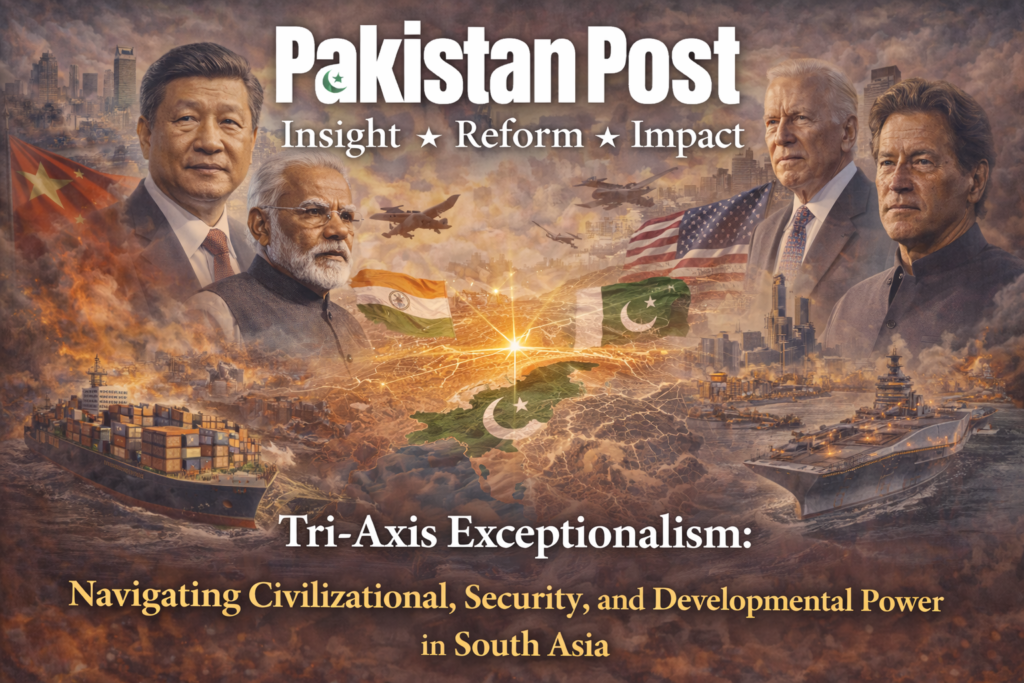
Competing narratives of exceptionalism have long shaped the geopolitical landscape of South Asia, defining the contours of regional influence and strategic alignments. India, asserting its role as the largest democracy in the world, projects a vision of civilizational leadership and moral authority, framing its foreign policy through the lens of democratic exceptionalism. This narrative, deeply rooted in postcolonial self-perception and reinforced through successive administrations, positions India as a custodian of regional stability and an indispensable partner for global powers in the Indo-Pacific context. Its strategic autonomy doctrine, coupled with technological and economic advancements, allows it to engage selectively with the United States, Japan, and Australia while maintaining the ideological and military flexibility to assert its primacy in South Asian affairs.
Contrastingly, Pakistan’s strategic posture is defined by what analysts term “security exceptionalism,” anchored in the notion of the nation as the fortress of Islam in the subcontinent. This ideological construct intertwines religious identity with state security, producing a framework where the preservation of sovereignty, territorial integrity, and societal cohesion is inseparable from broader geopolitical considerations. Pakistan’s engagements, whether through defence pacts with Saudi Arabia and Turkey or through partnerships with China, are informed by a historical consciousness of strategic vulnerability and an acute awareness of regional power asymmetries. The institutionalization of this security-centric narrative has influenced both military doctrine and foreign policy, embedding resilience and preemptive defence mechanisms into the national strategy while reinforcing the country’s narrative of legitimacy and regional stewardship.
China’s exceptionalism, framed in developmental and technological terms, introduces a third axis into the regional equation. Its economic modernization, state-led infrastructure initiatives, and the Belt and Road framework, particularly the China–Pakistan Economic Corridor, reflect a model where strategic influence is exercised through economic interdependence, technological investment, and capacity-building. China’s narrative positions it as a pragmatic arbiter of regional development, leveraging soft power and economic incentives to reinforce its strategic objectives, while challenging the moral and civilizational claims of other regional actors. The resulting tri-axis alignment, encompassing India–United States cooperation, Pakistan–China partnerships, and the strategic involvement of Gulf states such as Saudi Arabia and Turkey, creates a complex web of interdependencies, alliances, and competitive postures, where each state’s narrative seeks validation through policy, capability, and international recognition.
The development of these narratives has been largely inductive, emerging from historical interactions, conflicts, and strategic calculations rather than purely ideological invention. India’s civilizational and democratic exceptionalism evolved in response to colonial legacies, post-independence consolidation, and regional security imperatives. Pakistan’s security exceptionalism crystallized amid existential conflicts and the perception of encirclement, where the integration of ideology, military readiness, and strategic alliances became essential for national survival. China’s developmental exceptionalism arose from the imperative to secure domestic legitimacy while asserting influence beyond its borders, employing economic instruments as extensions of strategic intent. Each narrative, therefore, is both reactive and proactive, continuously shaped by regional dynamics, global policy shifts, and the interplay of ideology, technology, and security imperatives.
The interaction among these three axes produces a competitive but interlinked regional ecosystem. India’s strategic partnerships with the United States, including military cooperation, technology transfer, and joint exercises, reinforce its capacity to assert regional dominance, while simultaneously legitimizing its civilizational claims on a global stage. Pakistan’s coordination with China and engagement with Saudi-Turkish defence frameworks provide counterweights, enabling strategic depth, technological access, and ideological affirmation. The economic and technological influence of China further complicates the matrix, presenting both opportunities for development and vectors of dependency for regional states. These intersecting narratives drive policy decisions, diplomatic engagements, and security postures, reinforcing a regional architecture where alignment and counter-alignment operate through both material and ideological channels.
Analytical examination of official releases, defence cooperation frameworks, and policy statements demonstrates that these exceptionalism narratives are not mere rhetorical constructs but active instruments shaping decision-making, alliance formation, and regional perception. They inform military modernization, cyber and space strategy, economic corridors, and multilateral engagement, translating historical consciousness into actionable policy. Moreover, the symbolic and material aspects of these narratives mutually reinforce each other: civilizational claims legitimize technological and military investment, while economic and defence capabilities underpin ideological narratives. The resulting dynamic underscores the necessity of viewing South Asia not as a static geopolitical space but as an evolving theater where narratives and capabilities coalesce, creating both opportunities for cooperation and grounds for conflict.
The implications for regional stability are profound. The assertion of Indian exceptionalism, juxtaposed with Pakistan’s security-centric identity and China’s developmental paradigm, necessitates nuanced diplomacy, calibrated engagement, and awareness of perception management. Policymakers must navigate these intersecting narratives to prevent escalation, optimize collaboration, and sustain strategic equilibrium. Understanding the historical development, conceptual underpinnings, and operationalization of these exceptionalism narratives is therefore essential for formulating informed foreign-policy strategies, anticipating regional responses, and crafting multilateral mechanisms that recognize the legitimacy and constraints of each actor while promoting stability, resilience, and strategic predictability across South Asia.
A Public Service Message