
Pakistan at the Indo-Pacific Eurasian Seam: Strategic Autonomy and the Hybrid Order Frontier

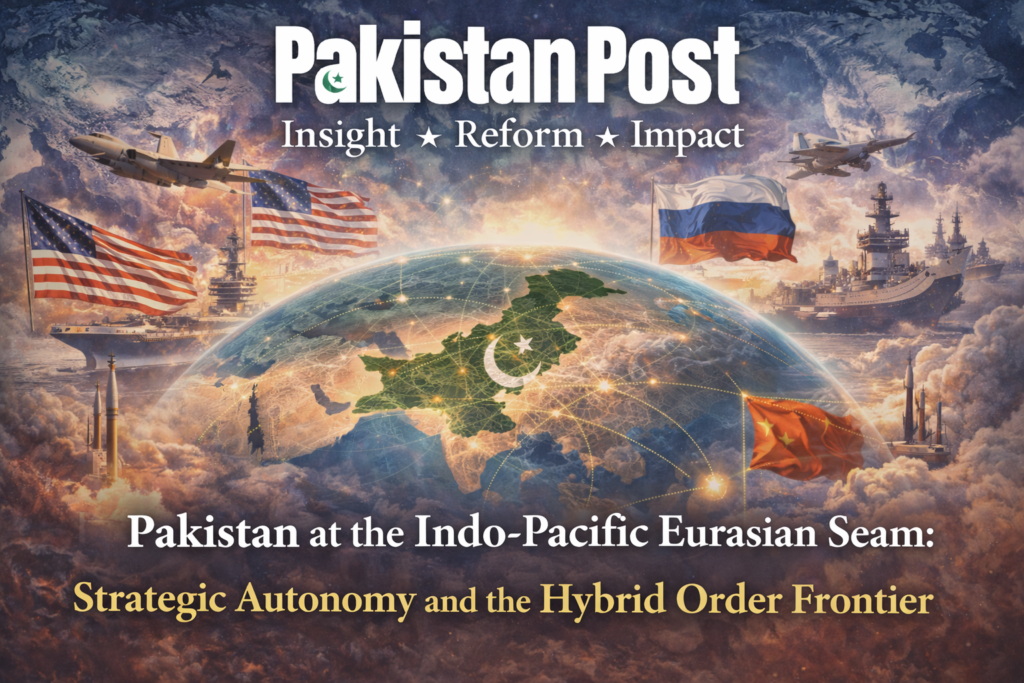
In the evolving architecture of twenty-first century geopolitics, power is neither purely maritime nor exclusively continental. It is increasingly hybrid, layered, and contested across land, sea, cyber, and cognitive domains. At the fulcrum of this emerging Indo-Pacific Eurasian seam, Pakistan occupies a strategic position rarely paralleled in contemporary international relations. It is neither a core member of the U.S.-anchored Indo-Pacific maritime coalition nor a subordinate satellite of the Eurasian land power axis. Pakistan sits between these systems as a medium power articulating a hybrid order frontier. Its choices over the next decade will determine not only its relative power and autonomy but also the degree to which it shapes or is shaped by the competing logics of Indo-Pacific and Eurasian polities.
This analysis situates Pakistan conceptually at the intersection of two strategic orders. The first is the maritime-centric Indo-Pacific architecture, increasingly anchored in U.S., Indian, Japanese, Australian, and Gulf security networks that seek to balance or counter Chinese influence. The second is a Eurasian land power system anchored by China, Russia, Central Asian states, Iran, and Pakistan itself. In this connectivity-driven geographic and political space, Belt and Road Initiative infrastructure intersects with Shanghai Cooperation Organization security coordination. Pakistan’s strategic identity in this seam is neither fixed nor predetermined. It is actively negotiated through material capabilities such as nuclear deterrence, evolving defense posture, and naval footprint facing the Arabian Sea. It is also constructed ideationally, framing Pakistan as a non-aligned state with alignment leanings, an Islamic civilizational bridge, and a potential regional mediator.
The geography of power in South and Central Asia remains anchored in the longstanding India-Pakistan dyad, a bifurcated security order defined by rivalry, mistrust, and periodic escalation. This dyad persists not merely as a relic of historical antagonism but as a structural condition shaping extra-regional engagement. Yet the strategic field is no longer dyadic in the narrow sense. The India-Pakistan axis now overlaps with a multi-vector fabric that includes China-Pakistan, Gulf, and Russia-Iran-Afghanistan linkages. These intersecting vectors produce a complex land power maritime seam in which Pakistan must navigate both internal imperatives and external pressures.
The India-Pakistan strategic dichotomy remains the core axis of South Asia’s security order but has acquired additional layers shaped by the broader Indo-Pacific dynamic. India’s integration into maritime security dialogues, its strategic convergence with the United States and its partners, and its own Indo-Pacific economic and defense vision have recast South Asia as a zone connected to, rather than isolated from, the wider Indo-Pacific system. Pakistan’s response to this has been neither monolithic alignment nor outright rejection. Islamabad pursues calibrated engagement with Indo-Pacific stakeholders through conditional cooperation on counter-terrorism finance, limited technology access, and maritime dialogues. This non-alliance with alignment leaning reflects a conscious attempt to preserve strategic autonomy while mitigating security dilemma pressures.
Simultaneously, Pakistan’s relations with Afghanistan have drifted into episodes of low-intensity warfare. The removal of benign engagement paradigms, replaced by conditional pressure and leverage-based diplomacy, illustrates a shift in Pakistani strategy toward using instruments such as border closures, trade reopening, and conditional access to trans-Afghan connectivity as tools of coercive persuasion. This shift is consequential not only for bilateral relations but also for Pakistan’s wider regional identity. By demonstrating a willingness to employ economic and security leverage, Islamabad signals its capacity for agency within the Eurasian system while balancing pressures from the maritime Indo-Pacific order.
Pakistan’s deepening strategic ties with China represent perhaps the most consequential axis of its hybrid order frontier. The China-Pakistan nexus has evolved beyond infrastructure connectivity under the CPEC rubric toward a multifaceted security architecture. Special security units, joint maritime cooperation near Gwadar, intelligence sharing on counter-terrorism operations, and coordinated consultations on regional crises reflect a de facto land and sea hybrid alliance. This alignment does not fit neatly into Cold War-style blocs but nevertheless conveys robust strategic interdependence. China’s interest in securing continental supply chains and maritime access dovetails with Pakistan’s need for security guarantees, investment, and infrastructure development. The result is a dynamic alignment that solidifies Pakistan’s place within a Eurasian connectivity order while Islamabad hedges to avoid strategic overdependence.
Simultaneously, Pakistan cultivates a Saudi-centric Gulf alignment as a strategic counterweight. Gulf Arab states, anchored in Riyadh’s expanding diplomatic footprint and deepening defense cooperation with Islamabad, offer avenues for financial support, investment diversification, and geopolitical backing. This Gulf dimension complicates simplistic binary framings of regional order, positioning Pakistan not merely between Indo-Pacific and Eurasian blocs but as a node in a broader trans-regional network that includes Arab security arrays and energy corridors. In this configuration, Pakistan’s littoral on the Arabian Sea, from Karachi to Ormara to Gwadar, emerges not as peripheral geography but as a convergence zone linking Middle Eastern, South Asian, and East Asian strategic spaces. Maritime lines of communication, port infrastructures, and naval access points along this littoral afford Islamabad leverage that transcends continental land power logics alone.
Within this hybrid order frontier, the United States’ Indo-Pacific construct makes deliberate overtures to Pakistan. While Islamabad’s deepening ties with Beijing might suggest drift away from Washington, the U.S. seeks to interlock Pakistan into broader maritime-oriented security dynamics through counter-terrorism finance linkages, limited technology cooperation, and inclusion in maritime security dialogues. These engagements are neither comprehensive alliances nor transactional episodic interactions. They reflect an American recognition that Pakistan’s strategic decisions have ramifications beyond South Asia’s traditional fault lines. For Pakistan, these limited engagements offer openings to preserve autonomy, access technology, and diversify partnerships.
The central question is whether Pakistan can sustain a hybrid order frontier status, a strategic posture that is neither a complete member of the Indo-Pacific maritime coalition nor a subordinate to Eurasian axis powers but instead a strategic bridge with negotiated autonomy. This possibility hinges on several interrelated dynamics: the configuration of Pakistan’s external alignments, the calculus of its nuclear and conventional deterrent, and the shape of internal institutional adaptations that govern strategy.
First, Pakistan’s security incentive structure is shaped by its enduring nuclear deterrence. Nuclear capability functions as both a positional anchor, preventing outright conventional defeat in the India-Pakistan dyad, and as an enabling conditionality for pursuing a more assertive diplomatic posture in regional security dialogues. The shadow of potential escalation moderates external pressure dynamics and confers on Islamabad a bargaining lever that is unique among medium powers. Yet nuclear deterrence is not a panacea. Its strategic utility depends on Islamabad’s ability to integrate it within a broader doctrine that judiciously balances restraint and assertion.
Second, Pakistan’s external ties resist easy categorization because they reflect a deliberate attempt at strategic autonomy. Engagement with China provides structural connectivity and defense support. Engagement with Gulf Arab states supplies financial and diplomatic diversification. Engagement with the United States and Indo-Pacific partners offers access to technology and mitigates isolation. This balancing act is not without tension. Divergent expectations, conflicting threat perceptions, and competing agendas can strain ties but it exemplifies a foreign policy orientation that privileges autonomy over alliance entrapment.
Third, Pakistan’s littoral geography on the Arabian Sea transforms maritime access into a strategic asset. Ports such as Gwadar and Karachi are more than economic nodes. They are junctions of naval reach, commerce, and diplomatic engagement. Gwadar’s emerging role in regional maritime stability frameworks and as a potential hub for lanes of communication talks illustrates how Pakistan can leverage geographic advantage for broader influence. In contrast to land-locked power projections that emphasize continental depth, Pakistan’s maritime footprint serves as connective tissue between Middle Eastern, South Asian, and East Asian orders.
Yet maintaining a hybrid frontier status faces structural challenges. Internally, the temptation toward securitized autonomy, the concentration of power in security services, internal repression under the guise of stability, and an external balancing strategy that prioritizes threat response over institutional adaptability, can erode the very autonomy Pakistan seeks. A securitized state may achieve short-term stability but risks long-term strategic stagnation if political inclusivity, economic resilience, and institutional accountability are sidelined. Conversely, an institutional open strategic adaptability, integrating civilian strategic planning with defense imperatives, leveraging regional dialogue platforms, and allowing measured alliance flexibility, can mitigate strategic overstretch while preserving autonomy.
To operationalize this middle path, Pakistan requires a doctrine I term the Indo-Pacific Eurasian Bridge. This doctrine is grounded in three core principles: conditioned connectivity, calibrated engagement, and internal strategic coherence.
Conditioned connectivity means Pakistan positions itself as a limited connector for trade, energy transit, and selective security cooperation without hosting permanent foreign alliance bases or surrendering strategic decision-making. Ports and trade routes become avenues of influence rather than instruments of subjugation. Corridors are negotiated shared spaces rather than controlled conduits. In practice, this implies enabling infrastructure connectivity while retaining regulatory sovereignty over economic and security terms.
Calibrated engagement requires balancing strategic autonomy with conditional engagement across four poles: the U.S West and Indo-Pacific network, the India-led regional architecture, the China-Russia-Central Asia-Iran axis, and the Gulf Arab centric security array. Pakistan must articulate clear parameters for each engagement, ensuring that no single alignment undermines its broader autonomy or imposes exclusionary demands.
Internal strategic coherence necessitates robust institutional mechanisms. A regional security dialogue architecture led or co-chaired by Pakistan, involving India, Afghanistan, Iran, Gulf states, China, and Russia, could offer a forum to address shared challenges: cross-border terrorism, norms for drone and autonomous weapons use, mechanisms to manage gray zone warfare, and frameworks for transparency in force modernization. Such a platform, while ambitious, underscores Pakistan’s potential role as a facilitator rather than merely a responder.
A Gwadar-centric strategic deepening agenda complements this dialogue architecture by coupling port development with regional maritime stability initiatives. Pakistan can leverage Gwadar’s location not only for economic throughput but also for shaping cooperative maritime security arrangements that benefit littoral states and middle powers alike. Instituting naval liaison forums, shared search-and-rescue protocols, and joint exercises around lanes of communication affirms Pakistan’s maritime agency.
Finally, the creation of a domestic grand strategy guidance body, comprising civilian leadership, defense strategists, economic planners, and technocrats, can coordinate alignment choices, prevent ad hoc policy reactions, and anchor Pakistan’s foreign policy within a long-term strategic narrative. This body would ensure that external engagements are matched with internal capacities, fiscal sustainability, human capital development, and institutional resilience, preventing the security curve from overwhelming the developmental agenda.
Pakistan’s hybrid position at the Indo-Pacific Eurasian seam is both a challenge and an opportunity. The challenge lies in resisting pressures toward exclusive alignments that constrain autonomy. The opportunity rests in translating geographic and strategic assets into platforms of influence. By embracing a doctrine of bridge building, fostering calibrated engagements, and reinforcing institutional coherence, Pakistan can shape an order that is neither imposed nor inherited but actively negotiated, in which autonomy and influence are mutually reinforcing rather than mutually exclusive.
In an era where geopolitical fault lines intersect with economic flux and technological change, Pakistan’s strategic choices will reverberate far beyond its borders. The very concept of a hybrid order frontier, once theoretical, is now tangible in Islamabad’s corridors of strategy. Whether Pakistan leverages this frontier to build connectivity, stability, and autonomy, or lapses into reactive securitization under external pressures, will define its role in the Indo-Pacific Eurasian era. The coming decade will not merely reveal Pakistan’s strategic agency. It will determine whether Pakistan can transform its seam position into a center of influence in a world increasingly defined by fluid orders and contested sovereignties.
A Public Service Message