
Fragmented Globalization and Pakistan’s Search for Economic Relevance in a Security-Driven Trade Order

The global trading system that once revolved around the logic of efficiency, comparative advantage, and frictionless capital movement is undergoing a structural transformation that is neither cyclical nor temporary. It is increasingly being reorganized around strategic trust, geopolitical alignment, and security considerations. In
South Asia’s Reconfigured Deterrence Logic in the Age of Hybrid and Multi-Domain Warfare

Deterrence in South Asia is no longer anchored solely in the classical grammar of tanks, territory, and nuclear signaling. It is increasingly shaped by a far more diffuse and continuous form of competition in which cyber intrusions, drone operations, satellite surveillance, economic pressure,
China–Pakistan Strategic Nexus and the Evolution of Full-Spectrum Deterrence in an Increasingly Militarized Indo-Pacific
The strategic relationship between the Islamic Republic of Pakistan and the People’s Republic of China has long been described in shorthand as “all-weather,” a diplomatic phrase that once captured political trust and transactional alignment without necessarily implying deep structural military integration. That description
Pakistan and the Emerging Iran–Saudi–Pakistan Security Triangle in a Post-Retrenchment West Asia
The strategic landscape of West Asia is entering a phase of controlled fluidity, shaped by shifting alignments, episodic détente, and the gradual redefinition of external guarantees. In this environment, the Islamic Republic of Pakistan is increasingly being viewed not as a peripheral observer
Pakistan as a Hinge State in the Reordering Eurasian Security Architecture
The geopolitical identity of the Islamic Republic of Pakistan is undergoing a subtle but consequential redefinition. Once treated largely as a buffer zone between competing great powers and regional blocs, it is increasingly being interpreted by strategists as a “hinge state” embedded within
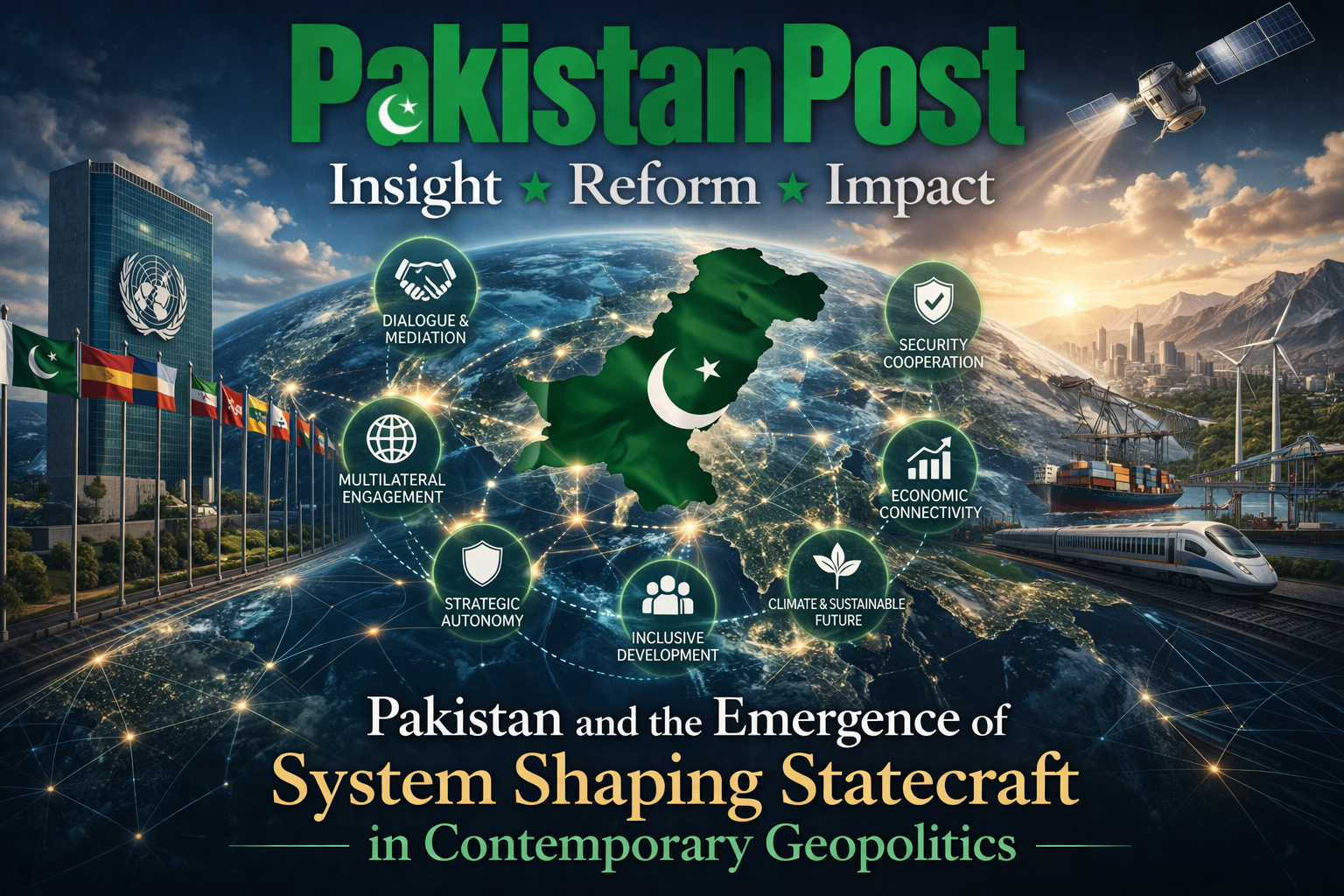
Pakistan and the Emergence of System Shaping Statecraft in Contemporary Geopolitics
The evolving contours of international diplomacy are increasingly challenging the traditional understanding of power as direct control exercised through military dominance, coercive bargaining, or formal treaty-based alliances. A growing body of state behavior suggests a transition toward a more complex model of influence
Customs Modernization, Legal Harmonization, and Institutional Compliance in Pakistan’s External Trade Architecture

The evolution of external trade governance in Pakistan reflects a structured shift from administratively fragmented regulatory practices toward a consolidated legal and procedural framework aligned with international trade standards. This transformation is primarily driven by the need to enhance predictability, reduce transaction costs,
Pakistan and the Evolution of Layered Statecraft in Regional Diplomacy

Pakistan’s emerging role in regional diplomatic configurations, particularly in relation to Iran linked negotiations, reflects a broader transformation in the nature of modern statecraft. The traditional understanding of diplomacy as a visible process of negotiation between sovereign actors is increasingly insufficient to explain
Inland Logistics Integration and the Efficiency of Coastal to Continental Trade Flows in Pakistan
The economic performance of maritime infrastructure is not determined solely at the point of coastal loading and unloading but is increasingly shaped by the efficiency of inland connectivity systems that link ports to production centers, consumption markets, and regional trade corridors. In the

Trade Continuity, Legal Compliance, and Port Efficiency in Pakistan’s Coastal Economic System
The economic function of maritime infrastructure in Pakistan is increasingly defined by the efficiency, predictability, and legal reliability of trade operations rather than by any security-based interpretation of coastal space. Within this framework, coastal assets such as Gwadar and Karachi are evaluated primarily