China–Pakistan Strategic Nexus and the Evolution of Full-Spectrum Deterrence in an Increasingly Militarized Indo-Pacific

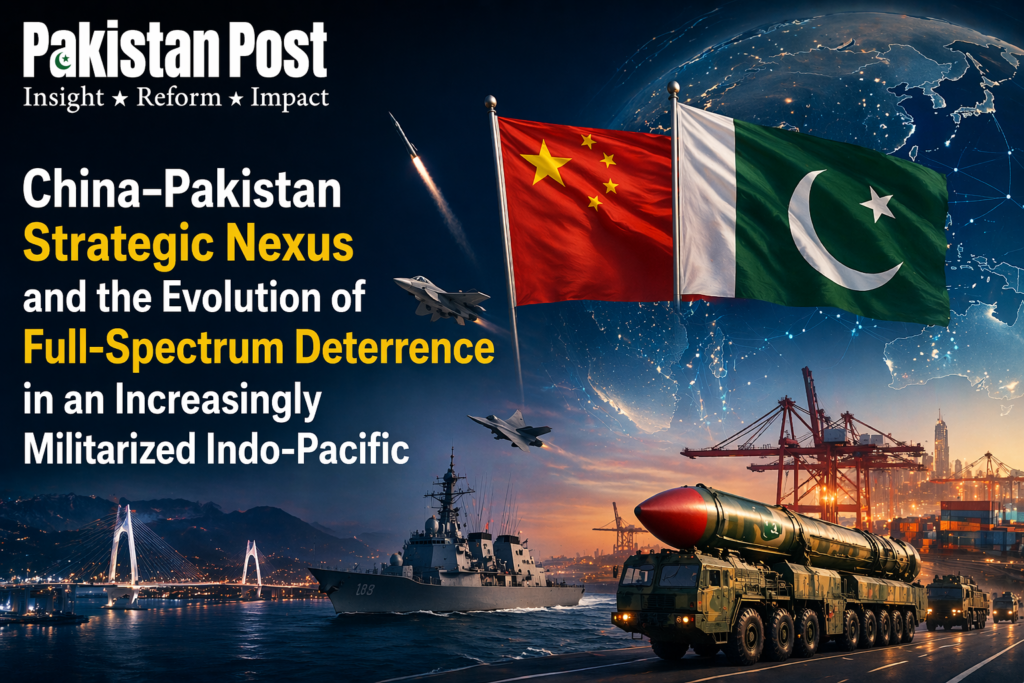
The strategic relationship between the Islamic Republic of Pakistan and the People’s Republic of China has long been described in shorthand as “all-weather,” a diplomatic phrase that once captured political trust and transactional alignment without necessarily implying deep structural military integration. That description is now increasingly inadequate. What is emerging in the third decade of the twenty-first century is not merely a bilateral partnership anchored in infrastructure and connectivity, but a gradually thickening strategic ecosystem in which economic corridors, maritime access, defense modernization, cyber capabilities, and deterrence signaling are beginning to overlap in ways that blur traditional categories of development cooperation and security alignment.
This evolution is occurring against the backdrop of a fundamentally transforming Indo-Pacific security environment, shaped by the intensification of strategic competition between China and the United States of United States, the reconfiguration of alliance structures, and the normalization of multi-domain warfare as a permanent condition rather than an exceptional phase. Within this shifting landscape, the China–Pakistan axis is increasingly being interpreted not merely as a regional partnership but as a node in a wider contest over maritime dominance, technological standards, and deterrence credibility.
At the center of this transformation lies the China–Pakistan Economic Corridor, often referred to as CPEC, which has moved far beyond its initial conception as a set of transportation and energy infrastructure projects. While its early phases focused on roads, ports, and power generation, its strategic implications now extend into logistics continuity, maritime access, and regional connectivity between western China and the Arabian Sea. The port of Gwadar, located in Pakistan’s southwestern coastline, has become emblematic of this shift. Although officially framed as a commercial hub designed to facilitate trade and regional integration, it is increasingly viewed through a strategic lens that connects inland Chinese provinces to maritime trade routes that bypass vulnerable chokepoints in the Malacca Strait.
This geographic logic is central to understanding why the China–Pakistan relationship is evolving beyond economic cooperation. For Beijing, diversification of maritime access is not an abstract ambition but a structural necessity within a global trading system that remains heavily exposed to naval pressure points and contested sea lanes. For Islamabad, integration into this connectivity framework offers potential economic uplift, but also introduces new layers of strategic exposure and expectation.
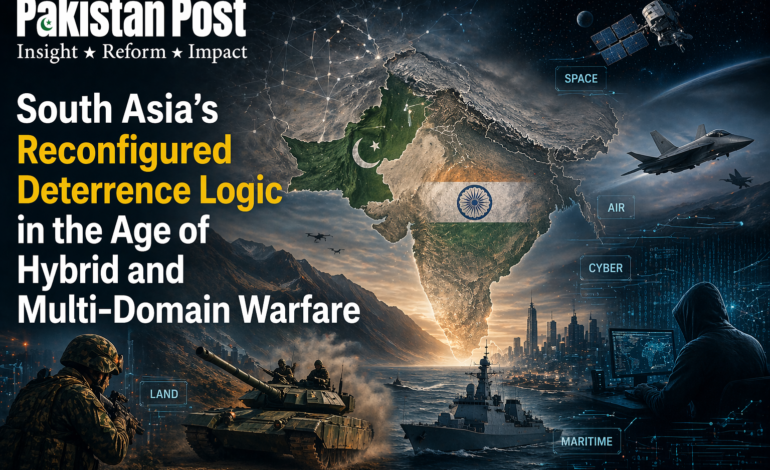
However, the most significant shift is not infrastructure-based but doctrinal. The nature of deterrence itself is changing across the Indo-Pacific region. Traditional deterrence, grounded in nuclear stability and conventional force balances, is being supplemented and in some cases disrupted by the emergence of cyber warfare, satellite surveillance, drone swarms, electronic warfare, and information operations. These developments have expanded the battlefield beyond physical geography into domains where attribution is difficult, escalation is rapid, and thresholds of conflict are increasingly ambiguous.
Within this environment, the China–Pakistan relationship is gradually acquiring characteristics of a multi-domain security partnership, even if it is not formally described as such. Defense cooperation between the two states has historically included joint production of military platforms, aircraft development programs, and training exchanges. However, what is now emerging is a deeper convergence in defense industrial ecosystems, surveillance capabilities, and potentially cyber and space-related coordination.
This does not imply the formation of a formal alliance structure comparable to NATO. Instead, it suggests the emergence of a layered deterrence interface, where cooperation is distributed across multiple domains without necessarily being codified into a single institutional framework. This flexibility is strategically useful in a global environment where rigid alliances can create escalation liabilities.
The Indo-Pacific context is essential to understanding this development. The United States has increasingly framed the region as the primary theater of long-term strategic competition, particularly in relation to China’s rise as a technological and military peer competitor. This has led to the strengthening of security arrangements involving regional partners such as India, Japan, Australia, and various Southeast Asian states. The aim of this architecture is to maintain a balance of power that prevents any single actor from achieving uncontested maritime dominance.
Within this architecture, the position of Pakistan is structurally complex. Its geographic proximity to India, its historical security alignment with China, and its episodic engagement with Western institutions place it in a triangulated strategic space. The bilateral rivalry between Pakistan and India remains the central axis of South Asian security dynamics, influencing force posture, nuclear doctrine, and crisis behavior. However, this rivalry is now increasingly embedded within a broader Indo-Pacific competition that extends beyond regional boundaries.
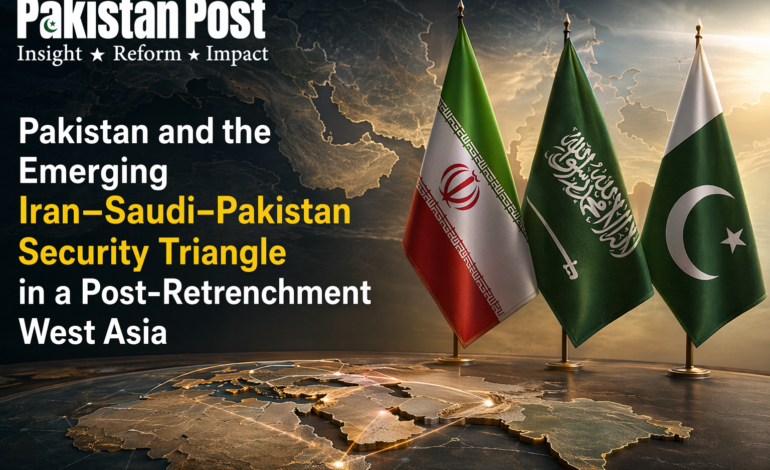
The China–Pakistan axis therefore functions as both a regional stabilizer and a strategic signal. It stabilizes in the sense that it provides Pakistan with external balancing capacity in relation to India. It signals in the sense that it reflects China’s willingness to maintain strategic depth in South Asia while expanding its maritime and continental influence simultaneously. This dual function complicates external perceptions, particularly in Washington and New Delhi, where the partnership is often interpreted through the lens of strategic containment.
Yet such interpretations risk oversimplifying the internal logic of the relationship. The China–Pakistan partnership is not solely driven by military considerations. It is also anchored in economic necessity, political alignment on certain global governance issues, and shared interest in regional connectivity. However, the increasing overlap between economic and security domains means that distinctions between civilian and military applications are becoming harder to maintain.
One of the most significant developments in this regard is the growing relevance of dual-use infrastructure. Ports, highways, communication networks, and energy grids built under connectivity frameworks can serve both commercial and strategic functions. This duality is not unique to the China–Pakistan relationship, but it is particularly pronounced due to the geographic positioning of Pakistan as a corridor between western China and the Arabian Sea.
The implications of this dual-use reality extend into maritime security. The Arabian Sea and adjacent waters are becoming increasingly important within Indo-Pacific naval planning. The presence of multiple external naval actors, combined with regional instability in the Gulf and Horn of Africa, has elevated the strategic significance of maritime surveillance and domain awareness. In this context, Pakistan’s coastline and port infrastructure acquire relevance beyond national boundaries.
However, this relevance does not automatically translate into autonomous strategic leverage. Pakistan’s economic constraints, periodic fiscal instability, and reliance on external financial support limit its ability to independently shape the trajectory of infrastructure-based strategic assets. This creates a structural asymmetry: Pakistan provides geography and access, while China provides capital, technology, and long-term strategic planning capacity.
The evolution of deterrence in this environment is particularly significant. In classical Cold War logic, deterrence was primarily nuclear and state-centric. In the contemporary Indo-Pacific environment, deterrence is increasingly multi-layered. It includes cyber deterrence, economic coercion, space-based surveillance, and information warfare. The threshold for conflict is no longer clearly defined, and escalation can occur across multiple domains simultaneously without formal declarations of war.
For Pakistan, this creates both challenges and opportunities. On one hand, it increases vulnerability to non-traditional forms of pressure, including cyber disruption, financial instability, and narrative warfare. On the other hand, its strategic alignment with China provides access to emerging technological ecosystems that may enhance its defensive and deterrent capabilities over time.
However, capability acquisition does not automatically translate into strategic stability. The integration of advanced systems into existing institutional frameworks requires doctrinal clarity, technical capacity, and robust civil-military coordination. Without these, technological enhancement can produce fragmentation rather than coherence.
India’s role in this evolving landscape remains central. As the primary regional competitor to Pakistan and a key partner in the US-led Indo-Pacific framework, India’s military modernization, naval expansion, and technological development significantly influence the regional balance. The Pakistan–India deterrence relationship therefore continues to function as a pressure point within the broader China–US strategic competition.
The interaction between these two layers—regional rivalry and global competition—creates a complex strategic lattice in which actions at one level reverberate across multiple theaters. A maritime incident in the Arabian Sea, a cyber intrusion affecting infrastructure systems, or a border escalation in South Asia can all have implications that extend beyond their immediate geographic context.
Within this environment, the China–Pakistan partnership operates as a stabilizing yet sensitive node. It stabilizes by providing Pakistan with strategic depth and alternative economic pathways. It remains sensitive because it is closely observed by external powers and embedded within broader narratives of great power competition.
The question of whether this partnership is evolving into a full-spectrum deterrence architecture depends on how one defines “full-spectrum.” If it implies formalized military alliance structures with integrated command systems, the answer remains no. However, if it refers to distributed cooperation across multiple domains including conventional defense, cyber capabilities, maritime awareness, and strategic infrastructure, then the trajectory suggests a gradual movement in that direction, albeit uneven and incomplete.
The future of this axis will likely be shaped by three interlinked variables: the stability of Pakistan’s internal political and economic systems, China’s continued expansion of its global strategic footprint under conditions of increasing resistance, and the evolution of Indo-Pacific security alignments led by the United States and its partners.
If Pakistan succeeds in stabilizing its domestic economic foundations, it may be able to convert geographic relevance into sustained strategic leverage. If China continues to prioritize diversified connectivity and secure maritime access, the importance of Pakistan as a corridor state will likely increase. If Indo-Pacific militarization accelerates, the pressure on Pakistan to clarify its strategic posture will intensify.
In this sense, the China–Pakistan relationship is not static. It is an adaptive system embedded within a rapidly changing global environment. Its evolution reflects broader shifts in how power is exercised in the twenty-first century, where infrastructure, data, perception, and deterrence are increasingly interconnected.
Ultimately, the axis between Pakistan and China is best understood not as a fixed alliance but as an evolving strategic interface. It is shaped by geography, driven by necessity, constrained by asymmetry, and increasingly defined by the logic of multi-domain competition. Whether it matures into a coherent deterrence architecture or remains a flexible but fragmented partnership will depend on how both states navigate an Indo-Pacific order that is still being written in real time.
A Public Service Message