Educational Misalignment and the Structural Human Capital Gap in Pakistan’s Economic Transition

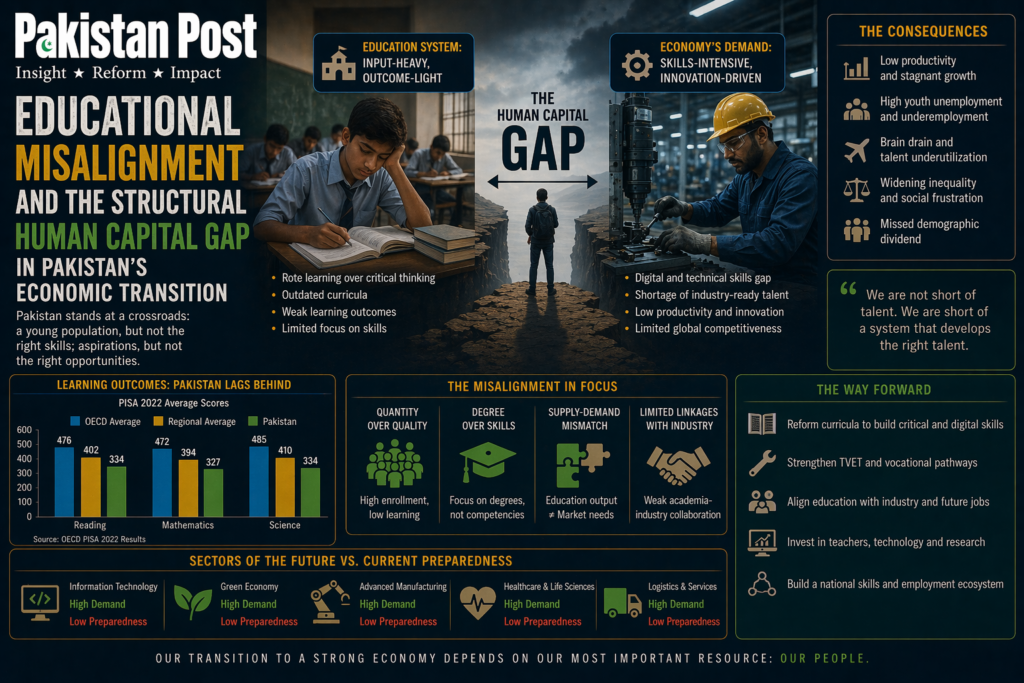
Pakistan’s education system stands at the centre of a widening structural contradiction: a rapidly changing global economy demanding advanced digital, analytical, and technical skills, and an institutional framework of learning that remains largely anchored in outdated curricula, fragmented governance, and uneven quality standards. The result is not merely an education deficit, but a deeper human capital misalignment that is increasingly shaping the country’s productivity trajectory, labour market competitiveness, and long-term economic resilience.
At the heart of this misalignment lies a systemic lag between educational output and labour market demand. While global economies are moving decisively toward automation, artificial intelligence, data-driven decision-making, and platform-based services, Pakistan’s education system continues to produce a workforce heavily concentrated in low-skill or semi-skilled categories. This is not a marginal gap; it is structural. It reflects decades of underinvestment in curriculum reform, weak linkages between academia and industry, and an institutional culture that prioritizes credential accumulation over skill formation.
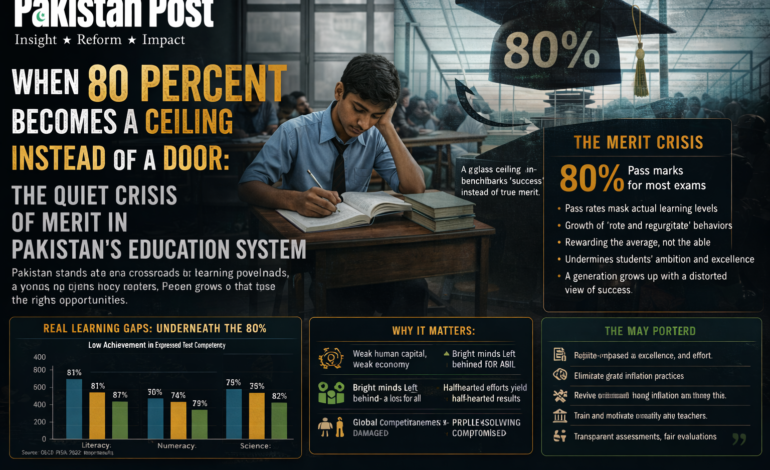
The formal education system, particularly at the secondary and tertiary levels, is characterized by rigid syllabi, examination-oriented learning, and limited exposure to practical application. In many institutions, learning remains rooted in rote memorization rather than analytical reasoning, problem-solving, or innovation capacity. This pedagogical approach, while producing measurable examination outcomes, fails to translate into employable competencies in a modernizing labour market.
Meanwhile, the labour market itself is undergoing rapid transformation. Even within Pakistan’s domestic economy, sectors such as information technology, financial services, telecommunications, logistics, and digital marketing are expanding, albeit unevenly. These sectors increasingly demand workers with hybrid skill sets that combine technical proficiency with critical thinking, adaptability, and digital literacy. Yet the supply pipeline from educational institutions remains only partially aligned with these requirements.
This disconnect is particularly visible in higher education. Universities in Pakistan continue to produce large numbers of graduates in general disciplines with limited employability in high-growth sectors. At the same time, technical and vocational training systems remain underdeveloped, fragmented, and often socially undervalued. The absence of a coherent national skills strategy has resulted in parallel systems of education that do not communicate effectively with each other or with the labour market.
The consequences of this misalignment extend beyond unemployment statistics. They shape the structure of economic growth itself. Low human capital productivity constrains industrial upgrading, limits foreign investment attraction in high-value sectors, and reduces the economy’s capacity to move up global value chains. In an increasingly competitive global environment, where comparative advantage is shifting from labour abundance to skill intensity, this represents a significant structural disadvantage.
One of the most critical bottlenecks lies in the weak integration between academia and industry. In advanced economies, universities, research institutions, and private sector firms operate within interconnected ecosystems that facilitate knowledge transfer, innovation, and workforce alignment. In Pakistan, these linkages remain limited and largely informal. Internship systems are inconsistent, research commercialization is weak, and industry participation in curriculum design is minimal.
This institutional disconnect has produced a persistent mismatch between graduate skills and employer expectations. Employers frequently report deficiencies not only in technical expertise but also in soft skills such as communication, teamwork, and problem-solving. These gaps are particularly pronounced in fields such as engineering, business administration, and computer science, where theoretical knowledge is often not matched by practical competence.
The digital transformation of the global economy further intensifies this challenge. Artificial intelligence, machine learning, cloud computing, and data analytics are reshaping employment structures across industries. Even traditional sectors such as agriculture and manufacturing are becoming increasingly technology-driven. Yet the penetration of these competencies into Pakistan’s education system remains limited and uneven.
Although there have been initiatives to introduce digital literacy programs and technology-focused curricula, these efforts often remain fragmented, pilot-based, or dependent on external funding cycles. Without systemic integration into the national education architecture, such initiatives struggle to scale or sustain impact.
Regional disparities further complicate the picture. Urban centres, particularly major cities, have relatively better access to quality education and emerging skill-building opportunities. In contrast, rural and peri-urban areas face persistent deficits in infrastructure, teacher quality, and institutional resources. This creates a dual-speed education system that reinforces broader socio-economic inequality.
Gender disparities also remain significant. While female enrolment in certain educational tiers has improved over time, labour market participation remains constrained by structural, cultural, and institutional barriers. This results in underutilization of a significant portion of the country’s human capital, further reducing overall productivity potential.
The governance structure of the education sector itself contributes to fragmentation. Education is largely devolved to provincial authorities, which has created variation in policy implementation, resource allocation, and curriculum standards. While decentralization can improve responsiveness, in Pakistan’s case it has often resulted in uneven quality and lack of national coherence in education strategy.
Public expenditure on education remains low relative to both regional comparators and global benchmarks. More importantly, the allocation of existing resources often prioritizes infrastructure expansion over quality enhancement, teacher training, and curriculum modernization. As a result, physical access to education has improved more rapidly than educational outcomes.
Private education providers have partially filled this gap, particularly in urban areas. However, the private sector itself is highly heterogeneous, ranging from elite institutions offering high-quality education to low-cost schools with variable standards. This stratification reinforces inequality in human capital formation, as access to quality education becomes increasingly linked to income levels.
At the tertiary level, research output remains limited and often disconnected from national development priorities. Funding for research and development is low, institutional incentives for innovation are weak, and collaboration with industry is minimal. This limits the capacity of universities to function as engines of knowledge creation and economic transformation.
The implications for economic competitiveness are significant. In a global economy increasingly driven by knowledge intensity, countries that fail to develop strong human capital ecosystems risk being locked into low-value segments of production chains. For Pakistan, this risk is compounded by demographic pressures. A large and growing youth population represents both a potential demographic dividend and a potential structural liability, depending on the quality of skills formation.
If education and training systems fail to adapt, this demographic expansion could translate into higher unemployment, underemployment, and informal sector absorption. Conversely, if aligned effectively with market needs, it could provide a foundation for sustained economic growth and productivity gains.
International experience suggests that successful transitions to knowledge-based economies require sustained investment in education quality, institutional coherence, and skills alignment. Countries that have managed to move up the value chain have typically done so through integrated strategies that link education policy with industrial policy and innovation ecosystems.
In Pakistan’s case, such integration remains limited. Education policy is often treated as a standalone social sector issue rather than as a central component of economic planning. This separation weakens the strategic alignment between human capital development and national economic objectives.
The role of technology presents both a challenge and an opportunity. On one hand, automation threatens to displace low-skill labour, increasing pressure on already vulnerable segments of the workforce. On the other hand, digital platforms can expand access to education, reduce geographical barriers, and enable scalable skills training if effectively deployed.
However, leveraging this opportunity requires institutional readiness that goes beyond technology adoption. It requires curriculum reform, teacher training, assessment redesign, and a shift toward competency-based education models. Without these foundational changes, technological interventions risk remaining superficial.
The question of whether human capital formation in Pakistan is keeping pace with global transformation trends is increasingly difficult to answer in the affirmative. While pockets of progress exist, particularly in the IT sector and certain private institutions, the overall system remains misaligned with the direction of global economic change.
This misalignment is not simply a technical issue; it is a structural constraint on economic development. It affects productivity growth, investment attraction, export diversification, and social mobility simultaneously. Over time, it risks entrenching a low-skill equilibrium in which large segments of the population remain excluded from high-value economic participation.
Addressing this challenge requires more than incremental reform. It demands a reconfiguration of education as a strategic sector, integrated with labour market intelligence systems, industrial policy frameworks, and technological development strategies. It also requires sustained political commitment across electoral cycles, which has historically been one of the weakest points in the system.
Ultimately, the future trajectory of Pakistan’s economy will be determined not only by macroeconomic stabilization or infrastructure investment, but by the quality of its human capital. In a world where knowledge, skills, and adaptability define competitiveness, the education system is no longer a peripheral concern. It is the central infrastructure of economic survival.
A Public Service Message