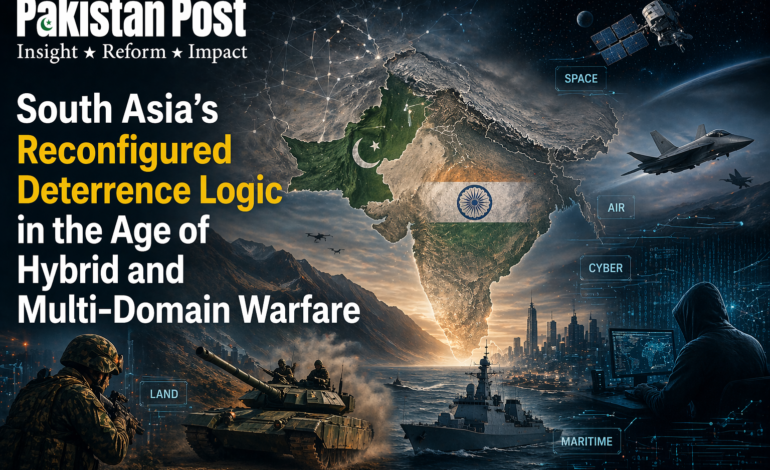
South Asia’s Reconfigured Deterrence Logic in the Age of Hybrid and Multi-Domain Warfare

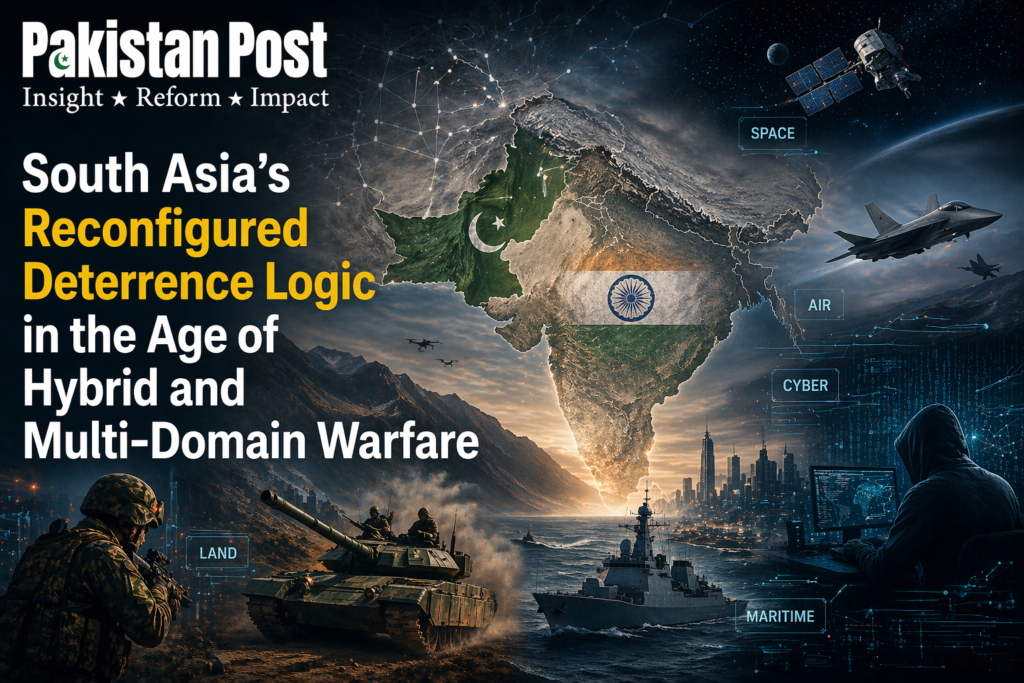
Deterrence in South Asia is no longer anchored solely in the classical grammar of tanks, territory, and nuclear signaling. It is increasingly shaped by a far more diffuse and continuous form of competition in which cyber intrusions, drone operations, satellite surveillance, economic pressure, and information warfare operate simultaneously, often below the threshold of formal war. In this evolving environment, the Islamic Republic of Pakistan finds itself navigating a strategic landscape where escalation is no longer episodic but persistent, and where the boundaries between peace and conflict have become increasingly indistinct.
At the center of this transformation remains the enduring rivalry between Pakistan and the Republic of India, a dyad that continues to define the core deterrence equilibrium of South Asia. Yet the nature of this equilibrium is shifting. Traditional models of deterrence, built on the assumption of clear thresholds and identifiable battlefields, are under strain. The emergence of hybrid warfare has introduced ambiguity into every layer of strategic interaction, making it difficult to distinguish between routine peacetime competition and pre-escalatory signaling.
This ambiguity is not accidental; it is structural. The diffusion of military capability into civilian technological domains means that actors can now engage in coercive behavior without crossing conventional red lines. Cyber operations targeting financial systems, energy grids, or communication infrastructure can generate strategic effects without triggering immediate kinetic responses. Similarly, drone incursions, electronic interference, and disinformation campaigns can be calibrated to remain deniable while still exerting pressure.
In South Asia, where historical mistrust is deep and crisis instability is recurrent, this ambiguity has profound implications. It compresses decision-making timelines, increases the risk of misinterpretation, and expands the range of actors and platforms through which escalation can occur. The result is a deterrence environment that is simultaneously more complex and more fragile than in previous eras.
Pakistan’s strategic doctrine has historically evolved in response to perceived conventional asymmetries with India, particularly in the aftermath of major conflicts and crises. Nuclear deterrence introduced a stabilizing layer at the strategic level, but it did not eliminate conventional or sub-conventional competition. Instead, it created a layered deterrence structure in which different levels of conflict are managed through different instruments of state power.
What is changing now is the density of interaction within these layers. Hybrid warfare compresses strategic time. A cyber incident can occur in seconds, a drone strike can bypass traditional border defenses, and an information campaign can reshape narratives in real time. This compression challenges the ability of traditional command-and-control systems to maintain calibrated responses.
The increasing role of drones in regional conflict dynamics is particularly significant. Unmanned systems reduce the political cost of limited military action while increasing the frequency of cross-border engagements. They also complicate attribution, allowing states and non-state actors to operate in overlapping spaces of plausible deniability. In such an environment, deterrence becomes less about preventing war and more about managing continuous contact below the threshold of declared conflict.
Cyber warfare adds another layer of complexity. Critical infrastructure systems, financial networks, and communication platforms are now potential battlegrounds. The strategic value of these targets lies not in physical destruction but in disruption, delay, and psychological impact. For states like Pakistan and India, which are both increasingly digitized but unevenly protected, cyber vulnerability becomes a key component of national security calculations.
Information warfare, meanwhile, operates in an even more diffuse domain. Narratives, perceptions, and media ecosystems have become instruments of strategic influence. In this context, the role of traditional and digital media in shaping crisis perception is no longer secondary; it is central. Escalation can be triggered or contained not only by military actions but by how those actions are interpreted, amplified, or contested in real time.
The cumulative effect of these developments is the erosion of linear escalation ladders. In classical deterrence theory, escalation was assumed to follow a predictable sequence: sub-conventional conflict, conventional engagement, and ultimately nuclear signaling as a final deterrent threshold. In the contemporary South Asian environment, these stages are increasingly blurred. A cyber incident can occur alongside a border skirmish, while information campaigns amplify perceptions of escalation even when kinetic activity remains limited.
This blurring complicates crisis management. Decision-makers must now interpret multiple streams of information simultaneously, often under severe time pressure and incomplete situational awareness. The risk of miscalculation increases not only because of adversarial intent but also because of systemic complexity.
India’s military modernization and doctrinal evolution reflect an awareness of these changes. Investments in integrated battle networks, rapid deployment capabilities, and cyber infrastructure indicate an attempt to adapt to multi-domain conflict environments. Pakistan, for its part, has also been compelled to adjust its strategic posture, emphasizing survivability, second-strike assurance, and tactical responsiveness in an increasingly fluid threat environment.
However, adaptation is uneven on both sides. Institutional capacity, technological depth, and resource availability differ significantly, creating asymmetries in how quickly and effectively each state can integrate new forms of warfare into their strategic doctrines. These asymmetries do not necessarily translate into decisive advantage, but they do influence crisis behavior and escalation thresholds.
The presence of nuclear weapons adds a stabilizing but paradoxical layer to this environment. Nuclear deterrence continues to impose a ceiling on full-scale war, but it does not prevent lower-intensity conflict. Instead, it encourages competition in domains that remain below nuclear thresholds. This creates what some analysts describe as a “stability-instability paradox,” where strategic stability at the highest level coexists with persistent instability at lower levels of conflict.
What is different in the current phase is the speed and simultaneity of these lower-level conflicts. Hybrid warfare compresses domains that were once relatively distinct. Cyber, information, and kinetic operations now interact in real time, creating cascading effects that are difficult to predict or contain.
External actors further complicate this landscape. The growing strategic involvement of the United States of United States in the Indo-Pacific, alongside China’s expanding regional footprint, introduces additional layers of alignment and signaling into South Asia’s deterrence environment. While South Asia remains geographically distinct, it is no longer strategically isolated. Decisions made in broader Indo-Pacific frameworks reverberate into the region’s security dynamics.
In this context, Pakistan’s strategic doctrine is increasingly shaped by the need to maintain deterrence credibility across multiple domains simultaneously. This includes ensuring conventional readiness, maintaining nuclear deterrence stability, and adapting to emerging threats in cyber and information domains. The challenge is not merely technical but conceptual: how to define deterrence in an environment where conflict is continuous rather than episodic.
One of the central tensions in this evolving doctrine is between escalation control and operational flexibility. States must deter adversaries without locking themselves into rigid response frameworks that can be exploited in ambiguous situations. At the same time, excessive ambiguity can increase the risk of misinterpretation, leading to unintended escalation.
Regional crisis history demonstrates how quickly localized incidents can escalate under conditions of uncertainty. The speed of modern communication systems, combined with the volatility of political narratives, means that crises now unfold in compressed timeframes. Diplomatic channels, while still essential, often operate in parallel with real-time media and military dynamics rather than preceding them.
The future of deterrence in South Asia will likely depend on the development of new stabilizing mechanisms that go beyond traditional military balances. These may include cyber norms, communication protocols for unmanned systems, crisis hotlines adapted for multi-domain incidents, and regional confidence-building measures that account for digital and informational warfare.
However, such mechanisms require political will, institutional trust, and sustained engagement, all of which remain uneven in the current regional environment. In the absence of robust institutional frameworks, deterrence will continue to rely heavily on perception management, rapid signaling, and calibrated ambiguity.
Ultimately, South Asia’s deterrence system is transitioning from a relatively structured bipolar military balance into a complex adaptive system characterized by continuous interaction, overlapping domains, and accelerated escalation dynamics. In such a system, stability is not a fixed condition but a managed process.
Pakistan’s challenge is to navigate this environment without losing strategic coherence, maintaining credible deterrence while adapting to technologies and doctrines that are reshaping the very meaning of conflict. India faces a parallel challenge of integrating multi-domain capabilities without increasing escalation risk. External powers observe and influence these dynamics, but they do not fully control them.
In this evolving landscape, deterrence is no longer a static equation. It is a living system, constantly adjusted, constantly tested, and increasingly defined by speed, ambiguity, and interconnection rather than clear boundaries or predictable patterns.
A Public Service Message