
Industrial Grid Integration and Energy Transition Risk: Strategic Pathways for Mitigating Financial Exposure and Enhancing Competitiveness

The evolving dynamics of Pakistan’s industrial energy sector underscore the strategic imperatives of operational resilience, energy security, and fiscal prudence. Captive power plants (CPPs) have historically provided industries with reliable, on-site energy solutions, ensuring continuity of production and shielding critical sectors from national
Pakistan’s Regional Security Calculus and Operational Coordination in a Volatile Middle Eastern Theatre
The intensification of hostilities between Iran, the United States, and Israel has generated a strategic environment defined by volatility, compressed decision timelines, and multidimensional risk vectors that extend far beyond the immediate theatre of conflict. For Pakistan, this evolving landscape necessitates a comprehensive
Iran’s Retaliatory Capabilities and Pakistan’s Strategic Contingency Posture
The evolving military confrontation between Iran, the United States, and Israel has introduced a new level of complexity to the strategic landscape of the Middle East. The coordinated strikes launched by US and Israeli forces against Iranian installations on February twenty eighth of
Pakistan’s Role as a Geo-Strategic Mediator in the Iran–US–Israel Crisis
The geopolitical landscape of the Middle East has entered a period of profound instability following the coordinated military strikes by the United States and Israel against Iran. The escalation of hostilities has not only intensified regional tensions but has also posed complex strategic
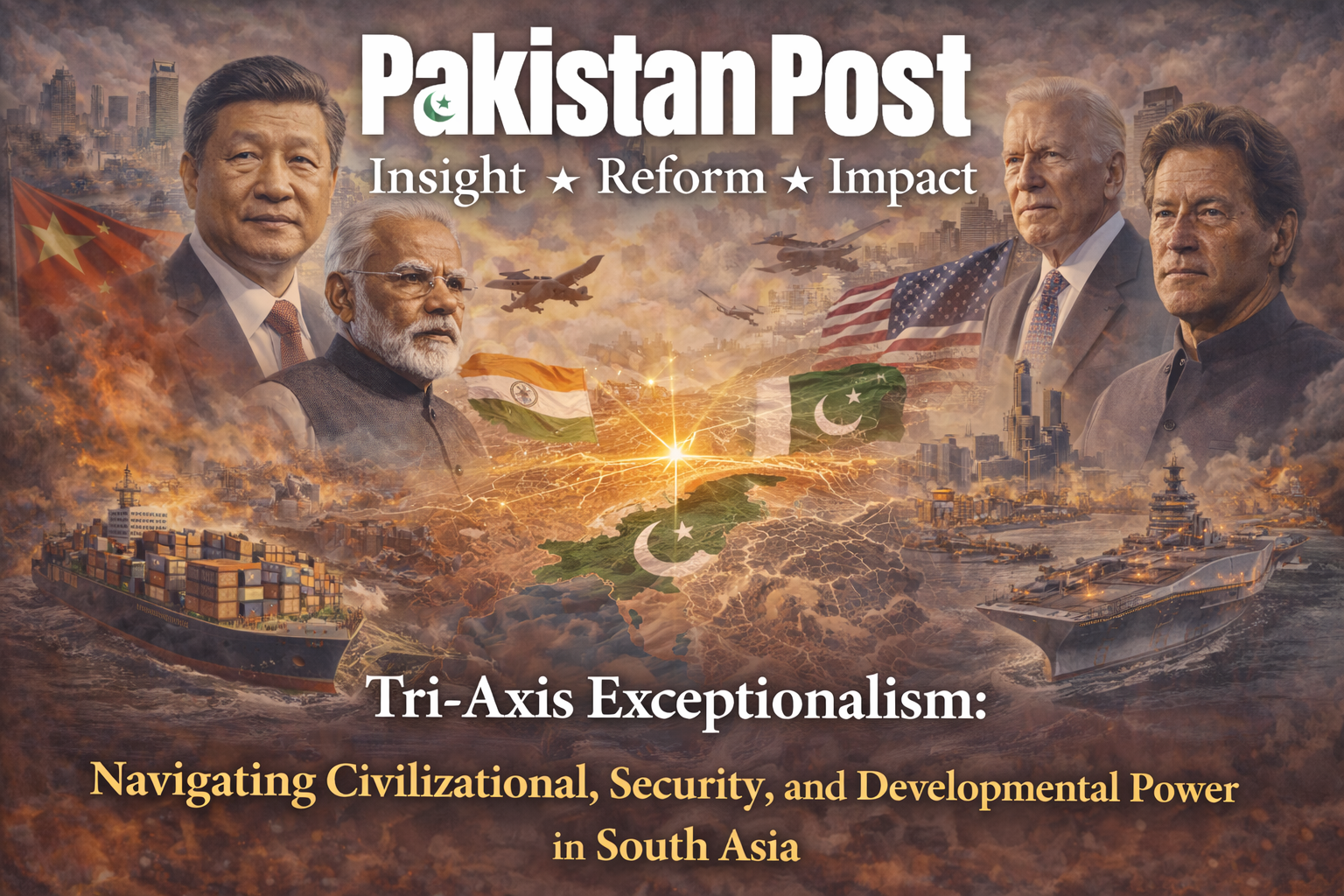
Tri-Axis Exceptionalism: Navigating Civilizational, Security, and Developmental Power in South Asia
Competing narratives of exceptionalism have long shaped the geopolitical landscape of South Asia, defining the contours of regional influence and strategic alignments. India, asserting its role as the largest democracy in the world, projects a vision of civilizational leadership and moral authority, framing
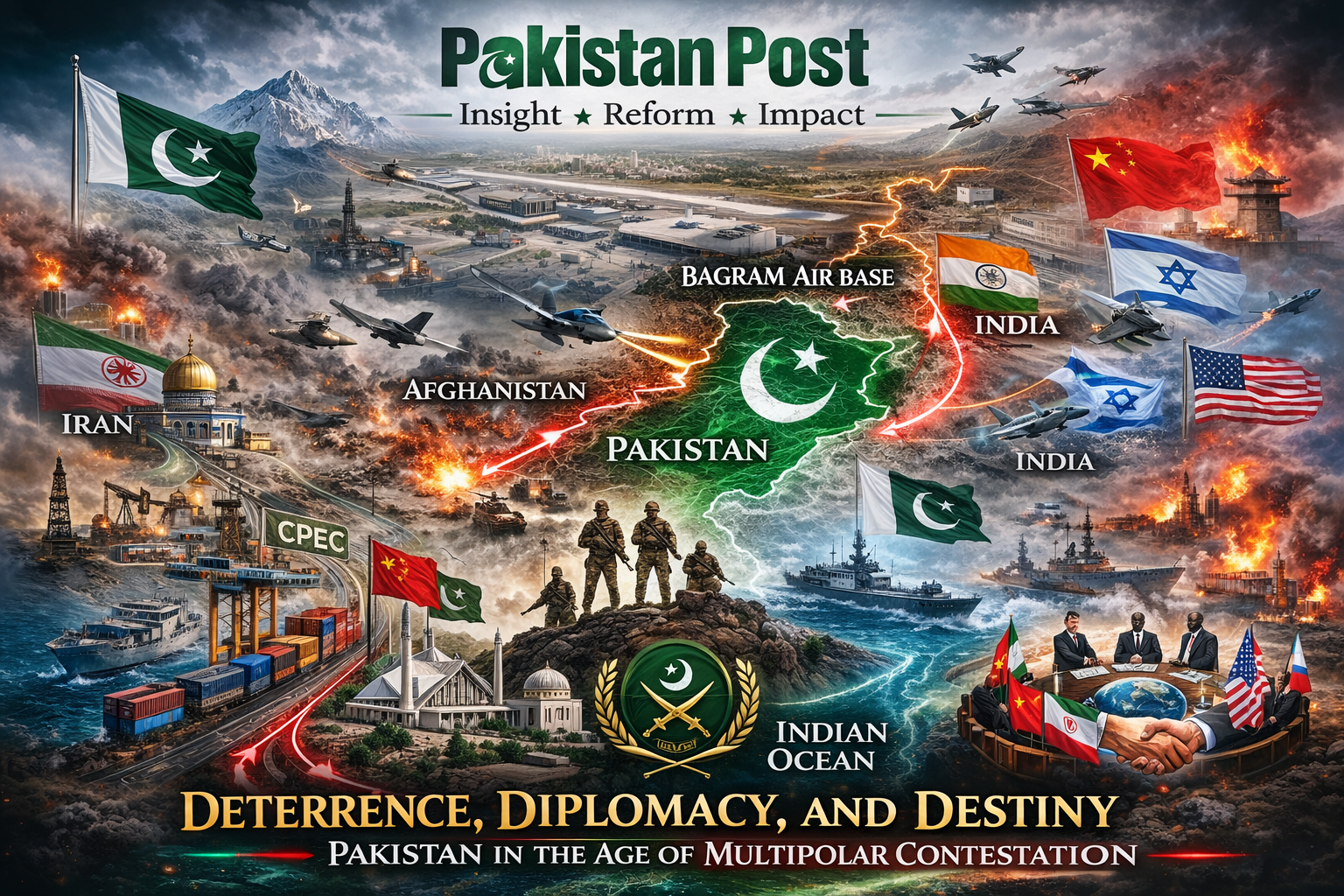
Deterrence, Diplomacy, and Destiny: Pakistan in the Age of Multipolar Contestation
Pakistan is not merely a geographic construct bounded by frontiers; it is a sovereign strategic actor shaped by history, sacrifice, and an enduring security consciousness. In moments of global turbulence, when alliances are recalibrated and power centers renegotiate influence, nations are tested not
Pakistan’s strategic position in the contemporary global order

Pakistan’s strategic position in the contemporary global order is simultaneously a product of geography, history, and emergent systemic shifts. The post-World War II international system, anchored by U.S. unipolar dominance, dollar hegemony, and Western-led multilateral institutions, is increasingly strained by the rise of

Strategic Leverage and Sovereignty: Pakistan in an Era of Global Realignment

Pakistan’s diplomatic posture today is being shaped not by isolated crises, but by the convergence of multiple systemic stresses that are transforming the international order. The intensifying rivalry between the United States and China, persistent conflicts in South Asia, instability across the Middle

Geo‑Economic Shifts: Strategic Pathways for Pakistan’s Economic Autonomy and Stability
The global geo-economic and geopolitical environment in the mid-2020s is defined by unprecedented structural complexity, where traditional assumptions of unipolar stability are increasingly challenged by a multipolar world order. At the center of this transformation is the intensifying rivalry between the United States

National Resilience in a Fracturing World: Governance, Economy, Defense, and Strategic Cohesion in Pakistan
The international system is entering a phase of prolonged instability marked not by a single hegemonic collapse, but by overlapping shocks: financial fragmentation, energy insecurity, militarized trade, and narrative warfare. For a state like Pakistanstrategically pivotal, economically constrained, and socially diverseexternal volatility does