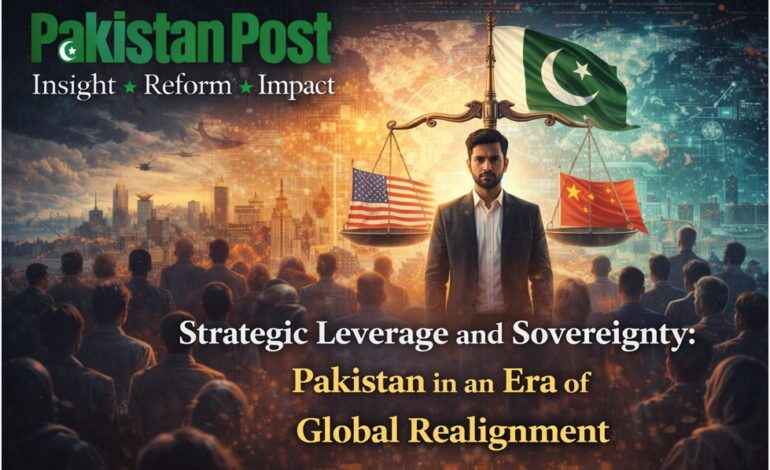
Strategic Leverage and Sovereignty: Pakistan in an Era of Global Realignment


Pakistan’s diplomatic posture today is being shaped not by isolated crises, but by the convergence of multiple systemic stresses that are transforming the international order. The intensifying rivalry between the United States and China, persistent conflicts in South Asia, instability across the Middle East, and rising tensions in the Far East together signal the erosion of the post–Cold War equilibrium and the emergence of a fragmented multipolar system. In such an environment, traditional alignment strategies are no longer sufficient. For a country like Pakistaneconomically constrained, strategically located, militarily consequential, and politically complex—the challenge is not merely to avoid conflict but to actively shape outcomes through diplomacy that is anticipatory, multidirectional, and strategically coherent.
Pakistan’s geographic and political position places it at the intersection of competing power systems. To the east lies India, increasingly aligned with Western strategic frameworks and assertive in both military and diplomatic domains. To the north and west stretch Central Asia and the Middle East, regions marked by resource competition, ideological contestation, and proxy conflicts. To the south lies the Indian Ocean, now a principal arena of great-power competition involving Chinese maritime interests and sustained U.S. naval presence. Overlaying these spatial realities is Pakistan’s deep strategic partnership with China, its economic and financial dependencies on Western institutions, and its historic ties with the Gulf states that underwrite domestic economic stability through energy supplies and remittances.
In this context, Pakistan cannot afford reactive diplomacy. Nor can it allow itself to be drawn into binary alignments that would undermine its sovereignty or constrain its strategic flexibility. The global environment increasingly punishes states that outsource their foreign policy choices to ideological impulses or short-term economic relief. Instead, Pakistan must pursue proactive diplomacy—one that anticipates power shifts, engages multiple actors simultaneously, and communicates its strategic intent with clarity both externally and internally.
Recent diplomatic engagements signal an emerging recognition of this necessity within Pakistan’s political and security leadership. The outreach undertaken by the military leadership, including Field Marshall Asim Munir’s engagements across the Middle East and North Africa, including Libya, reflects a deliberate effort to reposition Pakistan as a stabilizing and constructive actor within the Muslim world. These engagements are not symbolic; they signal a strategic recalibration in which Pakistan seeks to contribute to de-escalation in Gaza, Sudan, Libya, and broader Middle Eastern fault lines while maintaining working relations with Western powers that continue to exert decisive influence over conflict resolution, financial flows, and reconstruction frameworks.
This diplomatic posture recognizes a fundamental reality: the stabilization of the Muslim world in the current era cannot occur through isolation from the West, nor through rhetorical confrontation. Conflicts in Gaza, Libya, and Sudan are not only humanitarian crises; they are deeply embedded in global power competition, arms flows, energy markets, and international institutions. Any meaningful role Pakistan seeks to play in conflict mitigation or mediation must therefore involve engagement with the United States, Europe, and multilateral bodies, even as it articulates principled positions that resonate with Muslim publics and regional stakeholders.
At the same time, Pakistan must preserve its strategic alignment with China, particularly in the context of South Asia and the Indian Ocean. China remains Pakistan’s most reliable long-term strategic partner in defense, infrastructure development, and regional balancing against India. However, strategic alignment does not require diplomatic exclusivity. Pakistan’s challenge is to ensure that its deep cooperation with Chinaespecially in defense and CPEC-related connectivity—does not translate into automatic positioning against Western interests in unrelated theatres. This requires diplomatic sophistication: distinguishing between alignment and subordination, partnership and proxy behavior.
The United States and Europe, despite growing tensions with China, continue to value Pakistan’s role in regional stability, counterterrorism, and conflict mediation. Pakistan’s ability to communicate credibly with Washington and European capitals, particularly on issues such as Gaza ceasefire efforts, Red Sea security, Afghanistan stabilization, and Iran-related de-escalation, remains a critical diplomatic asset. The objective is not alignment with Western strategic agendas, but functional cooperation where interests overlap. This allows Pakistan to retain diplomatic space, reduce coercive pressure, and preserve access to financial and trade systems that remain indispensable in the short to medium term.
The Gulf states represent another essential pillar of Pakistan’s diplomatic calculus. Saudi Arabia, the UAE, and Qatar are not merely economic partners; they are increasingly autonomous geopolitical actors pursuing diversified alliances with China, the U.S., and regional powers simultaneously. Pakistan’s diplomacy must align with this Gulf pragmatism. By maintaining close coordination with Gulf capitals on energy security, labor mobility, and regional conflict management, Pakistan can reinforce economic stability while participating in broader efforts to de-escalate regional tensions. This triangular diplomacyPakistan, Gulf states, and Western actorsoffers a platform through which Pakistan can exert influence without overextension.
Equally important is Pakistan’s engagement with Iran and Central Asia. Pakistan cannot afford antagonistic relations with Iran, nor can it permit regional rivalries to spill over into its domestic security environment. A rational, measured diplomatic approach that emphasizes border security, trade, and regional connectivity while avoiding public alignment in regional proxy conflicts is essential. This balanced messagingsupportive of stability, respectful of sovereignty, and non-provocativemust be communicated consistently to both Iranian counterparts and Western interlocutors.
However, external diplomacy cannot succeed in isolation from internal consensus. One of Pakistan’s most underappreciated strategic challenges is the disjunction between elite strategic thinking and popular perception. Large segments of the population, shaped by historical grievances, ideological narratives, and limited exposure to contemporary geopolitics, often view international relations through moral absolutes. The world is framed as an adversarial “Judeo-Christian system,” diplomacy with the West as betrayal, and strategic compromise as weakness. This worldview, while emotionally resonant, is strategically debilitating.
Pakistan’s political and military leadership must therefore invest in strategic communication as a core element of national security. Proactive diplomacy will only be sustainable if it is explained to the public in terms of national interest, economic survival, and long-term sovereigntynot ideological alignment. Engagement with the West to de-escalate Gaza does not negate solidarity with Palestinians; dialogue with Europe does not undermine Islamic identity; coordination with the Gulf does not imply subservience; and strategic partnership with China does not require hostility toward all others. These distinctions must be articulated clearly and repeatedly.
Multilateral engagement offers Pakistan an additional buffer against binary alignment. Active participation in forums such as the United Nations, the Shanghai Cooperation Organization, the Organization of Islamic Cooperation, and emerging regional platforms allows Pakistan to anchor its diplomacy in collective processes rather than bilateral dependencies. Multilateralism provides legitimacy, distributes risk, and enhances credibilityparticularly for a middle power operating amid great-power competition.
Ultimately, Pakistan’s diplomatic success in this era will depend on coherence. Diplomatic outreach, military strategy, economic policy, and public messaging must reinforce rather than contradict each other. The objective is not neutrality in the abstract, but strategic autonomy in practice: the ability to engage all major actors, avoid entrapment in others’ conflicts, protect core national interests, and contribute constructively to regional stability.
The world is entering a phase where miscalculation carries systemic consequences. As power shifts from the old centers to emerging poles, states that fail to adapt diplomatically risk becoming battlegrounds rather than brokers. Pakistan, by virtue of its location, capabilities, and relationships, retains agencybut only if it exercises it deliberately. Proactive diplomacy, calibrated partnerships, and disciplined messaging are no longer optional tools; they are the foundations upon which Pakistan’s sovereignty, stability, and relevance will rest in the coming decade.
A Public Service Message