
Geo‑Economic Shifts: Strategic Pathways for Pakistan’s Economic Autonomy and Stability


The global geo-economic and geopolitical environment in the mid-2020s is defined by unprecedented structural complexity, where traditional assumptions of unipolar stability are increasingly challenged by a multipolar world order. At the center of this transformation is the intensifying rivalry between the United States and China, whose strategic competition now spans not only military domains but also economic, financial, and technological spheres. This contest is manifested in the use of the dollar as a coercive tool, the strategic maneuvering of energy and trade corridors, and the pursuit of global influence through infrastructure investment and regional alliances. For Pakistan, these dynamics interact with domestic economic fragilities and internal perceptions of security, creating a unique set of challenges and opportunities for policy-making that balances sovereignty, strategic autonomy, and internal cohesion. The stakes are high, given Pakistan’s reliance on external financing, trade partnerships with Europe and the Middle East, and deepening economic and strategic ties with China.
The United States’ global financial leverage remains rooted in the dollar’s status as the primary medium of international trade, the dominant reserve currency, and the linchpin of debt markets. This dominance has allowed the U.S. to impose sanctions, control trade flows, and shape geopolitical outcomes in ways that serve American strategic objectives. However, the U.S. is now confronted with a national debt approaching $38 trillion, a structural imbalance that complicates its ability to maintain long-term financial and geopolitical influence). At the same time, its use of sanctions as a foreign policy tool targeting Russia following the Ukraine conflict, restricting Venezuela’s crude exports through maritime control, and exerting pressure on Nigeria has heightened global awareness of the risks of reliance on dollar-denominated reserves). These actions, coupled with tariffs and trade measures against strategic competitors, have accelerated conversations around de-dollarization and encouraged alternative mechanisms for trade settlement, particularly among nations seeking to insulate themselves from U.S. coercion. For Pakistan, whose external debt is heavily dollar-denominated, servicing these obligations in the context of exchange rate volatility and tightening global financial conditions significantly constrains fiscal space and increases vulnerability to geopolitical pressures.
China, in contrast, has pursued a strategy of deepening economic influence through infrastructure investment, trade partnerships, and energy security initiatives. The Belt and Road Initiative, with the China-Pakistan Economic Corridor (CPEC) at its core, exemplifies Beijing’s approach to securing critical energy supply lines while integrating regional economies. The development of Gwadar Port, along with associated transport and energy infrastructure, not only enhances regional connectivity but also provides Pakistan with strategic leverage in global trade networks However, while these investments deliver tangible economic benefits, including industrial growth and enhanced logistics, they also embed structural dependencies. A significant portion of Pakistan’s external debt is owed to Chinese creditors, and the predominance of Chinese firms in trade and construction projects limits domestic value addition, raising long-term sustainability concerns. Strategic recalibrations by China, such as the partial withdrawal of financing from key projects, illustrate that even foundational partnerships carry conditional risks
Europe and the Middle East further influence Pakistan’s economic environment. The European Union represents a critical export market, particularly for textiles and labor-intensive goods, with preferential access schemes such as GSP+ contingent on compliance with human rights, labor, and environmental standards. These arrangements necessitate governance reforms that align with global norms but provide sustained access to high-value markets. The Middle East, meanwhile, contributes significantly through remittances, energy cooperation, and financial flows that underpin Pakistan’s domestic consumption and fiscal stability. The volatility of oil markets, however, and dependence on expatriate remittances underscore the need for strategic diversification of economic partnerships to ensure resilience against external shocks
These external economic pressures intersect with domestic strategic considerations. Pakistan’s security establishment, particularly the military, has historically played a central role in safeguarding the nation’s sovereignty and strategic autonomy. In the current context, the army’s leadership is acutely aware of the need to balance relations with the United States and China, ensuring that economic partnerships and security cooperation do not compromise Pakistan’s strategic independence. Military planners and policymakers recognize that over-reliance on any single global actor exposes Pakistan to coercion and undermines long-term national security. This balancing act, however, is complicated by internal societal perceptions, where segments of the public, influenced by historical memory and religious ideology, often interpret relations with the United States and the West through a lens of civilizational opposition, framing strategic partnerships as subservience to a “Judeo-Christian world order.” These perceptions, often emotional and ideologically charged, distort the public’s understanding of the army’s strategic calculus and create tensions between national security imperatives and popular sentiment.
Managing these competing pressures requires Pakistan to adopt a strategy of multi-vector economic and strategic engagement. The country must deepen trade and investment partnerships beyond China, Europe, and the Middle East, exploring markets in Central Asia, Southeast Asia, and Africa. This includes strengthening engagement with multilateral frameworks such as the Shanghai Cooperation Organization and the Economic Cooperation Organization to diversify economic dependencies. Bilateral currency swap agreements and alternative settlement mechanisms can mitigate exposure to the dollar, reducing the vulnerability of reserves and debt servicing to U.S. financial coercion. Concurrently, Pakistan must accelerate domestic industrialization policies that promote export-led growth and value addition, particularly in sectors such as textiles, information technology, and agribusiness, while ensuring compliance with international regulatory and quality standards. Fiscal and debt management reforms are essential, emphasizing concessional financing, prudent public investment, and transparency in debt reporting to safeguard economic sovereignty.
The interplay of geo-economic dependence, public perception, and strategic security considerations necessitates robust strategic communication. The government and military must convey to domestic audiences that calibrated engagement with multiple global powers is a deliberate policy of autonomy, not ideological alignment. By presenting foreign policy choices in terms of national interest, sovereignty, and resilience rather than moral binaries, Pakistan can mitigate misperceptions and reduce domestic pressure that could constrain strategic decision-making. Institutionalizing think tanks, academic programs, and media platforms to promote informed discourse on global economic and security trends is vital to creating a more nuanced understanding among the public.
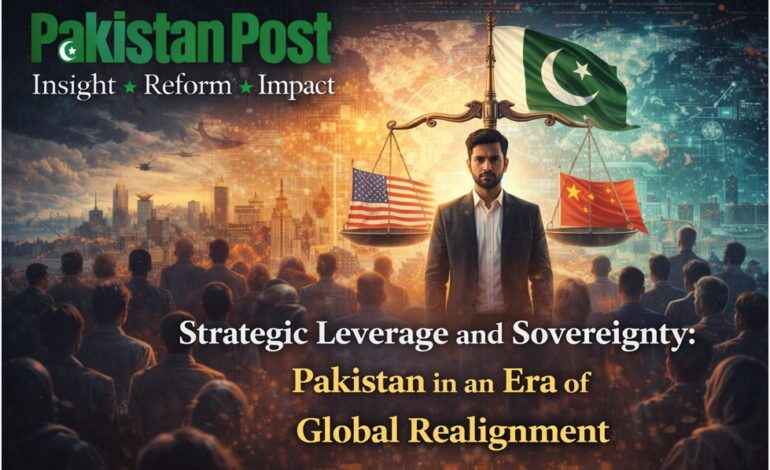
Externally, Pakistan’s policy must remain adaptable. While economic partnerships with China provide infrastructure and trade advantages, maintaining strong relations with Europe and the Middle East ensures access to critical markets, investment, and remittance flows. Relations with the United States, despite its coercive economic instruments, remain strategically valuable for financial assistance, trade, and regional security cooperation. Strategic diplomacy must integrate these considerations into coherent frameworks that safeguard national autonomy, reduce overdependence on any single partner, and enhance leverage in negotiations.
In terms of security, Pakistan must continue to strengthen its deterrence and defense capabilities while engaging in confidence-building and diplomatic outreach to regional neighbors. The army’s role in shaping strategic policy is essential, not as an actor seeking unilateral power, but as a guarantor of sovereignty capable of navigating external pressures without precipitating domestic unrest. Simultaneously, the state must actively counter narratives that distort the intent of military and foreign policy decisions, recognizing that domestic social cohesion and public trust are critical to sustaining strategic initiatives.
The global environment is likely to remain volatile, with the United States using economic instruments to preserve influence, China advancing its maritime and energy strategies, and Europe and the Middle East exercising economic leverage. Pakistan’s challenge is to navigate these pressures with a dual focus on economic resilience and strategic autonomy. By diversifying trade, investing in domestic industrial capacity, adopting financial instruments that reduce dependency on the dollar, and communicating policy intent effectively to domestic constituencies, Pakistan can maintain sovereignty while participating in a contested multipolar order. The integration of economic, strategic, and societal considerations is essential; piecemeal approaches risk either overdependence on external powers or internal instability fueled by misperceptions.
Ultimately, Pakistan’s path forward requires a synthesis of geo-economic insight, strategic military planning, and domestic communication. The country’s economic stability, regional security, and national autonomy are intertwined, and must be managed simultaneously to withstand global shocks and internal pressures. By leveraging its geographic location, cultivating diversified partnerships, and articulating a coherent national strategy that integrates military prudence with economic foresight and public engagement, Pakistan can position itself as an active architect of its destiny rather than a reactive player in global contests. Strategic autonomy, grounded in pragmatic engagement and informed by internal cohesion, remains the cornerstone of Pakistan’s sustainable development and security in an increasingly contested world order.
A Public Service Message