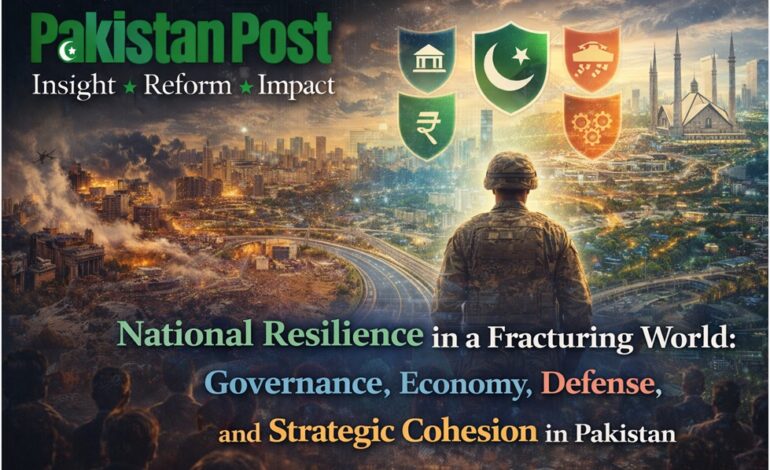
National Resilience in a Fracturing World: Governance, Economy, Defense, and Strategic Cohesion in Pakistan


The international system is entering a phase of prolonged instability marked not by a single hegemonic collapse, but by overlapping shocks: financial fragmentation, energy insecurity, militarized trade, and narrative warfare. For a state like Pakistanstrategically pivotal, economically constrained, and socially diverseexternal volatility does not remain external for long. It penetrates fiscal space, public opinion, civil–military relations, and institutional legitimacy. In such an environment, national resilience is no longer a function of military strength alone, nor of economic reform in isolation. It is the product of integrated governance, where fiscal management, energy security, defense planning, and public legitimacy reinforce one another rather than compete.
At the core of Pakistan’s challenge lies a structural asymmetry. The state is compelled to operate with long-term strategic logic, balancing China, the United States, Europe, and the Gulf, while significant segments of public discourse are shaped by emotion, historical grievance, ideological absolutism, and social media amplification rather than strategic literacy. This divergence does not merely generate political noise; it directly constrains policy execution, weakens deterrence credibility, and exposes institutionsparticularly the military and foreign policy apparatusto delegitimization pressures that adversaries can exploit.
The first imperative of national management in this environment is therefore governance coherence. Pakistan cannot afford fragmented authority structures where economic policy, defense posture, and diplomatic signaling operate on parallel tracks. Fiscal decisionssuch as IMF engagement, debt restructuring, or subsidy rationalizationmust be explicitly linked to national security outcomes. Energy procurement strategies must be treated as strategic assets, not merely commercial contracts, given their vulnerability to sanctions regimes, maritime disruptions, and geopolitical leverage. Defense planning must internalize economic constraints without allowing austerity narratives to erode preparedness. This requires institutionalized coordination between the Ministry of Finance, Energy Division, Foreign Office, and GHQ through a strengthened NSC mechanism that is not episodic but permanent and analytical.
Economic resilience begins with fiscal realism. Pakistan’s debt-based economic model leaves it exposed to external pressure from creditors whose strategic interests are not neutral. Yet abrupt disengagement from Western financial systems would be economically catastrophic. The viable path lies in managed diversification, not decoupling. Pakistan must gradually reduce single-source dependencies by expanding trade settlements, energy sourcing, and investment flows across multiple corridorsChina, the Gulf, Central Asia, Southeast Asiawhile maintaining functional access to Western markets and institutions. Fiscal discipline is not merely an IMF requirement; it is a sovereignty tool. A state that cannot finance its own budget forfeits strategic choice.
Energy policy deserves particular attention. Energy insecurity translates directly into political instability and strategic vulnerability. Pakistan’s reliance on imported fuels makes it sensitive to maritime chokepoints, sanctions spillovers, and price manipulation. Long-term contracts, diversified suppliers, and accelerated domestic energy developmentincluding renewables and indigenous gasare not environmental luxuries but national security imperatives. Energy decisions must be framed publicly as stability measures, not technocratic adjustments, to prevent their capture by populist narratives.
Defense management in this volatile environment must balance deterrence with restraint. Pakistan’s strategic alignment with China remains central to its defense posture, particularly in maintaining balance against India. However, this alignment must be framed as defensive and stabilizing, not bloc-forming. Avoiding entanglement in potential US–China confrontation requires doctrinal clarity: Pakistan’s military posture should emphasize territorial defense, protection of economic corridors such as CPEC, and maritime security, rather than expeditionary or ideological commitments. Strategic ambiguity, when disciplined, can be a source of strength.
A critical but often under-addressed dimension of national resilience is strategic communication and civic literacy. Modern conflict is as much about perception as it is about power. When public discourse is dominated by emotionally charged, historically selective, or ideologically rigid narratives, the state loses the ability to explain necessary trade-offs. This does not require censorship or coercion; it requires systematic public education on strategic realities. States that endure crises successfully invest in explaining why certain decisionsengagement with unpopular partners, restraint in conflicts, economic compromisesserve national survival rather than betray identity.
In Pakistan’s case, civil–military trust is both an asset and a vulnerability. The military remains one of the few institutions with nationwide organizational capacity, yet it is also the focal point of political frustration and misattribution. The solution is not image management but institutional transparency within strategic limits, and consistent articulation of how military leadership and the civilian government are aligned in safeguarding long-term national interests. When strategic rationale is absent from public discourse, conspiracy fills the void. When explanation is continuous, even unpopular policies retain legitimacy.
National unity in this context must be understood not as ideological uniformity, but as acceptance of strategic necessity. Historical narratives and religious identity are powerful social forces, but they must be contextualized within contemporary realities rather than weaponized against state policy. Education curricula, media engagement, and elite discourse should gradually shift from emotive binaries to strategic reasoningwhy neutrality at times preserves sovereignty, why economic compromise can strengthen defense, why restraint can be a form of power. This is not ideological dilution; it is strategic maturation.
Ultimately, Pakistan’s survival and progress in a volatile global environment depend on its ability to function as a rational, coordinated state under pressure. Internal cohesion does not emerge from suppressing dissent or manufacturing consent, but from aligning institutions, communicating trade-offs honestly, and demonstrating that decisionshowever imperfectare grounded in national interest rather than factional impulse. The coming decade will reward states that can absorb shocks without fracturing internally. For Pakistan, national management is no longer about choosing between ideals and pragmatism; it is about ensuring that pragmatism itself becomes a shared national understanding.
A Public Service Message