
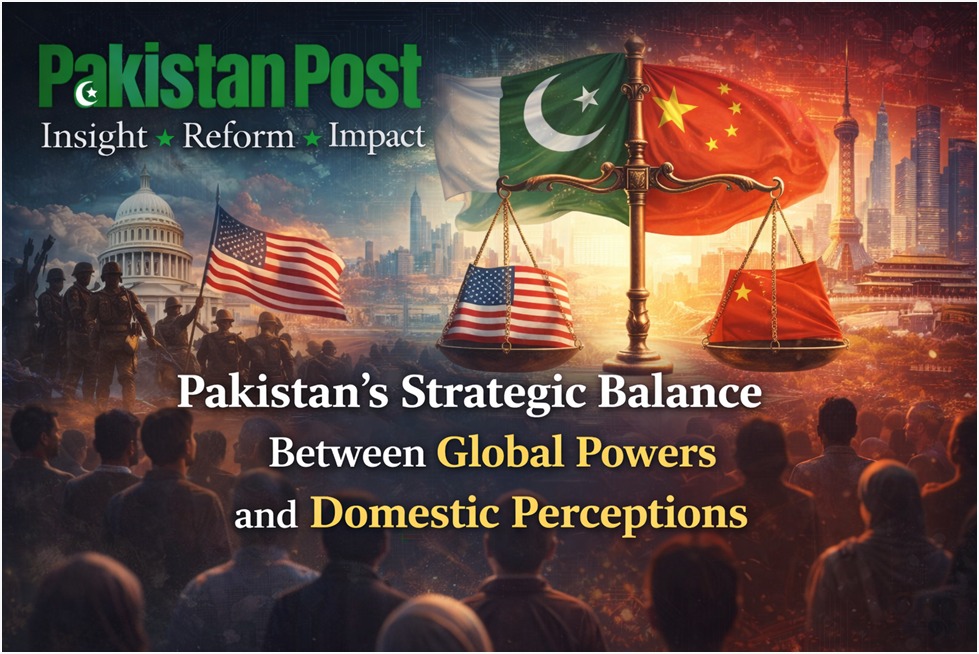
Pakistan’s Strategic Balance Between Global Powers and Domestic Perceptions

The global geopolitical landscape in 2025 is, by almost any measure, in a state of profound flux. Longstanding post‑Cold War assumptions about the endurance of a U.S.‑centered unipolar world have been overtaken by a more complex, unevenly articulated multipolar reality. Deepening rivalry between the United States and the People’s Republic of China now delineates the strategic architecture of our era, overlaying persistent local and regional conflicts — from Eastern Europe’s grinding war in Ukraine to the ever‑volatile Middle East tensions around Gaza, and rising flashpoints in the Indo‑Pacific over Taiwan with implications that ripple across continents. These dynamics are not abstract: they directly shape the strategic choices facing states like Pakistan, whose foreign policy and internal equilibrium must navigate the competing gravitational pulls of global powers while safeguarding national interests, regional security, and sovereign agency.
At the heart of this global contest lies the US–China strategic rivalry, a contest not confined to traditional military competition but encompassing economic, technological, financial, and normative domains. Beijing’s accelerated economic rise and putative model of state‑led development, juxtaposed against American efforts to consolidate alliances and technological partnerships to contain China’s influence, characterize a world in which power is no longer unipolar but unevenly distributed among multiple centers of influence. The strategic implications of this new order are vast: global supply chains are being rewired, financial architectures are being contested, and geopolitical alignments are being reassessed by states seeking leverage and autonomy within this shifting landscape. For Pakistan, situated at the crossroads of South Asia, Central Asia, the Middle East, and the Indian Ocean, these tectonic shifts pose both risk and opportunity.
Overlaying this grand strategic competition are persistent and interconnected conflicts. The war in Ukraine has evolved into a long‑term contest over European security and the legitimacy of sovereign borders. In the Middle East, the conflagration in Gaza and the broader Israel‑Iran rivalry reflect deep structural tensions that have repeatedly undermined attempts at peace. Simultaneously, the Taiwan Strait remains a potentially explosive flashpoint: Chinese military planners, according to recent defense assessments, appear on track to escalate force modernization and readiness with the capacity to challenge Taiwan’s status quo by the latter half of the decade. The international community watches with acute concern, as conflict over Taiwan could readily draw in U.S. and allied forces, with devastating economic and strategic consequences.
These global conflicts do not exist in isolation; they are embedded in broader trends toward a more fragmenting world order, where multilateral institutions struggle to mediate entrenched hostilities and where regional powers exercise greater autonomy. The United Nations Security Council, despite its formal mandate as the principal guardian of international peace, is increasingly seen as constrained by the veto dynamics and strategic interests of its permanent members — a symptom of deeper fissures in global governance.
For Pakistan, the strategic terrain is thus twofold: externally, the country is buffeted by external power competition and regional instability; internally, the narrative environment grapples with competing perceptions of the state, the military establishment, and the role of external actors. These internal dynamics are not marginal; they shape how Pakistan’s foreign policy choices are interpreted, supported, or contested within society.
Historically, Pakistan’s foreign policy has centered on self‑defense, sovereignty, and the pursuit of peace, balanced among competing regional and global interests. Rooted in the early vision of the state’s founders, who envisaged a diplomacy grounded in both principled engagement and strategic realism, Pakistan’s approach has consistently sought to balance relations with global and regional powers without sacrificing national autonomy. However, the emergence of an intensified US–China rivalry and the realignment of global strategic interests in recent years have placed unprecedented strategic stress on this equilibrium.
Economically, Pakistan has pursued a multi‑vector foreign policy designed to cultivate relationships with both the United States and China, among other actors, to diversify investment, trade, and financial support. This approach has been reinforced by Pakistan’s dependence on external financing, export markets, and economic partnerships. The United States, despite periodic downturns in bilateral relations, remains a significant economic partner, with trade and access to international financial institutions linked to American influence. China, for its part, has become Pakistan’s most consequential strategic partner, particularly through the China‑Pakistan Economic Corridor (CPEC) and broader Belt and Road Initiative (BRI) frameworks that connect Pakistan to wider Eurasian economic networks. Analysts note, however, that Pakistan’s economic model historically relies on balancing these external linkages, as full alignment with either power comes at the risk of alienating the other and constraining sovereign policy space.
Strategically, the Pakistan Army and the broader security establishment occupy a central role in shaping foreign policy and national security priorities. This is not unique to Pakistan; in many states facing acute security challenges, the military’s institutional priorities often intersect with foreign policy objectives. In Pakistan’s case, the strategic calculus has been framed by the imperative to prevent external coercion, maintain deterrence against regional threats, and secure critical economic corridors while preserving strategic autonomy in a multipolar context. Recent engagements from high‑level strategic dialogues with Chinese interlocutors to defensive cooperation frameworks with the United States reflect an enduring desire by Pakistan’s defense leadership to manage and balance its relationships with both powers.
This balancing act is compounded by evolving global dynamics. China underscores the strategic partnership with Pakistan as a pillar of regional stability, with Chinese leadership publicly affirming Pakistan’s military as a cornerstone of national stability and cooperation. Concurrently, there are current analyses indicating that Pakistan, under its latest security leadership, has consolidated substantial influence within national defense structures, positioning the army at the forefront of strategic decision‑making in ways that resonate with both Chinese and American strategic circles.
Yet this strategic pragmatism on the part of the security establishment does not always translate seamlessly into public perception. Within Pakistan’s broader society especially among segments driven by strong religious and historical narratives there exists a tendency to interpret global power dynamics through civilizational or ideological lenses. This has deep roots in historical experiences and collective memory, where past encounters with colonialism, the geopolitics of the Cold War, and perceived Western interventionism have left enduring psychological imprints. These narratives, which often mobilize references to historical conflicts between Islamic civilizations and Western Christian powers, can skew public understanding toward a bipolar worldview of “Us vs. Them,” simplifying complex geopolitical calculations into emotive binaries.
In the context of the current geopolitical moment, this dynamic manifests in several ways. Among certain segments of the public, policy decisions involving engagement with the United States — especially on security, economics, or diplomatic frontsare sometimes met with suspicion or framed as acquiescence to a perceived “anti‑Islamic global order.” This perspective is amplified in informal public discourse, where limited access to nuanced strategic analysis leads to emotive interpretations rooted in historical narratives rather than structural realities. Such views frequently overlook the differentiated interests of states and the pragmatic basis of diplomatic engagement in favor of ideological formulations that cast national strategic decisions as betrayals of civilizational solidarity.
Thus, Pakistan’s leadership faces the dual challenge of not only navigating external pressures from rival global powers but also managing internal perceptual dynamics that can distort public understanding of geopolitical strategy and security policy. The strategic choices made by the army and the broader security establishment whether to deepen cooperation with one power, hedge between competing interests, or assert autonomous stances risk being projected negatively by domestic constituencies that interpret these moves through emotional and historical prisms rather than nuanced strategic logic.
This internal tension underscores the necessity for strategic communication that bridges expertise and public understanding. The state’s policy community must articulate foreign policy choices in a manner that conveys both the rationale behind balance and the implications for national security, economic stability, and sovereignty. In doing so, diplomats, academics, and strategic communicators must grapple with complex questions: How do we explain the necessity of calibrated engagement with the United States while maintaining an enduring strategic partnership with China? How do we frame these relationships not as alliances driven by ideology but as functional instruments of statecraft serving Pakistan’s national interests?
In practical terms, this means embedding foreign policy discourse within frameworks that emphasize Pakistan’s agency and national interest rather than zero‑sum narratives. It requires conveying that engagement with multiple powers is not a commodity of convenience but a strategic necessity rooted in the imperatives of economic resilience, security deterrence, and sovereign autonomy in a multipolar world. It also involves clarifying that strategic partnerships, whether with China, the United States, or other global actors, do not have to entail entanglement in their broader rivalries. Such nuance is essential to counter simplistic interpretations that reduce complex diplomacy to existential alignments rooted in civilizational clashes.
Externally, Pakistan must continue to pursue a multi‑vector foreign policy that leverages its strategic partnerships to promote national objectives while avoiding being drawn into conflicts that do not serve its interests. This means deepening economic diversification — by cultivating trade relationships across Asia, Africa, and beyond and proactively engaging in regional security mechanisms that reinforce stability rather than exacerbate tensions. It also entails participating in multilateral institutions and forums that reflect the evolving global order, thereby enhancing Pakistan’s voice in shaping norms and mitigating crises. Engagement with multilateral bodies such as the Shanghai Cooperation Organization (SCO), the Organization of Islamic Cooperation (OIC), and emerging coalitions of states outside traditional power blocs can amplify Pakistan’s strategic autonomy and diversify its diplomatic options.
In parallel, Pakistan’s security posture particularly its defense doctrine and strategic deterrence must remain calibrated to regional realities without being subsumed by the strategic priorities of external powers. In South Asia, unresolved disputes remain the most immediate sources of instability, and prudent defense planning, confidence‑building measures, and diplomatic outreach are indispensable in managing potential escalations.
Domestically, the state must invest in strategic literacy, encouraging robust public discourse grounded in evidence‑based analysis rather than emotive narratives. This requires strengthening institutions from universities to think tanks and media ecosystems that can produce nuanced, fact‑based interpretations of global affairs for the public. A better‑informed citizenry strengthens national coherence and resilience in the face of external pressures and internal misconceptions.
The path forward for Pakistan in this multipolar era is neither simple nor predetermined. It demands strategic foresight, institutional adaptability, and communicative clarity. The external environment will remain contested, with rival powers testing the limits of influence and states recalibrating alliances. Yet Pakistan’s strategic architecture if rooted in autonomy, balanced engagement, and coherent communicationcan navigate these tectonic shifts without compromising sovereignty or stability.
As global power structures continue to realign, the role of the Pakistani state guided by sober realism, systemic understanding, and national interest becomes ever more critical. In this era of constitutional geopolitics and strategic competition, Pakistan must leverage its geographical advantage, historical resilience, and diplomatic dexterity to forge a foreign policy that is not merely reactive but proactive, not driven by fear or emotion, but by clear strategic intent. That is the challenge and the opportunity of our time.
A Public Service Message