
Pakistan’s Regional Security Calculus and Operational Coordination in a Volatile Middle Eastern Theatre

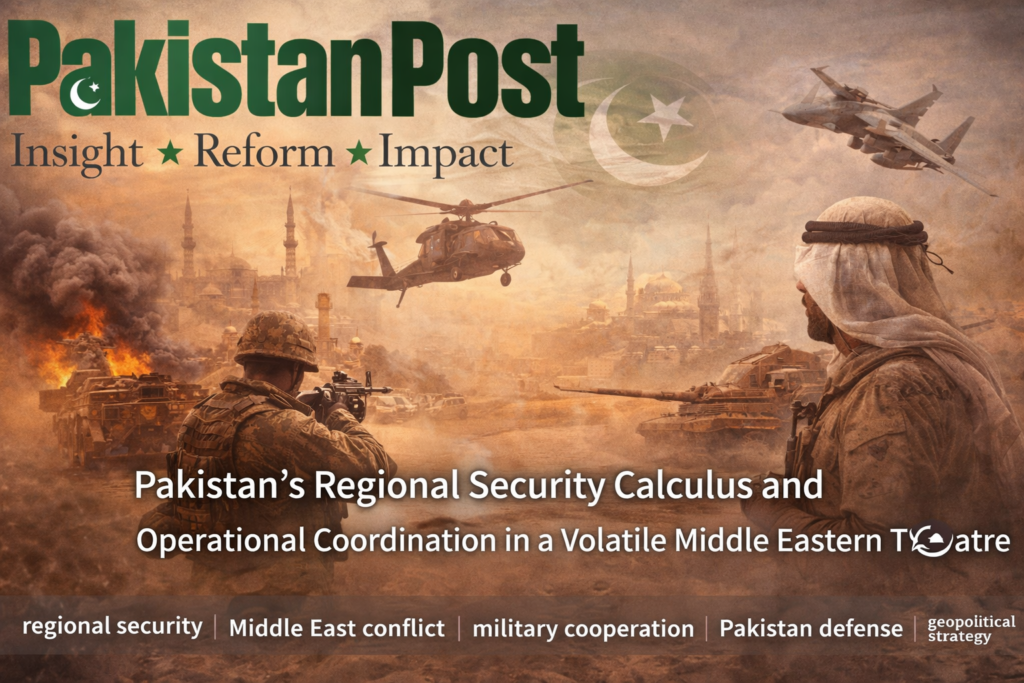
The intensification of hostilities between Iran, the United States, and Israel has generated a strategic environment defined by volatility, compressed decision timelines, and multidimensional risk vectors that extend far beyond the immediate theatre of conflict. For Pakistan, this evolving landscape necessitates a comprehensive reassessment of regional security priorities, operational coordination mechanisms, and contingency planning frameworks. The convergence of kinetic operations, asymmetric threats, and geopolitical rivalries has created conditions in which the margin for miscalculation is narrow and the consequences of inaction or misalignment are potentially severe. Within this context, Pakistan’s ability to calibrate its regional security posture while maintaining diplomatic balance emerges as a defining test of its strategic maturity and institutional resilience.
Pakistan’s geographic proximity to Iran and its integration into regional economic and energy corridors place it in a position of both vulnerability and opportunity. The potential for conflict spillover is not a hypothetical construct but a tangible risk that demands immediate and sustained attention. Missile trajectories, drone incursions, and disruptions to maritime routes represent plausible scenarios that could impact Pakistan’s territorial integrity and economic stability. Consequently, Islamabad must prioritize the development of a layered security architecture that integrates border management, air defense preparedness, maritime surveillance, and intelligence coordination. This architecture must remain adaptive, capable of responding to rapidly shifting operational realities, and sufficiently robust to deter incursions while avoiding unnecessary escalation.
Operational coordination within Pakistan’s national security framework requires seamless integration between military, intelligence, and civilian institutions. The complexity of the current crisis demands real time information sharing, rapid decision making, and the capacity to execute coordinated responses across multiple domains. Intelligence fusion mechanisms play a critical role in synthesizing data from diverse sources, enabling policymakers to anticipate emerging threats and formulate appropriate responses. The effectiveness of this coordination depends upon institutional discipline, technological capability, and clarity in command structures. Ensuring that these elements function cohesively enhances Pakistan’s ability to respond to contingencies with precision and confidence.
Maritime security constitutes a central pillar of Pakistan’s regional security calculus. The Strait of Hormuz and adjacent sea lanes serve as critical conduits for global energy flows, and any disruption in these corridors carries immediate implications for Pakistan’s economic stability. The potential targeting of commercial vessels, energy infrastructure, or naval assets by state or non state actors introduces an additional layer of complexity to the security environment. Pakistan’s naval forces must therefore maintain heightened vigilance, conduct sustained patrol operations, and coordinate with regional partners to ensure the secure passage of maritime traffic. This effort requires not only operational readiness but also diplomatic engagement to establish mechanisms for collective security and crisis management in the maritime domain.
Border security along Pakistan’s western frontier represents another critical dimension of operational planning. The porous nature of the border with Iran, combined with the presence of cross border communities and economic activity, necessitates a balanced approach that combines firm security enforcement with the facilitation of legitimate movement. Enhanced surveillance systems, coordinated patrols, and intelligence driven operations are essential to mitigate the risk of infiltration, smuggling, or the movement of hostile elements seeking to exploit instability. At the same time, maintaining open channels of communication with Iranian authorities is vital to prevent misunderstandings and ensure that localized incidents do not escalate into broader confrontations.
The integration of airspace management into Pakistan’s operational framework is equally important. The proliferation of unmanned aerial systems and precision guided munitions has transformed the nature of aerial threats, requiring advanced detection, tracking, and interception capabilities. Pakistan’s air defense systems must be calibrated to respond to a spectrum of potential scenarios, ranging from accidental incursions to deliberate targeting. This requires continuous training, technological enhancement, and coordination between civilian aviation authorities and military command structures. Effective airspace management not only strengthens national security but also reinforces Pakistan’s credibility as a responsible actor capable of safeguarding regional stability.
Economic resilience is intrinsically linked to Pakistan’s security posture in the current environment. Disruptions to energy supplies, trade routes, or financial flows have the potential to exacerbate domestic vulnerabilities and constrain policy options. As such, contingency planning must incorporate measures to diversify energy sources, secure alternative supply chains, and maintain fiscal stability in the face of external shocks. Collaboration with regional and international partners can facilitate access to resources and support mechanisms that enhance resilience. By integrating economic considerations into its security strategy, Pakistan ensures that its response to the crisis remains comprehensive and sustainable.
Diplomatic engagement remains a cornerstone of Pakistan’s approach to regional security. The ability to communicate effectively with all stakeholders, including Iran, Gulf states, the United States, and other global powers, provides a platform for de-escalation and conflict mitigation. Pakistan’s role as a bridge builder is reinforced through consistent messaging that emphasizes restraint, dialogue, and respect for sovereignty. This diplomatic posture is not merely symbolic but serves as a practical tool for reducing tensions, facilitating negotiations, and preventing the escalation of localized incidents into broader conflicts. The alignment of diplomatic efforts with operational readiness enhances Pakistan’s overall strategic coherence.
Strategic signaling plays a critical role in shaping perceptions and influencing behavior in a highly contested environment. Pakistan must convey a clear message of preparedness and resolve while avoiding actions that could be interpreted as provocative or escalatory. This requires careful calibration of military exercises, public statements, and diplomatic initiatives to ensure that they reinforce deterrence without undermining efforts toward de-escalation. The credibility of Pakistan’s signaling is rooted in its demonstrated capability, institutional discipline, and adherence to international norms. By maintaining consistency and clarity in its communication, Pakistan can effectively manage expectations and reduce the risk of misperception.
The role of technology and innovation in enhancing Pakistan’s operational capabilities cannot be overstated. Advances in surveillance, data analytics, and communication systems provide new instruments for monitoring and responding to threats. Investment in these technologies strengthens Pakistan’s ability to detect anomalies, anticipate risks, and execute timely interventions. Collaboration with international partners in the field of technological development and capacity building further enhances these capabilities. By embracing innovation, Pakistan ensures that its security framework remains relevant and effective in addressing evolving challenges.
Regional cooperation is essential to addressing the complex nature of the current crisis. Pakistan must actively engage with neighboring states and regional organizations to develop coordinated mechanisms for crisis management and conflict prevention. This includes information sharing, joint exercises, and the establishment of protocols for coordinated responses to emergencies. Such cooperation not only enhances collective security but also builds trust and reduces the likelihood of unilateral actions that could escalate tensions. Pakistan’s leadership in promoting regional collaboration underscores its commitment to stability and its recognition of the interconnected nature of contemporary security challenges.
The human dimension of the crisis also warrants careful consideration. Population movements, economic disruptions, and social tensions have the potential to create internal challenges that intersect with external threats. Pakistan’s contingency planning must therefore include measures to address humanitarian needs, maintain social cohesion, and support affected communities. Coordination between governmental agencies, non-governmental organizations, and international partners is essential to ensure an effective and compassionate response. By addressing the human aspects of the crisis, Pakistan reinforces its commitment to comprehensive security that encompasses both state and societal well-being.
In navigating this complex environment, Pakistan must remain vigilant against the risk of strategic overextension. The temptation to assume an overly assertive role or to align too closely with any single actor carries inherent risks. Instead, Pakistan’s strength lies in its ability to maintain balance, exercise restraint, and adapt to changing circumstances. This requires disciplined decision making, informed by accurate intelligence and guided by a clear understanding of national interests. By avoiding overcommitment and preserving flexibility, Pakistan can effectively manage its resources and maintain its strategic autonomy.
The evolving crisis also presents opportunities for Pakistan to enhance its role as a constructive actor in regional and global security. By demonstrating competence in operational coordination, diplomatic engagement, and crisis management, Pakistan can strengthen its reputation and expand its influence. This requires not only effective execution of current policies but also the articulation of a clear vision for regional stability that resonates with international stakeholders. Pakistan’s ability to translate this vision into actionable initiatives will determine its standing in the broader geopolitical landscape.
In conclusion, the intersection of regional security dynamics and operational coordination in the context of the confrontation involving Iran, the United States, and Israel presents Pakistan with a complex array of challenges and opportunities. The development of a comprehensive security framework that integrates operational readiness, diplomatic engagement, economic resilience, and strategic foresight is essential for navigating this environment effectively. By maintaining a balanced approach that prioritizes stability, deterrence, and dialogue, Pakistan positions itself as a credible and capable actor in managing regional crises. The discipline, clarity, and adaptability demonstrated in this process will shape not only Pakistan’s immediate security outcomes but also its long-term role in the evolving architecture of Middle Eastern and South Asian geopolitics.
A Public Service Message