
Deterrence, Diplomacy, and Destiny: Pakistan in the Age of Multipolar Contestation

Pakistan is not merely a geographic construct bounded by frontiers; it is a sovereign strategic actor shaped by history, sacrifice, and an enduring security consciousness. In moments of global turbulence, when alliances are recalibrated and power centers renegotiate influence, nations are tested not only by external pressures but by their internal cohesion. For Pakistan, the preservation of sovereignty remains paramount, and the Pakistan Army continues to function as the constitutional guarantor of territorial integrity and national resilience. The international system is undergoing structural transformation. The unipolar moment that followed the Cold War has gradually given way to contested multipolarity. The United States recalibrates its global commitments, China consolidates economic corridors, Russia reasserts strategic depth, and middle powers hedge through diversified alignments. Within this evolving order, South Asia has regained salience as a zone of strategic convergence and competition. Pakistan’s geography situates it at the intersection of Central Asia, the Middle East, and the Indian Ocean, rendering it indispensable in any serious geopolitical calculus.
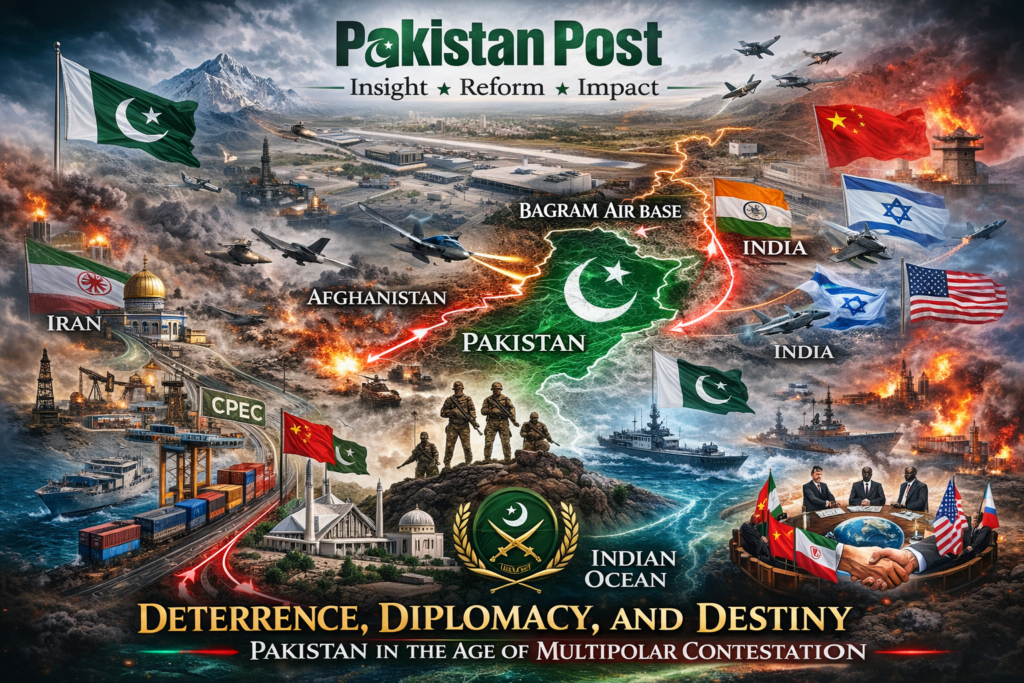
Afghanistan occupies a central place in this regional matrix. Pakistan has historically borne the humanitarian, economic, and security consequences of instability across its western frontier. Millions of Afghan refugees were hosted for decades, trade corridors were sustained despite insecurity, and diplomatic engagement persisted even in turbulent periods. Yet history demonstrates that Afghan territory has repeatedly been instrumentalized by external powers seeking regional leverage. From Cold War rivalries to post 9 11 military campaigns, Afghanistan has functioned less as a sovereign neutral space and more as a geopolitical chessboard. The possibility of open military confrontation between Pakistan and Afghanistan, though undesirable, cannot be dismissed in strategic planning scenarios. Border skirmishes, cross border militant activity, and allegations of safe havens create a fragile environment in which escalation risks miscalculation. An open war between the two neighbors would not remain confined to bilateral dimensions. It would immediately draw in external actors seeking advantage, whether through diplomatic pressure, intelligence penetration, or material support to competing factions. The Durand Line would transform from a contested frontier into a flashpoint with regional ramifications.
One of the most symbolically charged assets in this equation remains the Bagram Air Base. Beyond its physical infrastructure, Bagram represents the legacy of great power projection in the region. Any reactivation by foreign forces, any covert utilization by proxy elements, or any perception of militarized repositioning would alter deterrence calculations across Islamabad, Tehran, New Delhi, Beijing, and Washington. In an environment already saturated with mistrust, symbolic moves can carry disproportionate strategic weight. Compounding this volatility is the evolving security cooperation between India and Israel. Over the past two decades, their partnership has deepened across defense procurement, intelligence coordination, and cyber capabilities. The technological sophistication of the Israel Defense Forces, combined with India’s expanding defense modernization, enhances New Delhi’s operational reach. From surveillance drones to missile defense systems, the integration of advanced platforms reshapes conventional deterrence equations in South Asia.
In theoretical terms, balance of power dynamics dictate that when one state perceives potential encirclement or adversarial triangulation, it recalibrates accordingly. Pakistani concerns regarding the possibility of Afghan territory being leveraged by external actors aligned with Indian or Israeli interests stem not from paranoia but from structural realism. States respond to capability aggregation. If hostile intent is perceived alongside increased capability, strategic countermeasures follow. An open conflict with Afghanistan under such conditions would risk creating a corridor for external influence stretching from the Arabian Sea to Central Asia. Supply routes, intelligence networks, and logistical pathways could be exploited by rival powers. The humanitarian cost would be severe, but the geopolitical cost would be equally profound. Fragmented Afghanistan would become an arena once more for proxy maneuvering, with Pakistan’s western border transformed into a zone of persistent instability.
The Iran dimension adds further complexity. Relations between Iran and the United States have oscillated between cautious diplomacy and intense hostility. Should tensions escalate into overt confrontation, the entire regional security architecture would shift. Iran’s geographic proximity to Pakistan and Afghanistan means that any conflict involving Tehran would reverberate immediately across the western flank of South Asia. When relations between Tehran and Washington deteriorate, sanctions intensify, naval deployments increase in the Gulf, and covert activities multiply. In such an environment, Afghanistan’s strategic value as a potential staging ground or listening post becomes magnified. Pakistan would then confront a scenario in which instability on its western border intersects with a broader U S Iran confrontation. Energy corridors, trade routes, and border security arrangements would all be strained simultaneously.
An open war between Pakistan and Afghanistan during a period of heightened U S Iran hostility would create a multi layered crisis. Refugee flows could increase once more, stretching Pakistan’s economic capacity. Militant organizations might exploit the chaos to reconstitute networks. External intelligence agencies would find fertile ground for influence operations. The risk of miscalculated strikes or inadvertent cross border incidents would escalate. It is essential to underscore that Pakistan’s strategic doctrine is defensive in nature. Credible minimum deterrence remains anchored in prevention rather than provocation. However, deterrence requires clarity. If Afghan soil is used for hostile actions, response becomes a function of sovereign obligation. Proportionate action aimed at neutralizing threats does not constitute aggression; it constitutes state responsibility.
The broader global order transition amplifies these risks. Hybrid warfare blurs the boundary between war and peace. Economic coercion, cyber intrusions, narrative manipulation, and proxy violence operate below the threshold of declared conflict. Pakistan must therefore guard not only its physical borders but its informational and economic domains. National cohesion becomes a strategic asset equal in value to military hardware. Diplomatically, Pakistan’s pathway lies in calibrated engagement. Relations with Washington require maturity and transparency. Strategic partnership with Beijing must be balanced with diversified economic outreach. Engagement with Tehran should prioritize border stability and energy cooperation while avoiding entanglement in great power rivalry. Dialogue with Kabul, however strained, remains preferable to isolation.
Yet diplomacy must be reinforced by preparedness. An open war with Afghanistan would have cascading geostrategic consequences, particularly if coinciding with U S Iran escalation. The region could witness simultaneous theaters of instability stretching from the Strait of Hormuz to the Hindu Kush. Maritime trade through the Arabian Sea could be threatened. Investment flows into South Asia could decline sharply due to perceived instability. The economic dimension cannot be overlooked. War undermines development. Investor confidence erodes when borders ignite. Pakistan’s long term stability depends as much on economic resilience as on military capability. Strategic autonomy emerges from sustainable growth, technological advancement, and institutional strength.
In examining external alliances, Pakistan must avoid both overreaction and complacency. Not every diplomatic alignment constitutes encirclement, yet neither can potential hostile configurations be ignored. Prudence lies in vigilance without hysteria. Strategic analysis must remain evidence based and forward looking. The evolution of U S policy during the presidency of Donald Trump demonstrated how transactional recalibration can reshape regional equations. Interest in Afghan mineral resources, recalibrated security dialogue with Pakistan, and deepening ties with India occurred simultaneously. Such multidirectional engagement reflects American strategic flexibility. For Pakistan, the lesson is clear: engagement should be anchored in national interest rather than expectation of exclusive partnership.
Ultimately, Pakistan’s sovereign posture is grounded in realism. The state seeks neither confrontation nor subservience. It demands reciprocity in non interference and clarity in security arrangements. Afghanistan’s stability is in Pakistan’s interest. Iran’s stability is in Pakistan’s interest. Regional peace is not a rhetorical aspiration but a strategic necessity. However, peace cannot rest upon unilateral restraint. Should open hostilities emerge along the western frontier, Pakistan must ensure rapid containment to prevent external exploitation. Should U S Iran tensions intensify, Islamabad must pursue active diplomacy to prevent spillover while strengthening border vigilance.
The emerging multipolar order rewards states that combine deterrence with diplomacy, resilience with restraint. Pakistan’s path forward requires internal unity, disciplined strategic communication, and unwavering commitment to sovereignty. In an era where narratives can destabilize as effectively as missiles, national coherence becomes the ultimate defense architecture. Sovereignty, once compromised, is difficult to reclaim. Pakistan’s strategic community therefore approaches regional developments with measured seriousness. Open war with Afghanistan would represent a collective failure of diplomacy, yet preparedness for such a contingency is essential. Deterioration in U S Iran relations would magnify risks, yet calibrated engagement can mitigate escalation.
History teaches that nations anchored in strategic clarity withstand systemic upheaval. Pakistan’s objective is not expansion, nor alignment within hostile blocs, but preservation of autonomy within a shifting global order. The challenges are complex, the environment volatile, yet the guiding principle remains constant: defend territorial integrity, pursue diplomatic equilibrium, and maintain sovereign agency amid great power rivalry.
A Public Service Message