
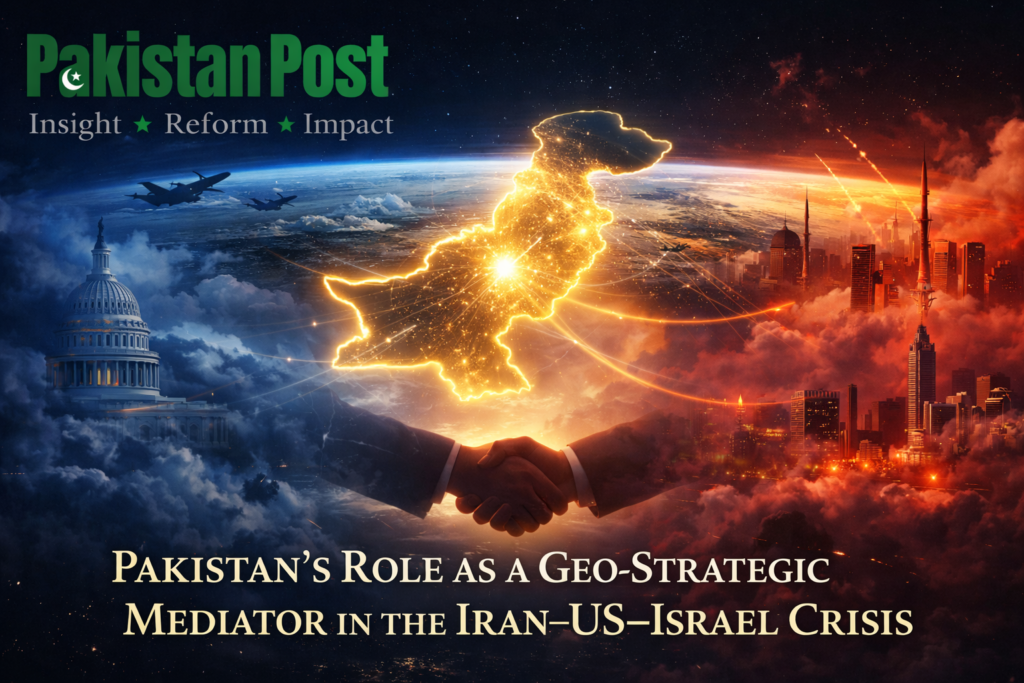
Pakistan’s Role as a Geo-Strategic Mediator in the Iran–US–Israel Crisis

The geopolitical landscape of the Middle East has entered a period of profound instability following the coordinated military strikes by the United States and Israel against Iran. The escalation of hostilities has not only intensified regional tensions but has also posed complex strategic challenges for neighboring states, particularly Pakistan, whose historical, cultural, and economic relationships with Iran place it at a critical juncture between diplomacy and security calculus. In this context, Pakistan’s role as a geo-strategic mediator acquires unparalleled significance, providing a framework through which regional equilibrium can be pursued despite the pressures of great power confrontation.
Pakistan’s strategic engagement reflects a deliberate balancing act between its traditional bonds with Tehran and its broader obligations to regional alliances and global stakeholders. The nation’s historical ties with Iran, underpinned by centuries of cultural exchange, shared religious heritage, and mutually beneficial trade, provide a foundation for credible dialogue and influence. These connections are not merely symbolic but translate into tangible diplomatic leverage that enables Pakistan to present itself as a credible interlocutor capable of fostering communication channels between opposing parties. At the same time, Islamabad must navigate the sensitivities associated with its relationships with Gulf states, the United States, and other international actors invested in regional stability. The capacity to simultaneously maintain trust with Tehran while engaging in constructive diplomacy with Washington and Riyadh exemplifies Pakistan’s nuanced approach to conflict management in highly contested spaces.
The operational dimensions of Pakistan’s mediation extend beyond traditional diplomacy into areas of strategic signaling and deterrence calculus. By maintaining measured expressions of solidarity with Iran, Pakistan communicates both a respect for sovereignty and a recognition of the risks posed by unilateral military escalation. These signals serve to reassure Tehran that its security concerns are acknowledged while simultaneously conveying to Gulf allies and global powers that Pakistan remains committed to stability and the avoidance of escalation. This dual signaling is critical, as it ensures that Pakistan retains operational flexibility in the event of regional contingencies, allowing it to modulate its posture according to evolving threat perceptions and alliance expectations.
Moreover, the conflict has underscored the importance of Pakistan’s engagement in multilateral forums. Active participation in discussions surrounding United Nations Security Council resolutions and regional initiatives enables Pakistan to shape normative frameworks governing state conduct during armed confrontations. By supporting measured diplomatic responses while resisting polarizing pressures, Islamabad can promote a narrative of responsible statecraft that enhances its credibility as a mediator. This engagement further reinforces Pakistan’s image as a bridge-builder capable of fostering negotiation and dialogue, providing a platform through which regional disputes can be addressed without resorting to kinetic escalation. Such positioning enhances Pakistan’s capacity to influence both the pace and trajectory of conflict resolution efforts, underscoring the strategic dividends inherent in balanced diplomacy.
The broader security implications of Pakistan’s mediation role are equally significant. The potential for conflict spillover into Pakistan’s western and southern borders necessitates an integrated assessment of threat vectors, force posture, and contingency planning. In operational terms, Islamabad must maintain heightened situational awareness regarding missile and drone capabilities emanating from Iran, US, and Israeli operations while ensuring that border management, intelligence coordination, and rapid response mechanisms remain fully operational. The strategic calculus also encompasses maritime security, particularly with regard to vital energy and trade corridors linking the Gulf to South Asia. Pakistan’s ability to safeguard these corridors, while simultaneously projecting an image of neutrality and constructive engagement, enhances both its deterrence credibility and its appeal as a stabilizing actor in the broader region.
Economic and cultural linkages further amplify Pakistan’s influence as a mediator. Trade flows, energy cooperation, and people-to-people connections between Pakistan and Iran provide avenues through which diplomatic engagement can be reinforced. By emphasizing the mutual benefits of stability and sustained commercial exchange, Pakistan can incentivize restraint and measured conduct among regional actors. Similarly, cultural diplomacy, including religious and societal connections, allows Islamabad to frame conflict mitigation efforts within a context that resonates with local populations and political elites alike. This multidimensional approach to mediation, which combines strategic signaling, operational readiness, and socio-economic engagement, enhances the credibility and effectiveness of Pakistan’s intervention in regional crises.
Pakistan’s diplomatic posture is also informed by a keen understanding of alliance dynamics. The country’s engagement with Gulf states, particularly Saudi Arabia and the United Arab Emirates, requires careful calibration to ensure that expressions of solidarity with Iran do not compromise longstanding security and economic partnerships. Similarly, ongoing dialogue with Washington and key European partners necessitates a transparent articulation of Pakistan’s commitment to regional stability, counter-terrorism cooperation, and the prevention of escalation. By aligning its mediation strategy with the interests of multiple stakeholders, Pakistan not only mitigates the risk of entanglement in direct conflict but also positions itself as an indispensable actor capable of facilitating consensus among disparate actors.
The strategic environment in which Pakistan operates is further complicated by the evolving nature of warfare and asymmetric threat vectors. Iran’s demonstrated capability to conduct precision drone and missile operations underscores the risks inherent in modern conflict, including the potential for rapid escalation, collateral damage, and disruption of critical infrastructure. Pakistan’s mediation efforts, therefore, must be informed by a sophisticated understanding of these operational realities. By integrating intelligence assessments, threat modelling, and scenario planning into its diplomatic strategy, Islamabad can provide informed guidance to regional actors, encouraging decisions that minimize risk while preserving sovereign prerogatives.
In addition to tactical and operational considerations, Pakistan’s role as a mediator carries significant implications for its global reputation. Demonstrated competence in facilitating dialogue and preventing escalation enhances Pakistan’s credibility on the international stage, positioning it as a nation capable of contributing to the maintenance of global security architecture. This reputational capital can translate into strategic dividends, including greater leverage in multilateral negotiations, enhanced partnership opportunities, and increased visibility in shaping regional security policy. In the contemporary context, where soft power and diplomatic influence are as critical as kinetic capability, Pakistan’s measured intervention offers a model for responsible and effective statecraft.
Furthermore, Pakistan’s mediation strategy highlights the intersection of religion, culture, and strategic policy. The shared Islamic heritage and historical engagement between Pakistan and Iran provide unique channels for trust-building that extend beyond formal diplomatic structures. By leveraging these connections, Islamabad can frame its engagement in a manner that resonates with domestic constituencies and regional stakeholders alike, thereby reinforcing the legitimacy and authenticity of its mediation efforts. This approach underscores the importance of integrating cultural literacy into high-level diplomacy, ensuring that interventions are contextually informed and strategically resonant.
In operationalizing its mediation role, Pakistan must remain vigilant regarding the dynamic interplay of regional actors and external powers. The presence of US and Israeli forces in the region, coupled with the strategic ambitions of Gulf states, Russia, and China, creates a highly fluid environment in which miscalculation or miscommunication could have cascading consequences. Islamabad’s strategic posture, therefore, must combine proactive engagement, calibrated signaling, and rigorous contingency planning to mitigate the risks of misperception and unintended escalation. This multidimensional approach ensures that Pakistan’s mediation is not only credible but also resilient in the face of unforeseen developments.
Finally, Pakistan’s efforts as a geo-strategic mediator reflect a broader paradigm in contemporary international relations, wherein middle powers play a crucial role in shaping conflict dynamics and promoting negotiation. By positioning itself at the intersection of historical ties, operational awareness, and multilateral engagement, Pakistan exemplifies how nuanced diplomacy can influence the trajectory of regional crises. The country’s ability to simultaneously maintain solidarity, protect national interests, and facilitate dialogue demonstrates a sophisticated understanding of strategic interdependence, offering a model for other actors navigating complex geopolitical environments.
In conclusion, Pakistan’s role in the Iran–US–Israel crisis extends far beyond ceremonial support or rhetorical alignment. It embodies a comprehensive strategy that integrates historical and cultural engagement, economic diplomacy, operational preparedness, alliance management, and multilateral influence. By executing this role with prudence, clarity, and strategic foresight, Islamabad not only contributes to the mitigation of conflict risks but also reinforces its position as a credible, responsible, and indispensable actor in the Middle East. In an era defined by rapid escalation, asymmetric threats, and contested sovereignty, Pakistan’s mediation exemplifies the confluence of traditional statecraft and contemporary geo-strategic acumen, offering vital lessons for policymakers, diplomats, and defense strategists worldwide.
A Public Service Message